

the earliest ‘citizen science’ goes back more than 2,000 years
- Written by: Konstantine Panegyres, McKenzie Postdoctoral Fellow, researching Greco-Roman antiquity, The University of Melbourne
If we want to research a subject, how do we do it? We could read about it in books or do experiments in a lab. Or another way is to find people who know something about it and ask them.
Collecting information from members of the public has long been a method of scientific research. We call it citizen science. According to National Geographic, this is “the practice of public participation and collaboration in scientific research to increase scientific knowledge”.
Today, citizen science is a popular practice, with dozens of programs designed by academics to engage the public and leverage power by numbers. Its origins, however, go much farther back than you might think – all the way to ancient times.
Aristotle and animals
Most of us know of Aristotle (384–322 BCE) for his philosophical works, but he was also a great scientist.
Aristotle consulted the general public when undertaking his scientific research projects. He wrote a number of books about animals, the greatest of which was his History of Animals. He also wrote smaller works including Parts of Animals and Generation of Animals. Collectively, these are usually referred to as Aristotle’s biological writings.

The Roman scholar Pliny the Elder (approximately 24–79 CE) has told us about some of Aristotle’s research methods when writing these texts.
According to Pliny, Alexander the Great (356–323 BCE) – who was Aristotle’s student – supported Aristotle’s research on animals by ordering the public to collaborate:
orders were given to some thousands of persons throughout the whole of Asia and Greece, all those who made their living by hunting, fowling, and fishing and those who were in charge of warrens, herds, apiaries, fishponds and aviaries, to obey [Aristotle’s] instructions, so that he might not fail to be informed about any creature born anywhere.
 An 1885 depiction of Alexander the Great with his tutor Aristotle.
The New York Public Library
An 1885 depiction of Alexander the Great with his tutor Aristotle.
The New York Public Library
Modern scholars aren’t certain Alexander actually gave this order. Nonetheless, Aristotle’s writings about animals often refer to information he received from others who worked directly with animals, such as hunters, beekeepers, fishermen and herdsmen.
For example, Aristotle thought worker wasps die off during the winter while mother wasps live through it. He must have relied on the reports of farmers for this information. In the History of Animals, he wrote:
The worker wasps do not live through the year but all die when winter has come on, whereas the leaders which are called mother wasps are seen throughout the winter and hide underground. For while ploughing and digging in the winter many people have seen mother wasps but none have seen workers.
Aristotle was at times also critical of the eyewitness information he received. For instance, in Generation of Animals, he says some people told him fish don’t copulate, because they had not seen fish copulating. But he goes on to say these people are wrong – and that he himself knows fish do indeed copulate:
The fish copulate in the same way as dolphins do, by placing themselves alongside of each other […] The fishermen do not notice this […] and so they join the chorus and repeat the same old stupid tale that fish conceive by swallowing the semen.
Aristotle was right. While most fish don’t have sexual intercourse, some do. Clearly, Aristotle had either asked enough people and/or investigated the issue himself to find the truth.
 Detail from a 12th-century manuscript of Aristotle’s History of Animals, from the Laurentian Library, Florence.
Biblioteca Medicea Laurenziana
Detail from a 12th-century manuscript of Aristotle’s History of Animals, from the Laurentian Library, Florence.
Biblioteca Medicea Laurenziana
Theophrastus and trees
Aristotle wasn’t the only ancient researcher who got information from members of the public. Another was the philosopher Theophrastus (372–287 BCE), whose main area of research was plants. Like Aristotle, Theophrastus weighed up and tested the credibility of the different reports provided to him.
In his Enquiry into Plants, he rejects the opinion of some of his informants, saying:
These informants were guilty of an important piece of ignorance. For they believed that the frankincense and the myrrh were produced by the same tree.
 Fresco depiction of a garden, Pompeii, 1st century AD.
Wikimedia
Fresco depiction of a garden, Pompeii, 1st century AD.
Wikimedia
Instead, he preferred the report of some sailors. These sailors, who had made a voyage and examined the trees in person, reported that frankincense and myrrh come from different trees.
Theophrastus believed them – and once again he was right. Frankincense comes from Boswellia trees, whereas myrrh comes from Commiphora trees.
Strange tales
Collecting information from the public isn’t straightforward. People might fabricate information, or report strange and bizarre sights that are difficult to verify.
The Roman historian Claudius Aelian (2nd-3rd century CE) collected all kinds of (sometimes strange) stories about animals for his work On Animals.
In one passage Aelian describes a number of animals with rather odd features:
In the time of Atothis, son of Menis, there appeared a crane with two heads […] and in the reign of another king there appeared a bird with four heads […] Nicocreon of Cyprus possessed a deer with four horns […] I myself have seen a sacred ox with five feet which was an offering to Zeus in the great city of Alexandria.
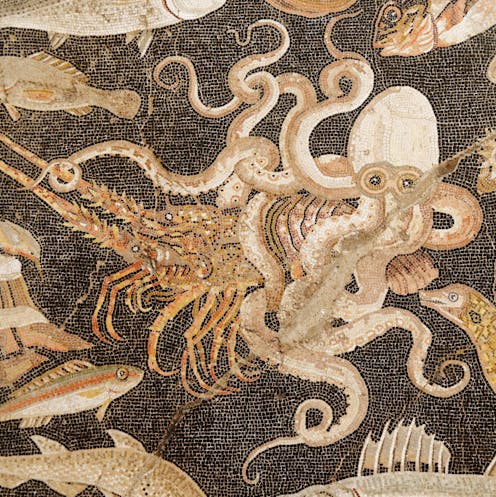
Elsewhere, Aelian reports on strange creatures we are more familiar with. Take, for example, his story of a giant octopus:
I learn of an octopus at Dicaearchia in Italy which attained to a monstrous bulk and scorned and despised food from the sea and such pasturage as it provided. And so this creature actually came out on to the land and seized things there. Now it swam up through a subterranean sewer that discharged the refuse of the aforesaid city into the sea and emerged in a house on the shore where some Iberian merchants had their cargo, that is, pickled fish from that country in immense jars: it threw its tentacles round the earthenware vessels and with its grip broke them and feasted on the pickled fish.
Aelian says one of the merchants wanted to fight the octopus to prevent it stealing their food, but was too afraid as the creature “was too big for one man” to fight.
 This octopus mosaic made in Spain dates from the 2nd-3rd century AD – around the same time Aelian was alive.
World History Encyclopaedia/Museo Arqueológico Nacional, CC BY-NC-SA
This octopus mosaic made in Spain dates from the 2nd-3rd century AD – around the same time Aelian was alive.
World History Encyclopaedia/Museo Arqueológico Nacional, CC BY-NC-SA
We don’t know whether Aelian’s stranger stories are true or not. Nonetheless, it’s clear at least some of these tales were collected from other people during his research.
By getting help from the public, ancient researchers were able to make a great deal of progress in studies of subjects such as animals and plants. They had to be careful, though. Much like today, discernment was necessary in the case of strange tales.
Authors: Konstantine Panegyres, McKenzie Postdoctoral Fellow, researching Greco-Roman antiquity, The University of Melbourne



















