

here’s how warehouses and shopping centres could produce 25% of Australia’s power
- Written by: Bruce Mountain, Professor and Director, Victoria Energy Policy Centre, Victoria University
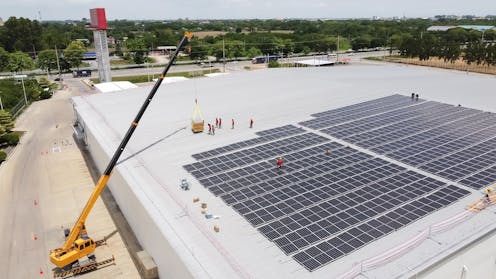
Imagine if Australian cities became major producers of clean energy, rather than relying on far-flung solar and wind farms.
Far fetched? Hardly. Our cities and towns are full of warehouses, commercial areas, shopping centres and factories. These types of buildings have one very important underutilised resource – large expanses of unoccupied rooftops, perfect for solar and battery power stations.
If our commercial and industrial areas took up solar and storage, it would be revolutionary. Electricity could be produced in cities and used in cities, reducing transmission losses. Commercial businesses could generate solar power during the day, store it in batteries on site and sell it back to the grid during the evening peak.
Our calculations show Australia has enough unused commercial and industrial rooftop space to supply at least 25% of our annual electricity use – five times as much as currently supplied by gas-fired generators.
Australia is already the world’s top rooftop solar nation, per capita. But our solar is largely on our houses. We have four times as much residential solar as we do on commercial buildings. In Europe, it’s the opposite – there’s 1.5 times as much solar on businesses as on houses. The EU’s new Solar Energy Standard is expected to double rooftop solar capacity in four years.
In our new discussion paper, we make the case for a massive expansion of battery-backed solar photovoltaic power on Australian business premises. Call it “business power”.
There are excellent reasons for policymakers and building owners to look at this. It offers a potentially large new source of cheap, reliable, clean electricity with little downside risk.

What’s the benefit of warehouse power stations?
Rooftop solar has been Australia’s quiet achiever. In 2023, rooftop solar produced 70% more electricity on Australia’s rooftops than either hydro generators or solar farms.
Solar farms are largely built in rural areas, as it’s easier to get large tracts of land. But city-based solar has advantages. City solar doesn’t change land use, need vegetation cleared or change the beauty of the countryside. Solar and wind farms in rural areas have to send power to cities, necessitating expensive new transmission lines. Some planned new lines have proven controversial.
When you add storage, you turn cheaply produced solar into a much more valuable commodity – reliable evening power. In evenings, the sun has set and demand soars. This is when much more expensive coal, gas or hydro generation dominates supply.
Locally produced battery-backed solar can also make better use of our distribution networks – the urban poles and wires. In a recent report, the peak body for Australia’s energy networks found surplus capacity in our distribution networks could be used by decentralised power generation and storage.
By contrast, some large rural transmission lines are already hitting capacity limits as distant wind and solar farms take up spare capacity.
What would it take to start this in earnest?
When a business owner or householder goes solar, it’s usually to save money. By producing their own power, they reduce how much expensive grid power they buy.
By contrast, our proposal would encourage businesses to install solar and batteries so they can export power to the grid.
A scheme like this would need policy support to get it started. That’s because it’s much less profitable to sell to the grid than it is to avoid buying from the grid. In electricity, as in other markets, wholesale prices are almost always lower than retailer prices.
To make it attractive to businesses, we propose the incentive of new floor prices (minimum prices) for electricity sold to the grid by businesses. It would cover electricity injected into the grid outside solar peak periods – before 11am or after 2pm – and from behind-the-meter batteries discharging to the grid during the evening peak, from 6pm to 9pm.
Floor prices would have to be set carefully to make investment worthwhile – but without unnecessary public largesse. To be eligible, businesses would have to have enough storage relative to the solar installation to be able to reliably store solar power to sell in the evenings. The payback period would differ from one business to another.
 If producing power in cities uses surplus distribution capacity, it might be possible to reduce how many new large transmission lines need to be built.
DifferR/Shutterstock
If producing power in cities uses surplus distribution capacity, it might be possible to reduce how many new large transmission lines need to be built.
DifferR/Shutterstock
What’s in it for the public?
Like almost all competing energy policies, this scheme would require governments to use public funds to stimulate supply. Why might consumers or taxpayers support this?
Our governments are already using the money of taxpayers and electricity consumers to fund new gas power stations, to prolong the life of ageing coal power stations and to encourage more large renewables and storage. We believe this scheme would stack up favourably on cost, speed, cleanliness, reliability and ease.
The scheme also offers a comparatively cheap way to cut greenhouse gas emissions. The value Australia’s government places on avoiding one tonne of carbon dioxide equivalent in 2024 is A$70. We estimate our scheme could cut emissions at a cost of around $23 a tonne.
What’s next?
Let’s say governments introduce these floor prices. What would happen next?
We anticipate business owners would weigh up the benefits. Many would decide to take advantage of the policy directly, while others might rent their rooftops to specialist companies to do the same.
Recent regulatory changes mean businesses are now legally able to export power without messing with their existing retail contracts.
Of course, policies come with risks. Desk-based studies like ours can only go so far. Important information is often only revealed by putting policies into practice. But schemes like this one could easily be tweaked or closed to new entrants – just as state governments did in ending premium solar feed-in tariffs.
In short, there seems to be little to be lost and a potentially large benefit to society.
Authors: Bruce Mountain, Professor and Director, Victoria Energy Policy Centre, Victoria University


















