

Humans can work with nature to solve big environmental problems – but there’s no quick fix
- Written by: Rachel Standish, Associate Professor, School of Environmental and Conservation Sciences, Murdoch University
“Nature-based solutions” are gaining momentum in environmental policy, including in Australia. They involve working with nature to protect, restore or manage ecosystems in a way that benefits both people and the environment.
This might include restoring coastal mangroves to protect a community from coastal erosion, or replanting forests to store carbon, provide cleaner air, and create habitat for wildlife.
But such solutions must go the distance, if their full potential is to be realised. In particular, they must be able to withstand short-term disturbances such as fire or drought, as well as longer-term change such as global warming.
How do we ensure their resilience? Our review of nature-based solutions around the world set out to answer this question.
We found biological diversity – at the level of genes, species, communities and whole ecosystems – is key to creating nature-based solutions that last. In contrast, quick-fix solutions, such as planting a single species of tree, are less likely to work in the long run.
These findings are crucial for Australia, as the federal government establishes markets for nature repair and informing biodiversity policies.

Biodiversity is vital
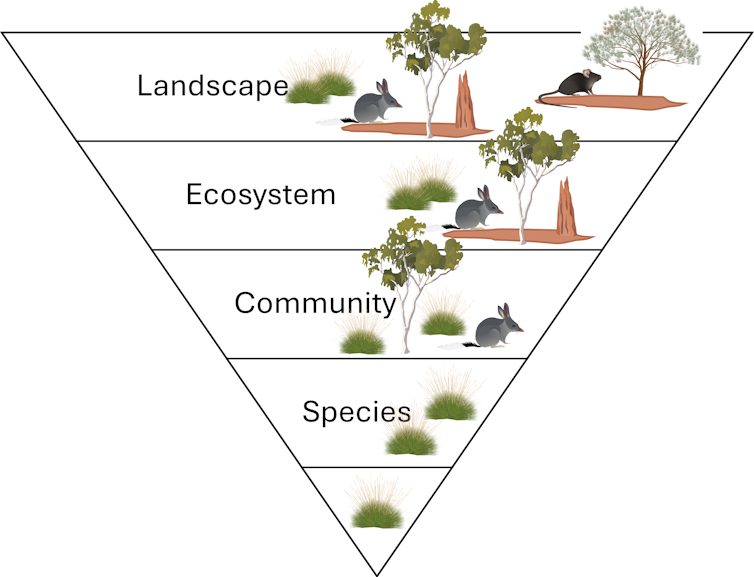
Biological diversity refers to richness at every level – from the genetic diversity of individual plants, animals and fungi, to the range of species, and diversity within communities, ecosystems and landscapes.
Diverse ecosystems are more resilient. That’s because different species in an ecosystem vary in their responses to change.
For example, some plant species complete their life cycle before the drought season. Other plants tolerate drought by adjusting their metabolism. A third group avoid drought by shutting down, including shedding old leaves and closing their stomata.
This means even when some species are stressed or missing altogether, an ecosystem can keep ticking along.
The same is true for planted forests. Diverse planted forests are more resilient to fires, pests and diseases compared with low diversity projects. So they’re more likely to capture and store carbon, helping tackle climate change.
So if we want nature-based solutions to last, biodiversity must be at the core.
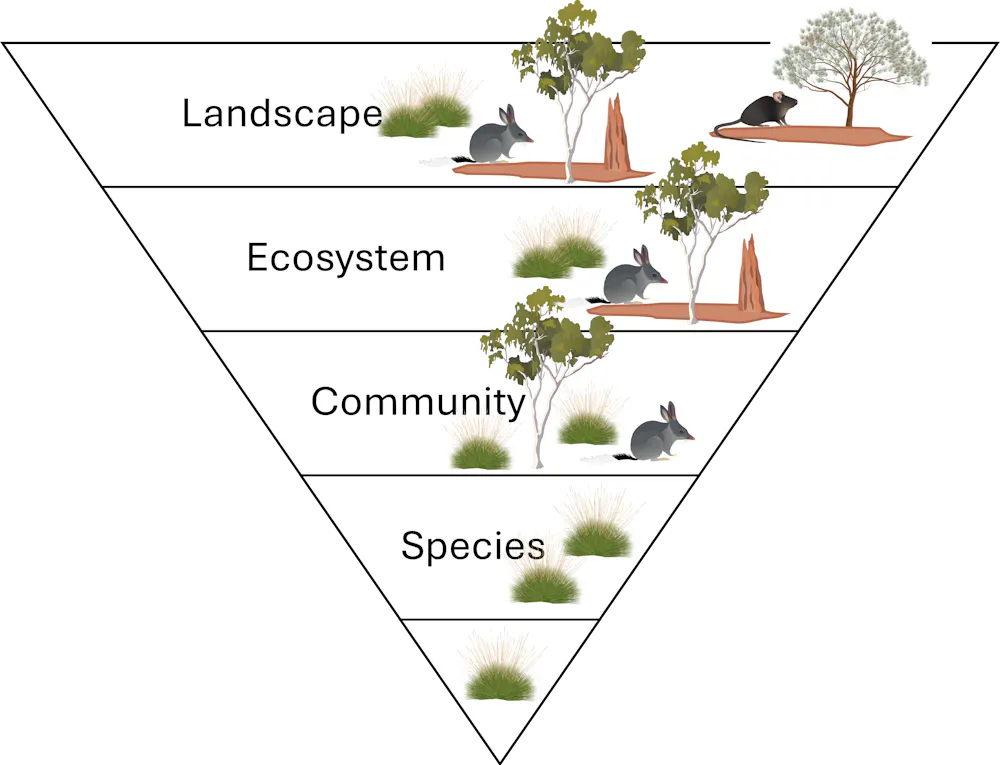 Biological diversity engenders resilience. That means diversity at every level, from individual plants through to entire landscapes.
Symbols courtesy of the Resilient Landscapes Hub, National Environmental Science Program
Biological diversity engenders resilience. That means diversity at every level, from individual plants through to entire landscapes.
Symbols courtesy of the Resilient Landscapes Hub, National Environmental Science Program
What we did
Our review involved analysing 78 research papers published internationally and in Australia over the past 20 years. We wanted to assess how ecological resilience was addressed in nature-based solutions.
A subset of papers described nature-based solutions in urban, agricultural and forested landscapes. Many focused on reducing impacts of climate change in cities. Then we considered key papers on ecological resilience and how to apply this knowledge to nature-based solutions.
So what did we find?
Most projects did not consider how resilience came about. This was true for resilience within species and populations, such as ensuring genetic diversity. It also applied at the landscape scale, such as providing connectivity between animal populations to prevent inbreeding.
The exception was afforestation projects – planting forests in degraded landscapes. In this domain, there is increasing recognition that species diversity is needed to create resilient ecosystems.
Researchers have, however, identified ways to make ecosystems more resilient – for example by restoring degraded land adjacent to remnant vegetation or controlling invasive predators that eat native wildlife.
The knowledge exists. The key now is to put these resilience ideas into practice.
 Diverse carbon projects are more resilient to disturbances. Yate woodland, ten years after planting, Koreng Country, southwestern Australia.
RJ Standish
Diverse carbon projects are more resilient to disturbances. Yate woodland, ten years after planting, Koreng Country, southwestern Australia.
RJ Standish
Which interventions can help?
Our review confirms the best nature-based solutions mimic nature. So, interventions to conserve existing ecosystems are ideal. Once an ecosystem is destroyed, restoring diversity is difficult.
Controlling invasive species such as cane toads can also help by protecting pockets of native species from these threats.
Measures can also be carried out across entire landscapes. For example, the Gondwana Link project in southwestern Australia set out to revegetate abandoned farmland and reconnect patches of bushland for native wildlife.
Climate change is prompting land managers to rethink their “local is best” approach to sourcing seed and seedlings. Plants that are better adapted to heat and drought may be preferable. However, this approach requires further testing.
And returning plants with different drought strategies could help restore landscapes scorched by wildfire.
Looking ahead
Quick-fix, low-diversity solutions are not likely to recover after disturbances such as fire and drought. So while these projects are nature-based, the solution could be fleeting.
In Australia, the Nature Repair Market will incentivise nature-based solutions. First Nations people, conservation groups and other landholders will be rewarded for actions that deliver improved biodiversity outcomes. This includes returning vegetation along rivers and controlling invasive weeds and pests.
Our findings suggest nature repair and biodiversity markets should support actions that provide long-term benefits rather than quick wins. This could involve providing clear guidelines to landholders and ensuring their activities are accredited. It may also involve monitoring the outcomes of projects and rewarding success.
And these solutions take time to create. Governments should invest in research to develop projects that deliver long-lasting benefits. This includes understanding how to motivate people to drive successful outcomes.
Restoring biologically diverse landscapes may take time and effort. But for the sake of both people and the natural world, we must get it right.
Authors: Rachel Standish, Associate Professor, School of Environmental and Conservation Sciences, Murdoch University


















