

Google AI


Modern Australian

Black Caviar’s death has prompted uncomfortable questions about how champion mares spend their retirement

  • Written by: Cathrynne Henshall, Post Doctoral Fellow-School of Agricultural, Environmental and Veterinary Sciences, Charles Sturt University

The death of one of Australia’s most-loved thoroughbreds, Black Caviar, brought an outpouring of grief from the racing industry and fans across the world.

It also sparked some uncomfortable questions about what retirement actually means for a champion mare like her and what really goes into breeding a racehorse.

Some questioned the quality of care she was given and whether she was valued for more than just her ability to produce foals. Many were surprised at how thoroughbred breeding works in practice, even for champions like Black Caviar.

Does good care always mean good welfare?

The background

Black Caviar gave birth to her final foal on Saturday morning. Shortly afterwards she was euthanised after contracting laminitis (an extremely painful condition in which blood flow to the hoof is severely restricted).

“She had a milk infection about a week ago and we just treated it like you do with all broodmares. But, like a lot of treatments, it went straight to her feet,” trainer Peter Moody said.

“Basically, it killed her feet.”

Continuing the sad news, the unbeaten mare’s final foal, a colt, died shortly after.

Black Caviar was one day shy of her 18th birthday when she died. Retired racehorses often live between 25–30 years.

Black Caviar died after delivering her ninth foal in 11 years since her retirement from racing in 2013.

The average gestation period for a horse is 340 days.

Thoroughbred breeding basics

The Australian breeding season begins on September 1 each year.

Mating is achieved “naturally” (use of artificial insemination is banned for thoroughbreds worldwide) – although the process is dramatically different from what happens with horses in natural settings.

In the wild, the mare usually initiates mating by approaching the stallion and performing a range of courtship behaviours before allowing him to mate (or “cover”) her multiple times a day during her receptive period.

If she’s not ready to breed, she will refuse the stallion’s advances, which may including kicking and biting him or galloping away.

Black Caviar’s death has prompted uncomfortable questions about how champion mares spend their retirement In the wild, there is a courtship between a mare and a stallion before she allows him to cover her. Paul McGreevy/Wes Mountain/The Conversation

But at the stud, safety and efficiency is prioritised.

To prevent injury to the stallion and to facilitate an efficient covering, the mare will be fitted with equipment designed to ensure she can’t react during the procedure.

To minimise kicking, she may be fitted with breeding hobbles or boots that limit the movement of her hind legs. A breeding cape protects her neck from bites during copulation.

A device known as a twitch may be used as an additional form of restraint. This is a loop of string or rope that is twisted tightly around the upper lip, causing a temporary reduction in heart rate and the release of endorphins that induce calmness in the mare.

She may also have a foreleg held up while the stallion mounts to further restrict her ability to avoid the stallion.
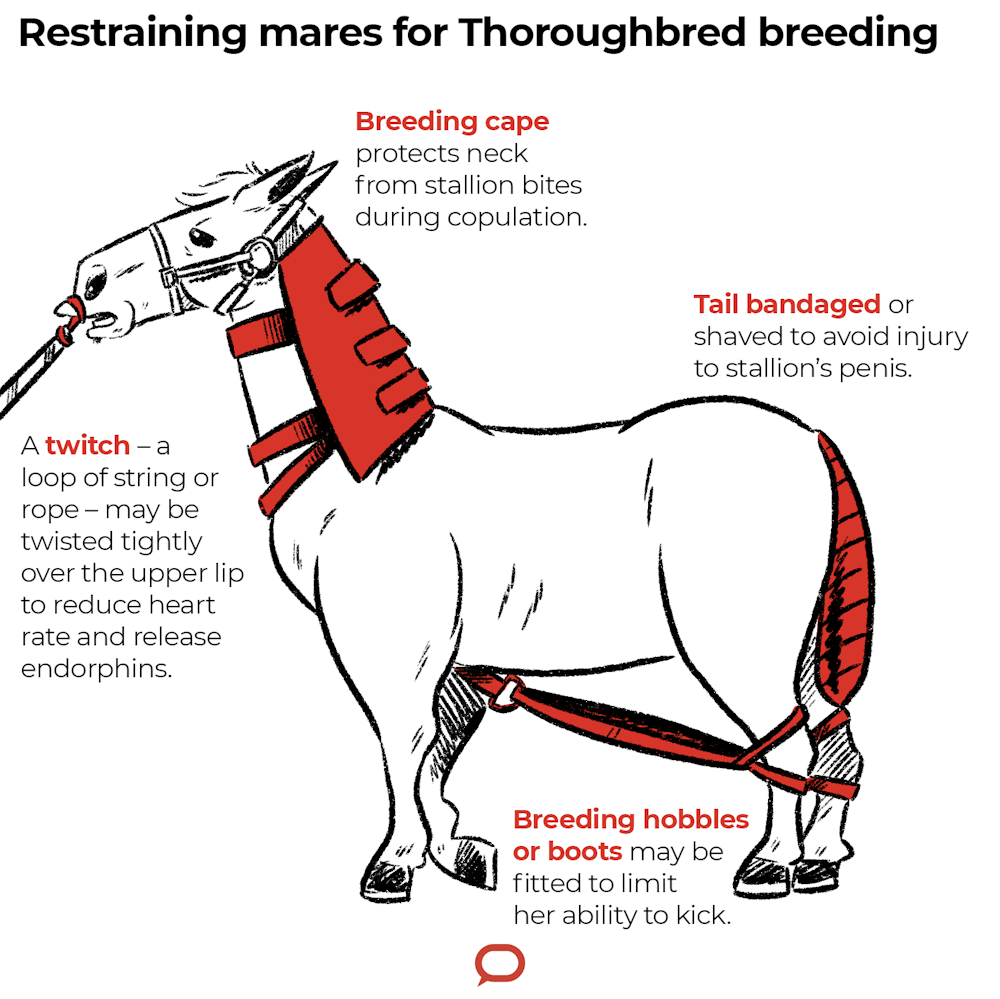
Wes Mountain/The Conversation, CC BY-ND The stallion’s natural mating behaviour is also restricted during mating. Instead of a courtship between two animals, the stallion is taught to mount the mare on command under the control of the handler. What about animal welfare? Throughbred breeding has a long history, but recently community concerns about the ethics of the industry have emerged. One is the welfare of the animal during mating – not just the mare but the stallion and foal, and the care they receive after birth. In Black Caviar’s case, it’s safe to assume she was given the very best care, considering her importance and value to her owners. But even so, during covering, she would have been restrained like any other mare, having no agency in regards to who she was mated to or what happened to her. Stallions are also affected by standard industry practices. Once a stallion retires to stud, it will most likely be socially isolated from horses other than during covering for the rest of their lives. Stallions living in the wild not only have the company of their mares, they also regularly play with their foals. It’s also important to consider the quantity of horses being bred. The racing industry relies on a continual supply of young horses, especially two and three-year-olds. In Australia, most of the biggest prizes in racing are age restricted, so owners and trainers need a continuous supply of young horses that are eligible for those races. This creates a huge incentive to keep breeding, which adds more pressure on horses like Black Caviar to produce offspring, even as the mare ages and the risks of poor outcomes increases. Black Caviar had nine foals, but such a number isn’t uncommon in the thoroughbred industry where access to the latest veterinary interventions is available. In the wild, mares may only give birth to five to seven foals in their lives depending on the availability of food and protection from predators. What does getting pregnant almost every year do to a mare? More pregnancies mean there’s generally more opportunities for things to go wrong. As horses get older, the muscles, ligaments and tendons around their abdomen often get laxer and they are more prone to infections, so they are more at risk of difficulties during and after pregnancy. Every pregnancy accumulates the risk for mares once they are in their mid-to-late teens. The economic realities of breeding Finally, in analysing the reaction to Black Caviar’s death, it’s apparent there’s a sizeable disconnect between people within the industry and those outside it. Some outside “the bubble” queried the treatment of the champion racer. But many in the industry – including Thoroughbred Breeders NSW president Hamish Esplin – quickly jumped to the defence of Black Caviar’s owners. Every person who starts working in the racing or breeding industries does so because they have a true connection and love for horses. But there’s no denying the economic truths – it’s a business in which the primary assets are the horses, and mares generate income by producing foals. Ultimately, all that care and concern for a horse is to ensure it can keep having foals for as long as possible. Although Black Caviar’s owners kept her foals rather than selling them as yearlings, which is the usual practice, those animals still entered the racing and breeding industries. Undoubtedly, Black Caviar was much loved and received the best of care. But even after winning 25 races, she still had a job to do – produce as many foals as possible that might one day generate a similar return on investment as she did. Authors: Cathrynne Henshall, Post Doctoral Fellow-School of Agricultural, Environmental and Veterinary Sciences, Charles Sturt University

Read more https://theconversation.com/black-caviars-death-has-prompted-uncomfortable-questions-about-how-champion-mares-spend-their-retirement-237039

Breach of Contract in Business: What Are Your Options?

Contracts are essential to business relationships. They establish expectations, allocate responsibilities and provide a framework for delivering goods...

How Pest Control Companies Can Rank for the Problems Customers Search First

Introduction SEO for Pest Control needs to start with the customer’s problem. Most people do not search for pest services in a neat or technical wa...

What Are the Benefits of Renovating an Older Home in Sydney?

Sydney has plenty of character homes, from Federation cottages to mid-century brick homes. Renovating rather than rebuilding can preserve what makes t...

Pool and Deck Design: How to Plan the Perfect Outdoor Living Space for Your Sydney Home

For many Australians, the backyard is where life happens. Summer barbecues, weekend swims and long evenings outdoors are all part of the lifestyle, ...

Is Solar Pool Heating Worth It? What Sydney Homeowners Should Know

There's nothing quite like a backyard pool on a hot Sydney day. But once autumn rolls in, many pools sit unused for months because the water is simp...

Planning a Luxury House Move: A Week-by-Week Timeline for Prestige Sydney Homes

Selling or buying a prestige home is a major milestone. Whether it's a waterfront residence in Birchgrove, a grand Federation home in Haberfield or ...

Downsizing or Upgrading Your Caravan? Here's How to Sell It Without the Hassle

Selling a caravan can feel like a major task, especially when you are unsure about its value, paperwork, or how to find a buyer. Whether you are dow...

The Best Overseas Adventure Holidays for Australians Who Love the Outdoors

Australia offers no shortage of incredible outdoor experiences, but sometimes the best way to satisfy your sense of adventure is to head overseas. A...

Cape Town Wine Shuttle: Winelands Tasting & Tours

Embark on an unforgettable journey through the picturesque Cape Winelands, where world-class wines and breathtaking scenery await. Our Cape Town Win...

Metal Fabrication: Choosing Metal Fabrication Melbourne Services for Custom Projects

What Modern Metal Fabrication Involves From individual components to complete structures, metal fabrication brings together processes such as desig...

Why Giant Rats Tail Grass Keeps Coming Back After Spraying

Giant Rats Tail Grass (GRT) is one of the most frustrating pasture weeds for farmers and lifestyle property owners. You spray an infested area, see th...

When Custom Cardboard Boxes Make Sense for Your Business

Custom cardboard boxes can be useful when a standard carton does not fit a product, packing method or presentation requirement particularly well. A ...

Full-Height vs. Pop-Top Caravan: Which Is Better for Family Travel across WA?

A pop-top caravan is an excellent choice for travellers who want the comfort of a caravan without committing to a larger, bulkier setup. With a lowe...

Bottle Label Printing: Key Factors for a Professional Finish

Why the Printing Method Matters When businesses need packaging or printed containers developed for a particular application, the right supplier can m...

Virtual Livestock Fencing and GPS Tracking: Improving Visibility Across Cattle Properties

What Virtual Livestock Fencing Means for Modern Cattle Management Managing cattle across extensive properties requires more than knowing where anim...

Sydney Pawnbrokers Explained: How Hocking Your Car Actually Works

Sometimes you need cash, and you need it soon. If you own a car, you may already have a way to get it. That's what people mean when they say they've...

Moving Interstate from the Gold Coast to Brisbane (or Back)? What Removalists Wish You Knew First

Have you talked to anyone who’s done the move? They say the same thing: the drive up the M1 is the easy part. It's everything around it that catches...

Why the Spring School Holidays Are a Great Time to Visit Coffs Harbour

The spring school holidays are a good time to spend a few days on the Coffs Coast. The weather is starting to warm up, there is plenty to do outdoor...

















