

promises for Indigenous people buckle under history’s weight
- Written by: Robyn Smith, Lecturer in Colonial History, Charles Darwin University
First Nations people please be advised this article speaks of racially discriminating moments in history, including the distress and death of First Nations people.
Earlier this month on the Bungul ceremonial ground at Gulkula in Arnhem Land, Northern Territory Police Commissioner Michael Murphy apologised to First Nations people for “past harms and injustices caused by members of the Northern Territory police.” The aftermath has been much discussed.
Irrespective of your view on the commissioner’s apology, police are but one cog in the wheel of “government men” about whom Aboriginal people in the NT have rightly long been suspicious.
Other cogs over the course of history were overland telegraph officers, welfare officers, “protectors” (some of whom were police), doctors (some of whom were protectors) and magistrates. In fact, many Aboriginal people in the NT are rightfully distrustful of almost any organ of government. This is because settler colonialists engulfed their lands and forced them onto the most arid and least fertile areas, among other reasons.
It’s against this ongoing backdrop that Territorians head to the polls this weekend. With such a traumatic past casting a long shadow, the little that political parties are offering Indigenous communities this time around hardly moves the dial.
Territory of convenience
This deep-seated distrust has been fostered over centuries, as I’ve charted in my research on colonial history, including in my book on massacres in Australia’s north. I also worked with a team, led by the late Professor Lyndall Ryan, to map colonial massacres across the country.
This history still shapes government dynamics in the territory, so understanding it is key.
In addition to those mentioned above, “government men” also included pastoralists and publicans. They mounted their own punitive reprisals for cattle killing and pilfering. Government men killed Indigenous men attempting to liberate abducted Indigenous women, many of whom had been subjected to sexual slavery.

Civilians acted as government-appointed magistrates in the most far-flung parts of the country. They dispensed frontier justice without knowledge, training or a shred of human decency. This was often in collusion with the accused (usually a fellow white person) and their counsel.
This attracted very little attention, either at the time or since. Australia didn’t care.
As colonialism morphed into federalism, finger-pointing about who was responsible for funding the Northern Territory began.
South Australia discovered maintaining infrastructure was expensive and hastily punted the Northern Territory to the federal government in 1911 (though former Deputy Premier Vickie Chapman rued that decision in her 2022 valedictory speech).
Political imperatives – mostly on the east coast – meant it was electoral suicide for the Commonwealth to fork out infrastructure spending for about 5% of the population, more than 25% of which is Aboriginal, occupying about 30% of the continent.
As historian Lyndon Megarrity wrote, there were two exceptions to this: the strategic importance of northern Australia to defence and its apparently boundless resource potential. Otherwise, Megarrity wrote, northern Australia has always been subject to the politics of neglect.
No listening, no respect
Settler colonial policies were accompanied by a relentless succession of government men visiting communities and barking orders or promising the impossible.
In the Top End, such men became likened to white cockatoos because of their propensity to fly in, flap around, screech a lot and fly out: no courtesy, no listening, no respect.
Electoral cycles ground on. Federal and, after 1978, territory governments changed. Conditions on the ground did not. At least not in any substantial way.
The settler colonial phenomenon of government men was no better exemplified than in 2007 when soldiers swarmed into remote communities without notice under “the intervention”.
Suspending its own Racial Discrimination Act, the Howard government compulsorily acquired town leases, managed the incomes of all welfare recipients, revoked Aboriginal land permits and dramatically increased the presence of police.
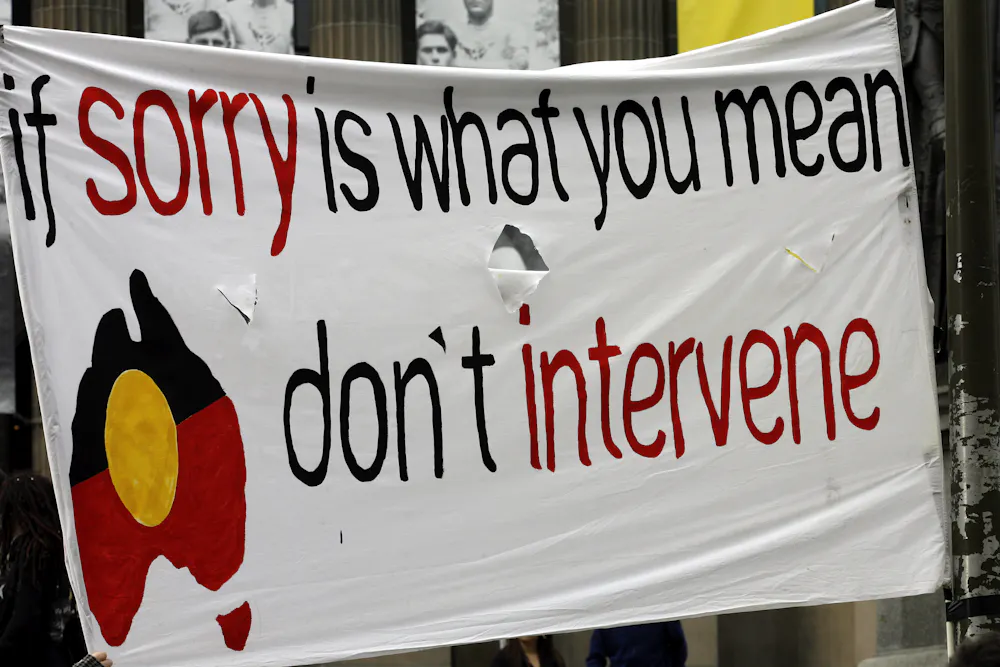 The 2007 Northern Territory Intervention severely limited the rights of Indigenous people.
Simon Mossman/AAP
The 2007 Northern Territory Intervention severely limited the rights of Indigenous people.
Simon Mossman/AAP
Despite this, then-Prime Minister John Howard still maintains the intervention was justified.
Notwithstanding a recent surge for the Voice referendum, Aboriginal voter engagement in regional and remote areas plummeted. People struggle to see the relevance of any government to their own communities. Many see no possibility of change and therefore no point in the electoral process.
That remains the case for the forthcoming election. It will be decided by middle class people in the northern suburbs of Darwin, few of whom have any idea of conditions outside their urban comfort zones.
Elsewhere across the territory, everything is at stake: communications, culture, health, housing, education, environment, food security, income, law, justice, suicide, transport and safety. The gap isn’t closing. In fact, the NT is the worst performer under the Productivity Commission’s Closing the Gap targets.
Little on the table
Back at Garma, the federal government was reasonably well represented. The Northern Territory government was not.
One representative of the Legislative Assembly was present: the local independent Member for Mulka and highly respected senior Yolngu man, Yingiya Guyula.
So well respected is he that Labor (currently in power) failed to field a candidate against him, although that may be more closely related to the comfortable margin by which he holds the seat.
Garma fell after the writ had been issued and thus during the caretaker period, so perhaps local politicians were preoccupied with their own electorates.
Alternatively, Labor may have been chastened by an unresolved Independent Commission Against Corruption (ICAC) investigation into alleged electioneering travel by former Chief Minister Michael Gunner during the same period in 2020. The party allegedly spent thousands of dollars for charter flights to remote communities in close electorates on the same day remote polling was taking place.
The NT Electoral Commission’s Remote Engagement Team was present at Garma. It worked from its bough shed shopfront to engage and enrol people.
The incumbent Labor government and Country Liberal opposition claim to have the solutions, capacity and leadership to tackle the key issues, pitching their credentials at campaign launches in urban Darwin and Palmerston on the eve of early polling.
Neither party has had much to say about policies for the one in four Indigenous people.
But in reality, neither has the capacity to fix much because of the Commonwealth’s historic and growing infrastructure deficit. This compounds and reinforces structural inequity.
Unless the federal government wants to step up, the politics of neglect continues, regardless of who wins on Saturday.
Authors: Robyn Smith, Lecturer in Colonial History, Charles Darwin University


















