

Skills like 'crap detection' can help kids meet cybersecurity challenges head on
- Written by: Matthew Riddle, PhD Candidate, Melbourne Graduate School of Education, University of Melbourne
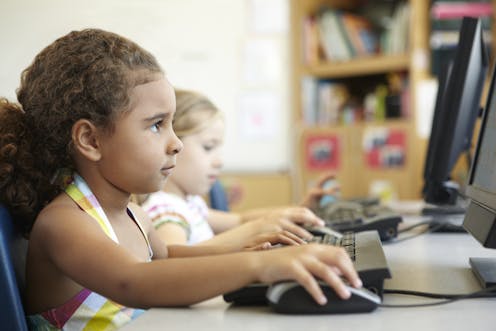
How well are we preparing the typical primary school kid for life when they graduate in 2032?
Current attitudes to education around cybersecurity and online safety skew towards caution at all costs. We often focus on schools’ duty of care rather than fostering skills and frameworks of digital ethics which empower students.
There is a danger we are letting kids down with a fear-driven mentality instead of engaging their challenges head on. Both parents and teachers can help kids in this capacity: let’s take a look at how (tips below).
Read more: Don't fall for it: a parent's guide to protecting your kids from online hoaxes
Fear can be a barrier
We educational technologists often have cybersecurity discussions with students, parents and teachers with digital fluency levels ranging from expert to little-to-no knowledge.
As parents and teachers we can understandably be fearful of the role of technology in kids’ lives, however this can sometimes be a barrier to student learning.
Around six years ago, Wooranna Park Primary School in Victoria, Australia introduced new technologies that had an immediate positive influence on student outcomes. Yet some drew negative feedback from parents, due mainly to misconceptions and fear of the unknown.
Read more: A guide for parents and teachers: what to do if your teenager watches violent footage
Communication is vital
Sandbox video game Minecraft is a powerful tool for collaborative learning. It provides an infinite 3D space where students collaboratively learn just about anything you can think of: from numeracy and literacy, to 3D printing, coding, science, financial literacy and art.
Many schools use Minecraft now. Yet it was met with a lot of trepidation from parents when first introduced as a learning tool at the school. One parent had specific fears about Minecraft (“isn’t it about murdering babies or something?”), taking these directly to the principal, who took the time to share the benefits and provide detailed information. This particular parent now plays Minecraft with their children.
Likewise when YouTube was first allowed within the school, some parents and even staff were worried about it. However as a video sharing service where people can watch, like, share, comment and upload videos, it is now a core technology supporting self-directed learning. Today the school would feel like it was coming to a standstill without it.
Read more: Curious Kids: what makes an echo?
The pedagogic context is the key here — and it wasn’t until learning engagement data was communicated to the school community that overall negative opinion changed to a positive one. Now students aren’t just consuming content from YouTube, they are uploading their own work and sharing it with their parents.
Personal responsibility, healthy conversations
Minecraft and YouTube are examples of Web 2.0 technologies. We are now transitioning into the age of Web 3.0 – the decentralised web, where personal responsibility is paramount.
We’re at the cusp of the widespread adoption of a whole range of disruptive technologies that work less like curated gardens and more like ecosystems. These are based on new core technologies like blockchain and the distributed web (also known as Interplanetary File System, or IPFS).
These approaches effectively eschew the “platform”, and allow users to connect directly with each other to communicate, create and transact. These will benefit students in the long term, but will inevitably draw alarm due to misunderstanding in the short term.
The way we can get ahead of this as a community is by introducing a culture of having healthy conversations at home and in school much more often.
Start them young
It is almost never too early to start teaching kids about cybersecurity.Students at Wooranna Park Primary School as young as five and six are learning about cutting edge technologies such as IPFS, cryptography, blockchain, virtual and augmented reality (VR/AR), robotics and artificial intelligence (AI).
The kids learn these topics within the context of active inquiry, giving them choices about the software and devices they use in order to empower them as technology-enhanced learners.
A recent study of 1:1 classroom projects by researcher Theresa Ashford found a strongly regulatory culture in education focused on “filtering and monitoring”. This failed to instil a critically important framework of digital ethics, with students quickly finding ways to navigate around barriers.
We can avoid this by not being fearful of technology use by children, but instead helping them navigate through the complexities.
Tips on how to talk to your children about cybersecurity
talk to them about what they are doing online, what websites they visit, and what apps and online services they are using
sit with them while they use technology and observe, then discuss what they think about and how they feel
ask whether they think what they see online is always true, and how they would know if something wasn’t real
encourage critical thinking and credibility evaluation skills (what Howard Rheingold calls “crap detection”) as well as ethical engagement by talking through specific examples
provide clear ways that kids can check primary sources, such as looking for credible primary sources (not just depending on the Wikipedia entries, but reading the primary sources linked by them)
encourage kids to protect their personal data, and explain that when you put something online it will most likely be there forever
brainstorm with them about possible online pitfalls, like bullying, scams, targeted advertising, child exploitation and identity theft
commit to learning alongside your kids about the online worlds they inhabit.
Terms to search and explore with your child
- password strength – the measure of the effectiveness of a password against attackers
- two-factor (or two-step) authentication (2FA) is a method of confirming a user’s claimed identity by utilising something they know like a password, with a second verification like an SMS or verification app
- encryption – the translation of data into a secret code instead of “plain text”
- blockchain – a distributed ledger technology that records transactions using many computers
- cyberbullying – the use of services such as text messages or social media to bully a person
- SSL – the “s” at the end of https:// when you visit a website, which means you can generally trust the site to transport your personal information in an end-to-end encrypted format
- virtual private network (VPN) ensures a safe and encrypted connection over a less secure network
- virus and malware – software written expressly to infect and harm computer networks and devices
- IPFS – interplanetary file system, the decentralised web
- peepeth – blockchain-powered, decentralised social network
- hardware wallets – a device that stores the public and private keys which can be used to secure cryptocurrencies, and can also act as a means of two factor authentication.
Security tools to explore with your child
- haveibeenpwned.com – check if you have an account that has been compromised in a data breach
- interland – embark on a quest to become a confident explorer of the online world
- Google security check – evaluate your security within the Google ecosystem
- authy.com – add two-factor authentication to common services
- howsecureismypassword.net – work out how long it would take a computer to crack your password.
This article was written with significant input from Kieran Nolan, a Melbourne-based educational technologist.
Authors: Matthew Riddle, PhD Candidate, Melbourne Graduate School of Education, University of Melbourne


















