

Here’s why more Australian scientists should team up with authors on books about animals
- Written by: Euan Ritchie, Professor in Wildlife Ecology and Conservation, School of Life & Environmental Sciences, Deakin University
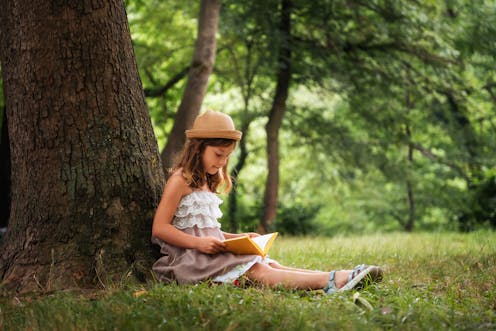
Few things are more wonderful than well-written and produced children’s books. They captivate kids, families and classrooms, leaving lifelong impressions. They shape our world. But for the most part, engaging and scientifically accurate children’s books on Australian animals – particularly the lesser-known species – are sorely lacking.
In contrast, books about animals from the northern hemisphere abound. They dominate the shelves in our libraries and bookstores.
Failing to appreciate and celebrate Australian natural history has serious consequences. In the midst of Australia’s biodiversity crisis, it is crucial Australians learn about the remarkable species that call this large and diverse continent home.
Connecting with nature during childhood instils the importance of caring for wildlife and their homes. Once established, this responsibility can carry into adulthood. By helping us fall in love with Australia’s amazing wildlife and ecosystems, children’s books can help transform Australia and its dire conservation record.
National Science Week and Children’s Book Week ran back-to-back this year. What better time to encourage more collaboration between authors and scientists?
A short reading list
Fiction featuring Australian animals, such as Possum Magic, The Magic Pudding and Snugglepot and Cuddlepie, were personal favourites. The children in our lives adore Diary of a Wombat.
But picture books depicting Aussie wildlife are rarer than they should be. So many truly amazing and unique creatures are just waiting to be brought into our homes.
It’s even harder to find accurate books in which the biology and ecology of species is correct. We have sought them out for our kids. Happily, some shining examples include:
The problem
People’s biases created through literature can persist into adult life. Many Australians know and care more about honeybees, bullfrogs, squirrels, elephants, bears and robins than native wildlife such as dinosaur ants, blue banded bees, bogong moths, giant cuttlefish, corroboree frogs, pygmy possums, tree kangaroos, thorny devils and palm cockatoos.
The Australian national anthem states:
Our land abounds in nature’s gifts, of beauty rich and rare
And yet mainstream Australia doesn’t celebrate, emphasise, or connect with nature nearly enough. The consequences of that disconnect can be seen across Country.
Inaccuracies in children’s literature across the world
When wildlife does make an appearance in children’s literature, we often find inaccuracies. For example, bats are not blind. Whales don’t blow fountains of water out of their blowholes – this would be very bad news for a whale!
Poisonous animals are toxic when eaten, while venomous ones inject poison when they bite, sting or spear others. Spiders are not insects but arachnids. Ants and termites are wildly different creatures. Whales are not fish, they are mammals. And, speaking of mammals, echidnas and the platypus are not marsupials, they are monotremes – they lay eggs!
These errors matter because basic scientific literacy shapes our understanding of the world. They may be partly due to unnecessary oversimplification that underestimates children’s capacities to learn complex concepts and language. But that’s not the full story.
Scientific accuracy can be difficult to achieve. Authors are often constrained by money and time. And scientific literature is dense and, regrettably, often inaccessible behind paywalls.
Unfortunately, information on readily accessible websites is often inaccurate – but detecting errors can be very difficult for non-experts. What can authors reasonably do? Our suggestion is to reach out to scientists.

The solution
Joining forces can create literature filled with accurate yet accessible and engaging information spanning the complexity and nuances of Australian ecology. Many scientists want to work with authors to help tell stories about the plants, animals, fungi, slime moulds, microbes, other lifeforms, and ecosystems they know and love.
There are many ways to facilitate mutually beneficial relationships between scientists and authors. These could include inviting each other to conferences and writers’ festivals, establishing scientist- or author-in-residence programs, or establishing online communities where people can find each other.
We argue science communication has a key role to play too. This is how we formed collaborations with Australian author and illustrator Sarah Allen. Reflecting on her journey, Allen has said:
I’ve had an interest in environmental education for a long while and I love non-fiction picture books. One night, I was up late illustrating a unicorn book, and heard ecologist Professor Euan Ritchie talking on Radio National about Australia’s extinction crisis. The interview literally stopped me in my tracks. I put my pen down from the unicorns and thought… I have to do something about this. I set about researching and writing a book about marsupials.
Working together is a win-win
The arts and sciences are inherently creative pursuits — both create and convey information — so it’s a natural pairing. Artists are master communicators and scientists often want to maximise the impact of the knowledge they’ve created, to reach people and audiences they may not be equipped to. Collaborations here are a win-win.
Australian author, comedian and musician Tim Minchin, put it best when he said the separation between the arts and sciences is a “recent, stupid and damaging idea”. But we can fix this. Working together will benefit our children, wildlife, environment and society.
Authors: Euan Ritchie, Professor in Wildlife Ecology and Conservation, School of Life & Environmental Sciences, Deakin University


















