

Don't wait for a crisis – start planning your aged care now
- Written by Alison Rahn, Adjunct Research Fellow, School of Humanities, Arts & Social Sciences, University of New England; Senior Research Officer, School of Social Sciences & Psychology, Western Sydney University

The earlier you start planning, the better.
Most Australians prefer to die at home but few adequately plan for it. Consequently, just one in seven dies at home.
Some say they will make plans “when the need arises”. But what if you have a heart attack, go into a coma, have a stroke, or develop dementia before having shared your thoughts? We’re all ageing and none of us knows when our health will deteriorate to the point where we need daily domestic or medical assistance.
In the absence of clear instructions, you may instead be admitted into a hospital or aged care facility. That’s where most Australians aged 65 and over end up dying.
Read more: A good death: Australians need support to die at home
The earlier you start planning for your aged care, the better. To start off, think about the possible scenarios you may encounter in later life.
Consider whom you wish to maintain relationships with, including intimate partners.
Think about how you will pay for home and aged care services, and whom you might rely on to be your advocate or carer.
Communicate your decisions (verbally and in writing) in as much detail as possible to those who need to know, such as future carers and health providers. This removes much of the guesswork later.
Relying on government-funded services is risky
Government-funded home care packages are intended to keep people in their homes for as long as possible. They provide supplementary support such as cleaning or shopping services, home visits by nurses and, in some cases, equipment to help with mobility or minor home modifications.
But while demand for these services is increasing, staffing and funding levels aren’t keeping up. Older Australians wait, on average, 18-24 months to access a home care package. In the meantime, many people are forced to move into residential care.
Read more: Explainer: what is a home care package and who is eligible?
More than 3.5 million Australians are expected to be using aged care services by 2050. This would require an additional 980,000 workers in the aged care workforce.
However, aged care providers already report a shortage of workers. In fact, the home care workforce has declined since 2012, meaning much-needed home care services are not always available.
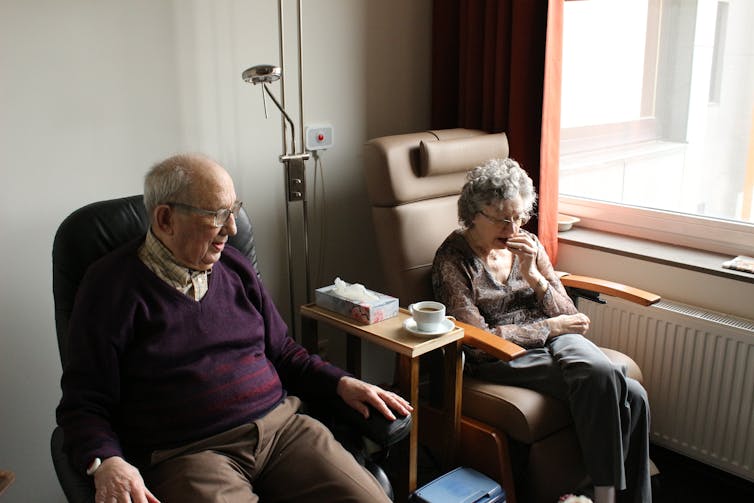 Many older Australians want to stay in their homes for as long as possible. Elien Dumon
It’s also important to note that Australia’s aged care system is increasingly moving to a “user pays” model, whereby aged care clients are means-tested and expected to contribute financially to their care.
So it’s unwise to assume government funding will be sufficient to pay for your aged care services.
Attitudes to residential aged care
Aged care horror stories abound in the media, especially now the Royal Commission into Aged Care Quality and Safety is underway. Unfortunately, equal media coverage is not afforded to the many excellent aged care facilities in Australia.
The royal commission reported some Australians would rather die than live in residential aged care. But there is scarcely any research into public perceptions of residential aged care and whether they change over time.
Read more: Would you like to grow old at home? Why we’re struggling to meet demand for subsidised home care
In my own research, such attitudes resulted from exposure to negative media coverage, visiting residential aged care facilities, or working in aged care. Of particular concern were issues typical of institutional living – lack of privacy, personal choice or control. This was a particular issue for partnered residents, who represent one-third of aged care residents.
However, simply making a pronouncement that you reject residential care is not sufficient to prevent it happening. Entry into residential care usually happens in response to a crisis, either because people live alone or because family carers can no longer cope. The most common trigger is dementia.
Besides residential aged care, your other options include living independently with or without voluntary family or community support, a home care package and/or self-funded care. However, every scenario requires that you prepare in advance as follows.
 Maintaining social connections and learning can decrease your risk of dementia. Val Vesa
Preparing for the end of your life
On an individual level, there are five important things you can do for yourself.
1. Adopt a healthy lifestyle
Learn about dementia, which is preventable in one-third of cases. Make lifestyle changes to reduce this and other diseases of old age. Maintaining social connections, getting regular exercise, lifelong learning, quitting smoking, losing weight, treating depression and even correcting for hearing loss all make a significant difference.
Read more: Some brain training programs are backed by evidence. Here's how to pick them
2. Consult a financial planner
Early in your working life, plan your retirement income to last to 90 years of age and beyond. Aim to be debt-free and factor in costs associated with home care.
Assume you’ll be one of the 62% of people over 85 who needs residential aged care in their final years and budget accordingly. For this, you will need a bond of A$300,000 to A$500,000 minimum. Except in the lowest socioeconomic groups (who are exempted from bonds), insufficient bond money means many people, especially if they’re partnered, will not be able to afford residential aged care.
3. Talk about your wishes
First consider your preferences: where you want to die, who cares for you and what provisions you are likely to need. Then make your wishes widely known, especially to anyone you’d like to have care for you.
4. Write it down
Record your wishes using formal end-of-life planning tools well before you need them. Learn about Enduring Guardianship, Enduring Power of Attorney and Advance Care Planning in your state. By recording your wishes and nominating representatives, you will be reducing the stress and uncertainty for your family and health providers.
 End of life planning tools can help. Trinity Treft
Choose representatives who will willingly act as advocates on your behalf, to ensure your wishes will be carried out. Advance care planning is especially important if you do not want medical intervention to keep you alive.
5. Choose carefully where you live
Consider the suitability of your home and suburb if walking becomes difficult and driving is no longer an option. Are you near a hospital? Can you reach it by public transport? Can you walk to the shops? Is your garden high-maintenance? Are friends and family nearby? Are there services available that could come to your home? Move before you need to.
Support (and be supported by) your community
Ageing is a whole-of-community issue – it affects us all. We cannot expect individuals to be solely responsible for their care.
In the past, caring for older people in their final years was routinely carried out by families and communities. This is still the best strategy. But it relies on communities forming volunteer groups to actively care for their older people.
To safeguard your future, support a volunteer organisation in your neighbourhood, such as Compassionate Communities (in Sydney, the Blue Mountains, and southwest Western Australia), One Good Street (in Melbourne), Good Karma Networks (in Victoria, South Australia, New South Wales, Queensland and New Zealand), or Amitayus Home Hospice (in Byron Shire, NSW).
Some of these organisations provide training for those caring for older people. Others invite neighbours to help each other by sharing their knowledge or skills with older people and their carers.
Authors: Alison Rahn, Adjunct Research Fellow, School of Humanities, Arts & Social Sciences, University of New England; Senior Research Officer, School of Social Sciences & Psychology, Western Sydney University
Read more http://theconversation.com/dont-wait-for-a-crisis-start-planning-your-aged-care-now-113572

















