Want a safer world for your children? Teach them about diverse religions and worldviews
- Written by: Anna Halafoff, Senior Lecturer in Sociology, Deakin University
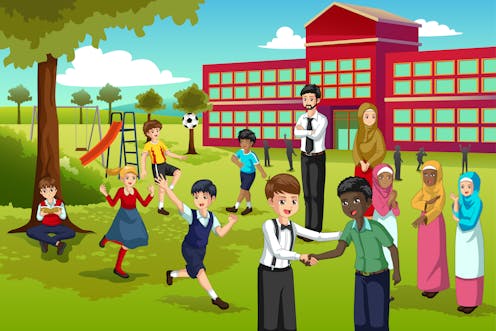
Around 80% of secondary school students who had classes about diverse religions claim to have positive views of Muslims. This compares to around 70% who had not attended such classes.
Our national study of Australian Generation Z teens (those born around the mid-1990s to mid-2000s) showed teens who had been exposed to education about diverse religions and worldviews were more tolerant of religious minorities, including Muslims and Hindus, than those who hadn’t.
General religious education is distinct from religious instruction, which is taught by teachers or volunteers from religious communities. Religious instruction focuses on faith formation in a particular religion.
Teachers provide classes in diverse worldviews and religions, which include learning about major faith traditions and other worldviews, such as humanism and rationalism.
Such classes are often a distinct subject in Catholic and other religious schools in Australia. But government schools don’t typically provide opportunities to study diverse worldviews. They may provide limited content in some humanities subjects, such as history.
Teaching children about the diversity of cultures and viewpoints in their social environment may help counteract the religious prejudice seen in the media.
Religious and worldview education
Religion in schools, and particularly whether it should be taught in a secular context, is a controversial topic in Australia and internationally. Debates persist about how content on religion should be included in curricula and whether education about diverse worldviews can play a role in social cohesion and preventing violent extremism.
Read more: Religion should be taught secularly in our schools
In the mid-2000s Australia’s public secular schools had few opportunities to provide teaching about diverse worldviews and general religious education. Victoria prohibited teaching about religion until 2006 but allowed volunteers to deliver special religious instruction in school hours until 2015.
Schools in New South Wales, Western Australia, Northern Territory and Tasmania still offer special religious instruction. NSW students can elect to do a secular ethics option instead of a religious one.
The national Australian Curriculum began to be developed in the 2000s. It now contains some limited content on diverse religions and worldviews.
Victoria’s 2015 iteration of the new curriculum included – for the first time – two dedicated sections on learning about worldviews and religions in humanities and ethical capability. The emphasis is on Australia’s major faith traditions: Buddhism, Christianity, Hinduism, Islam, Sikhism, Judaism and secular humanism and rationalism.
The Generation Z study
The Generation Z study ran between 2016 and 2018. To inform education policy, it aimed to investigate how teens make sense of the world and religious issues. The study explored teens’ views on religious, spiritual, non-religious, cultural and sexual diversity in 21st-century Australia.
The study comprised 11 focus groups in three states with almost 100 students in Years 9 and 10 (ages 15-16). It also included a nationally representative phone survey of 1,200 people aged 13-18, and 30 in-depth follow-up interviews with survey participants.
We have already published the findings that Australian teens fall into six spiritually types, including a range of non-religious, spiritual and religious young Australians.
Read more: New research shows Australian teens have complex views on religion and spirituality
Our findings also showed Gen Z teens are open to and accepting of religious diversity. More than 90% agreed having many different faiths in Australia makes it a better place to live.
But views toward religious minorities were mixed. We found 74% hold positive attitudes towards Islam, Buddhism and Hinduism; 21% hold moderate to neutral views; and 5% hold negative views.
Around 85% of teens think people of different faiths experience discrimination or abuse because of their religion. In focus groups, some students of minority faiths raised concerns about anti-Semitism and a relative lack of understanding of Hinduism and Buddhism, compared to the Abrahamic faiths in Australian society.
Our pre-survey focus groups also revealed Australian teens have moderate levels of religious literacy. While their knowledge is quite broad, it is relatively shallow. Many students could easily recognise a number of Christian, Muslim, Buddhist and Yoga images, including of the Dalai Lama. But only one student from a state selective school knew what his actual title meant and why he was so significant to Tibetans.
In our survey, 56% of students attending government secondary schools and 42% of those attending independent private secondary schools said they hadn’t had any diverse religion education or instruction in religious traditions. By comparison, 81% of students in Catholic secondary schools had received both.
Our data suggest education about diverse religions is associated with reduced negative perceptions of religious minorities. Students who had received this type of education had the most positive views towards Australia’s religious minorities. Students who hadn’t were about twice as likely to hold negative or neutral views.
Read more: Religious classes in schools must adapt to fit a changing Australia
This still holds when controlling for factors such as age, gender, school type, socio-economic status and religious identity.
Gen Z teens who have had education about diverse religions overwhelmingly thought it helped them understand other people’s religions (93%), that it helped make them more tolerant of other people’s religions (86%), and that it was important to study these (82%).
Of those who hadn’t participated in such programs, 69% wanted to learn more about the world’s religions, and 67% wanted more lessons on non-religious worldviews.
We recommend the Australian Curriculum includes more education about diverse religious and non-religious worldviews in state, religious and independent schools. This would increase religious literacy and promote inter-religious understanding and respect among Australia’s diverse religious and non-religious population.
Authors: Anna Halafoff, Senior Lecturer in Sociology, Deakin University