

official report warns our chance to save the Great Barrier Reef is fast closing
- Written by: Ove Hoegh-Guldberg, Professor, School of the Environment, The University of Queensland
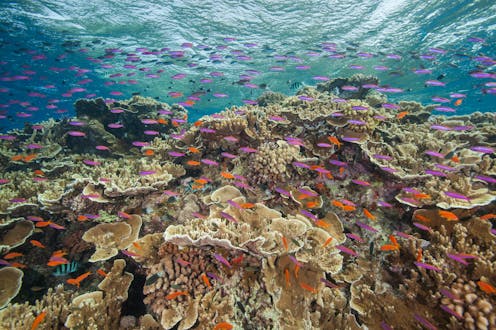
The Great Barrier Reef will continue to deteriorate, largely to climate change, and the window to secure its future is rapidly closing. That is the sobering conclusion of a major new report into the state of the reef.
The report was released by the Great Barrier Reef Marine Park Authority. It confirms what scientists have long known: humanity is killing the Great Barrier Reef, and other reefs around the world, by failing to curb the greenhouse gas emissions that cause global warming.
Earlier this year, I visited parts of the southern Great Barrier Reef where mass coral bleaching and death had just occurred. The picture was devastating. Vast swathes of coral were bleached a ghostly white. It was interspersed with bright flashes of pink and blue: a final, heartbreaking release of coral pigment as the organism makes a last-ditch effort to survive. I’ve since learned much of that coral is now dead.
Anyone who knows anything about coral reefs would have been upset by what I saw. The world’s largest reef was in very, very bad shape. As I swam, in the back of my head was the knowledge that 2023 was Earth’s hottest year on record. In fact, the Great Barrier Reef is the warmest it has been for at least 400 years.
Unless humanity takes dramatic action to halt climate change, we will lose the beautiful, complex reefs that have existed on Earth for millennia. As this latest report shows, even governments and officials now acknowledge this fact.
Make no mistake: the reef is in dire straits
The 2024 Great Barrier Reef Outlook report, released late on Friday, is the fourth in a series of five-yearly reports on the reef’s health.
It found warming oceans and severe tropical cyclones are compounding other threats such as crown-of-thorns starfish outbreaks, poor water quality and unsustainable fishing.
The report said the condition of some coral species has improved over the past five years – from “very poor” to “poor”. We shouldn’t get too excited about this. It means a few fast-growing coral species are bouncing back.
Make no mistake: the reef’s overall prospects remain dire. As the report states:
While recent recovery in some ecosystem values demonstrates that the reef is still resilient, its capacity to tolerate and recover is jeopardised by a rapidly changing climate.
It’s also important to note that the report covers the five years to December 2023. It does not capture the damage caused by the mega-bleaching event up and down the reef last summer.
As my colleagues and I wrote recently, the Great Barrier Reef has suffered five mass bleaching events in the past nine summers.
Bleaching occurs when corals become so heat-stressed they eject the tiny algae living inside their tissues. These organisms give coral some of its colour and help power its metabolism. In mild bleaching events, corals can recover. But in the severe events that are becoming more common, corals do not survive.
Analysis by others shows the mortality in stark detail. The left-hand image below shows coral at Lizard Island “fluorescing” or releasing bright pigment in March this year. This protective measure aims to limit the damage to remaining microalgae.
The image on the right, three months later, shows more than 97% of the same corals had died.
Climate change is not the only threat
The report said climate-driven disturbances are compounding the effects of other chronic damage to the reef from:
- unsustainable fishing
- pollution
- sediment runoff
- outbreaks of crown-of-thorns starfish.
Among other key findings of the report were that:
- most populations of marine turtles have declined
- species such as seabirds, sharks, rays, dugongs and seagrasses have recovered in some areas and plateaued or declined in others
- populations of estuarine crocodiles are recovering
- many species in declines are listed as threatened or protected.
Strong leadership is needed
I first visited the Great Barrier Reef in 1980, as a university student. My interest in it has never waned. It’s one of those incredible bits of nature that defies description.
The reef’s World Heritage listing is proof of its outstanding global value. Australians love and feel pride in this vast and stunning place. The reef supports the livelihoods and wellbeing of many, including Traditional Owners who have cared for it over thousands of generations. It sustains all of us: economically, culturally and spiritually.
You might see a photo of healthy-looking coral and think the reef must be doing well. But I have seen the problem first-hand over many years. The reef is suffering badly – and every fraction of a degree of global warming compounds the harm.
Humanity must take urgent action to limit global temperature rise. But we are failing. We are failing the Great Barrier Reef and indeed, coral reefs across the planet.
There was a time when governments and reef managers were not willing to admit the extent of the problem. I don’t think that’s the case anymore. As the report states:
2024 opens a new chapter for the reef. Future warming already locked into the climate system means that further degradation is inevitable. This is the sobering calculus of climate change.
Climate change is a global problem, but Australia is undeniably part of it. This nation cannot export fossil fuels to be burnt overseas if we want to save the Great Barrier Reef. Dealing with this will take strong political leadership, from the prime minister down.
Humanity has all the facts in front of us. Earth is in an unchartered time of very rapid change. If we don’t respond, we will lose the Great Barrier Reef.
Authors: Ove Hoegh-Guldberg, Professor, School of the Environment, The University of Queensland


















