

how much can fare cuts boost public transport use?
- Written by: David Levinson, Professor of Transport, University of Sydney
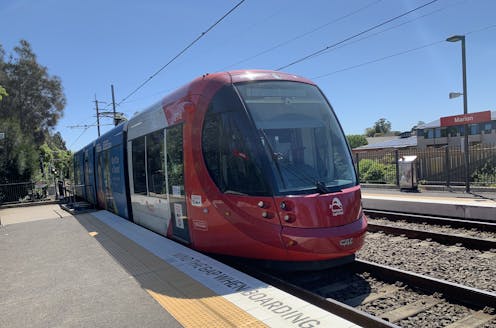
Public transport ridership has taken a beating in many Australian cities since the onset of COVID. With more people still working from home – typically office workers who had been concentrated in central business districts – passenger numbers remain well below pre-COVID levels on routes serving those CBDs.

In any market, when supply is largely fixed and demand drops, a natural response is to lower prices. Queensland has cut public transport fares to only 50 cents for a six-month trial. Canberra is about to offer free fares for the next couple of months.
When cities elsewhere have cut fares, passenger numbers have increased. It happened in Perth when public transport was free for a month last summer. Melbourne has a free tram zone in the CBD. But it’s not a simple equation. There are many factors at work.
Will lower fares lead to a lasting uplift in passenger numbers? Will the results differ between free and almost-free travel?
The Queensland and ACT fare cuts are fascinating experiments that could well change how public transport fares are set in Australia.
What impacts do fares have?
First, fares help cover the costs of the service and perhaps even generate profit. However, the “farebox recovery ratio” – the share of operating costs paid by fares – is low (under 30%) in most Australian cities. This means fares contribute nothing directly towards building rail lines or repaying funders, much less earning a profit.
Second, fares may be set to ration use by time of day. So lower off-peak fares give people an incentive to travel at less busy times.
Third, fares deter people who might otherwise use stations or vehicles as a temporary shelter or refuge.
These many competing purposes can result in confusing or even self-defeating fare structures.
Sydney, for example, uses concession rates for certain users, peak pricing for certain times of day and weekly caps on how much the heaviest users have to pay. For some distances, buses and light rail are more expensive than trains. For others they are not.
In such cases, fares can be too low to contribute much to running the system but too high to attract enough riders to match system capacity.
How sensitive are people to fare changes?
For small changes, the rule of thumb from empirical studies has been that a 10% increase in fares loses about 3-4% of riders, but there is wide variance.
Studies in the United States have found demand in large metro areas was less sensitive to fares than small areas in the long run.
But with big fare changes, we cannot be as sure. We cannot confidently predict a 50% cut in fares will result in a 15% increase in passengers, or that free travel will lead to a 30% or 40% increase. That is, however, what New South Wales’ Independent Pricing and Regulatory Tribunal (IPART) found in 2020 when studying free fares in Sydney, which it did not recommend.
It’s not a simple matter of price
Responses to fare changes depend on context. We see sensitivity to long-term changes in fares for passengers who change from a discounted concession card, such as tertiary students, to a full-rate adult card, leading to a reduction in their use.
However, other factors confound changes in demand due to price. A person’s new workplace might be harder to get to using public transport than driving. They might have less flexibility to travel at off-peak times. Or having bought their own car might affect their travel choices, as might petrol prices and other costs of living.
For a short-term, well-publicised cut in fares, people may take advantage of it to make trips they otherwise would not have taken, or would have done by car, on foot or on bike. In contrast, people are not going to give up their car if they expect fares will soon return to previous levels.
One thing a short-run change can do is give people who have never ridden the bus or train (or haven’t in many years) a taste. If they like it, it could lead to a permanent uplift in their use.
What does overseas experience tell us?
Several places overseas have experimented with fare structure.
In the northern summer of 2022, Germany introduced a discounted €9 (about A$15) per month ticket. There was an 8% increase in travel – only a 3% increase was attributable to gaining a taste for public transport. A minority of trips replaced those that would otherwise have been made by car. Regular public transport use rose from 29% of travellers to 38% once the €9 ticket came in, then settled at 32% afterwards.
Tallinn in Estonia was one of the first capital cities to offer fare-free public transport. After some years, there was a clear increase in ridership from 55% to 63%. Three points came from a shift from private cars and the other five from walking.
So how do we assess the Australian experiments?
The decision to make the Queensland system nearly free – charging 50 cents instead of nothing – has been justified as a way to gather information about public transport use through the tap-on and tap-off process. While this is a real benefit, it might mean the benefits of a fare-free system aren’t fully unleashed.
First, in-vehicle tapping on and off can increase the time users take to board and alight, causing delays and effectively reducing the speed of the service. This adds to running costs as more vehicles are needed to provide the same frequency of services. More importantly, it makes public transport less competitive with private cars.
Second, it’s costly to collect fares. The cost might be greater than the revenue from the 50-cent fare. On the other hand, a small price might help deter people from using the system as shelter and short-distance walkers who might switch to a free service.
We won’t know what would happen in Queensland if public transport were fully free, though Canberra will provide a useful counterpoint. The results of these trials may soon reshape public transport fare-setting in Australia.
Authors: David Levinson, Professor of Transport, University of Sydney


















