

Local Māori urge government to address long-running dispute over rare cultural heritage landscape
- Written by: Tim McCreanor, Professor Race Relations, Health and Wellbeing, Massey University
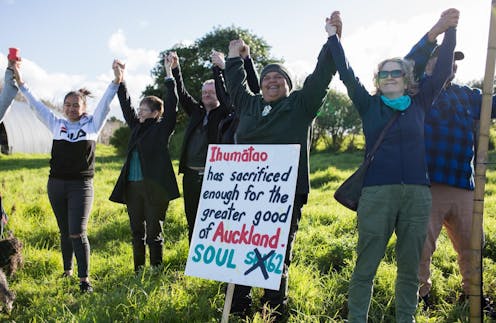
An escalating crisis at Ihumaatao, near Auckland’s airport, is challenging the commercial development of Māori land that is part of a rare cultural heritage landscape.
Transnational corporation Fletcher Building Limited has the legal consent to build 480 dwellings on 32 hectares of land confiscated from local iwi (Māori tribe) in 1863. Mana whenua (local Māori) were shut out of the consenting processes for the development and left without any viable legal remedy.
Last week supporters of the mana whenua-led, community-supported campaign Save Our Unique Landscape (SOUL) presented a near 18,000-strong petition to the New Zealand government, urging it to intervene to protect the land for future generations. SOUL wants the government to either buy the land or mandate a process that can produce an outcome all parties can live with.
Read more: Indigenous peoples are crucial for conservation – a quarter of all land is in their hands
Nation’s history at Ihumaatao
The unfolding events are a reminder that, for indigenous peoples, colonisation is unending. Mana whenua were expelled by force at the start of the colonial invasion of the Waikato in 1863, making them landless and impoverished. In the intervening decades, their sacred mountains were quarried for roading, and their food-gathering places and fishing grounds plundered. Now commercial development of their confiscated lands and resources threatens their survival and status.
Ihumaatao is among the oldest continuously occupied areas in Aotearoa New Zealand. Polynesian voyagers arrived on this peninsula in the eastern Manukau Harbour about 800 years ago at the beginning of human settlement of Aotearoa. They cleared land, raised families and prospered. For centuries, Māori lived in this special place; gardening, hunting, gathering seasonal foods from nearby forests and harvesting kaimoana (seafood) from the estuaries.
The oldest investigated middens have been carbon dated to the 12th century. Archaeologist Dave Veart says the currently contested block is an inseparable part of “our Stonehenge”, the adjacent Otuataua Stonefields Historic Reserve. Rich in ancient sites of significance, the reserve already has heritage protection because of its value for the study of the origins of human settlement of Aotearoa.
New Zealand is the last major landmass to be settled, and this area is recognised internationally for its cultural heritage and status as the final step in the global human diaspora.
Confiscation history
When settlers arrived in the fledgling town of Auckland in the 1840s, mana whenua began commercial production of livestock, potatoes, wheat and maize to meet the burgeoning market. But the settler demand for control and ownership of land and resources quickly escalated into tensions and conflict with Māori, as the newcomers sought to impose their vision of what Pākehā (non-Māori) historian James Belich has called a “better Britain” in the south seas.
In 1852, despite the promises of the Treaty of Waitangi, Britain passed the New Zealand Constitution Act, handing “responsible settler government” to the colonial enterprise. Settler control fomented agitation over land, war in Taranaki in 1860, and three years later, the invasion of the Waikato.
Read more: Explainer: the significance of the Treaty of Waitangi
Pākehā historian Vincent O’Malley suggests these wars created a watershed of aggression that radically disrupted the peaceful Māori communities to the south of Auckland. On July 9, 1863, Governor George Grey issued a proclamation requiring Manukau Māori to swear allegiance to the Crown or retire south of the Waikato boundary.
The freshly-minted New Zealand Settlements Act 1863 was used as a colonial mechanism to confiscate their lands and other possessions. Through the so-called “compensation court” provisions of the act, the land was claimed for the Crown and granted to settlers.
At Ihumaatao, where 1100 acres were confiscated, Gavin Struthers Wallace from County Argyle in Scotland, obtained 81 acres of prime Māori horticultural land, complete with a permanent spring and Māori stonewall garden infrastructure in 1867. Knowingly or otherwise he acquired confiscated land without the agreement of mana whenua; they have never received an acknowledgement, an apology or redress.
Colonial settlement and unending injustice
The deposed owners of the now disputed land at Ihumaatao returned from the Waikato from 1864 to eke out a subsistence existence as labourers on their former estates. Meanwhile, settlers and the colonial state prospered. For a time, the sea and home gardens on a tiny reservation provided meagre sustenance, but soon urban sprawl encroached. As Auckland boomed after the second world war, their ancestral cone Maungataketake was levelled to make runways for Auckland’s airport and the city’s sewage treatment plant was established on their territory near Puketutu Island, polluting their fishing grounds and creating other nuisances.
Despite ongoing resistance and inquiries dating from 1865, the Crown has never addressed the injustices endured by mana whenua. Instead, the Crown hides behind a “one-size-fits-all” Treaty of Waitangi policy under which privately owned land will not be considered for settlements.
Read more: Explainer: the significance of the Treaty of Waitangi
This bare sketch cannot convey the anguish, loss and trauma endured over generations. The 1985 Waitangi Tribunal investigation of the Manukau Harbour claim summed up the situation:
At Ihumatao … the inhabitants [were] attacked, their homes and property destroyed and their cattle and horses stolen, but then they were punished by confiscation of their lands, for a rebellion that never took place.
The Fletcher plan - injustice redoubled
In 2014, Wallace’s descendants, the Blackwells, working with Fletcher and Auckland Council, used the fast-tracked, developer friendly Special Housing Areas Act to designate the land as a special housing area. The act bypassed long-established planning protections and consenting processes, curtailing requirements for consultation with Māori.
In the face of Auckland’s housing crisis, 10,000 affordable new dwellings are planned for nearby Mangere. This makes Fletcher’s low-density, high-cost proposal seem even more of an anachronistic injustice than it was when first mooted.
As pre-development work on the land is due to begin, mana whenua and the broader community are mobilising to face down the bulldozers.
Authors: Tim McCreanor, Professor Race Relations, Health and Wellbeing, Massey University


















