

Women play a crucial role in agriculture – so why are they often locked out of owning land?
- Written by: Lucie Newsome, Lecturer, Business School, University of New England
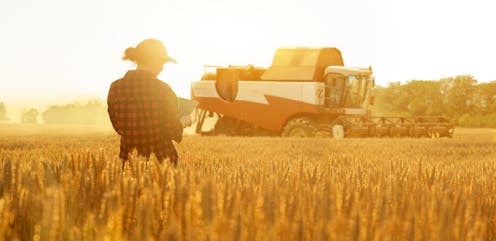
When we think of a farmer, we still often imagine a man. But in reality, women contribute 49% to real farm income.
This isn’t just by increasingly working as farmers themselves. Keeping a farm business going usually relies on women’s off-farm work as well, particularly in times of drought.
Despite this, women often do not have ownership of farmland. And when it comes to who gets the family farm in succession planning, daughters, mothers and daughters-in-law are all likely to miss out.
There are established legal protections that women can draw on to challenge this. But our recent research finds these are often seen as a threat to the continuity of the family farm, and attempts are made to deliberately lock women out.
Australian agriculture only suffers as a result. To fix the problem, some stubborn attitudes will need to change.
Passing down the family farm through the generations
The process of deciding who will take over the family farm is known as farm transition and succession. Passing down land through the generations is of upmost importance for farming families.
Farmers see themselves as custodians of land, building on the work of previous generations for the benefit of their descendants. Farm land ownership is tied to identity, social standing, culture and community.
Passing on a viable farm business often relies on keeping it intact, rather than dividing it among siblings. But agricultural land prices have skyrocketed, meaning that for many families, succession planning can be a multimillion-dollar issue.
Beyond the obvious emotional charge, this also makes it extremely difficult for a sibling who wants to take over the farm to buy out the others. It also can mean siblings who do not take over the farm are giving up more and more money.
As you’d expect, this has made farm succession planning big business. Lawyers, accountants and business advisors are all used to help farming families negotiate a way forward.
So, who gets the farm?
Sons, mostly. The most recent data suggests that daughters only take over the family farm in 10% of cases. But as this data is now quite old, a large upcoming survey will assess whether this remains the case.
The default position for most Australian farming families is that a farmer equals a man – their sons are seen as best placed to take over the farm. They are often socialised into this role from birth.
But this view is severely outdated. As farming becomes more professionalised, entrepreneurial and technology-driven, the myth that it requires brute physical male strength is losing power.
Fortunately, gender norms in agriculture are slowly shifting. While there is still a long way to go, daughters are increasingly considered as farmers and are less likely to be overlooked in the distribution of family assets.
The ‘dreaded’ farm daughter-in-law
Few are so mistrusted in the politics of farm succession as the daughter-in-law. Despite this, their on- and off-farm work and their roles as caregivers and community members are crucial to the reproduction of farming families, the family farm and rural communities.
Women have become less accepting of being locked out of land ownership as education levels, family law and gender norms have changed.
But for the landholding generation, they are still often seen as a threat to the continuity of the family farm.
A daughter-in-law’s attempts to start succession planning processes, to raise questions about the underpayment of her partner or herself, or attempts to seek a career outside of rural areas can all also be seen as challenges to the traditional farm family.
This is despite the fact she is often just attempting to secure a degree of certainty for her immediate family.
Deliberately locked out
For some time, Australian family law has extended to de facto partners as well as married partners.
In the case of a divorce or intimate partnership breakdown, the court has the power to decide on how property assets – such as farms – will be distributed between the partners.
In doing so, it aims to achieve an equitable distribution, rather than seeing assets as owned in a 50/50 split. It may take into account the needs of each partner and their financial and non-financial contributions, such as child care.
Despite this, our research found the landholding generation are using the farm succession processes to protect the continuity of the farm from a claim by the daughter-in-law.
This includes delaying transfer of the farm to their adult children, so that the daughter-in-law cannot make a claim on it in the case of divorce. Family business structures that quarantine the farm asset, such as binding financial agreements, are also being used.
But collectively marginalising the farm daughter-in-law and excluding daughters from succession is only hurting the industry. In their attempts to preserve the status quo of gender relations, many family farms are failing to prepare for a changing business and social environment.
Women have been graduating from agricultural degrees in equal numbers as men for more than two decades. Females farmers have been found to have high levels of entrepreneurship, innovation and strong sustainability values.
How can farming families do better succession planning?
Australia’s food security and agricultural industry depend on succession being done well. It needs to be a continuous conversation with the whole family, aided by professionals with a range of skills.
That means women can no longer be deliberately excluded. As one professional in our study commented:
A lot of these girls have sacrificed a lot and … [they] are whip-smart and actually could contribute enormously to these businesses being more successful if [the older generation would] just put fear aside, be clear about what they’re frightened of, deal with it, and move on.
If the industry wants to thrive in the 21st century, attitudes will have to change.
Authors: Lucie Newsome, Lecturer, Business School, University of New England


















