

NZ mistletoes are parasites but not villains – they’re vital for birds and insects during winter
- Written by: Janice Lord, Associate Professor in Botany, University of Otago
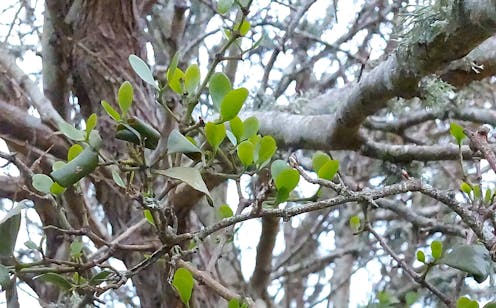
Mistletoes are the stuff of myth and legend, vilified for providing the arrow that shot Norse god Balder, but venerated in Celtic and Roman mythology as protection against dark forces.
It is no wonder – mistletoes are unlike any other plant. All species in the mistletoe family, Loranthaceae, are parasites.
The bird-dispersed seeds stick to branches with a special glue and tap into the host tree’s water-conducting vessels (xylem) to access nutrients from the sap.
Mistletoes are called hemi-parasites because they still photosynthesise to produce their own carbohydrates. Most are evergreen, remaining leafy in winter even when their deciduous host trees lose their leaves. This feat is possible because they can continue to draw sap by capillary action, even when the host tree is dormant.
Mistletoes are keystone species
This ability to remain leafy year round is one reason mistletoes are increasingly called keystone species – they play a key role in maintaining ecosystem function, just as a keystone at the top of a masonry arch holds the whole structure in place.
Mistletoe fruits, as well as the flowers of many species, feed birds. The shelter they provide could moderate the impacts of climate change on bird populations.
Our new study shows mistletoes also provide a critically important winter refuge for foliage-dwelling arthropods, especially when they grow in non-native deciduous trees which now dominate many landscapes in New Zealand.
Arthropods – which include insects, arachnids, crustaceans and myriapods – account for most species on the planet. They are not only an important food source for other animals but are crucial to maintaining ecosystems globally, with ecological contributions from pollination to the breakdown of organic matter.
Winter refuge
All of New Zealand’s six species of leafy mistletoes are native. In te reo Māori, they are known as pirita, pikirangi or roeroe. One is extinct and four are considered at risk, mainly due to habitat loss and damage from possums.
All New Zealand mistletoes are evergreen, as are almost all native trees. But deforestation and the widespread planting of non-native deciduous trees in urban and agricultural areas has drastically altered the types of host trees available for native mistletoes and native arthropods.
The green mistletoe Ileostylus micranthus is the most common throughout New Zealand because it is able to parasitise a wide range of hosts, including non-native deciduous trees.
Our study examined the arthropod communities on green mistletoes parasitising evergreen and deciduous host trees. The idea was specifically to see whether the host type (evergreen vs deciduous) and season (summer vs winter) affect the proportion of arthropods found on mistletoes themselves, compared with their host trees.
We found mistletoes harbour significantly more native arthropods overall than the host trees they parasitise. But most importantly, they shelter significantly more arthropods in winter when growing on deciduous hosts, suggesting they are acting as habitat refuges during the colder months.
The benefits of leafy mistletoes in winter may be that they shelter arthropods from weather extremes and hungry birds. They may also provide a more humid microclimate due to the “wasteful” water usage mistletoes engage in to draw sap from the host.
Humidity is important to small arthropods. They are vulnerable to desiccation as they have a much higher surface-to-volume ratio than vertebrates and many have external respiratory systems. Relocating to a humid refuge is a common way for arthropods to avoid desiccation.
Cherish, don’t chop!
One of the issues we faced was that several mistletoes we sampled in summer were deliberately cut off between seasons and could not be resampled in winter. Even mistletoes on native trees were removed from council-managed areas during our research despite our permission to study them.
Other research on the endangered white mistletoe, Tupeia antarctica, was also disrupted. A tree branch that had been banded, with council permission, to stop possums destroying one of the rare mistletoes, was completely removed by council contractors. This was all the more distressing as the at-risk endemic moth Zelleria sphenota was plentiful on that particular mistletoe.
It’s a myth that mistletoes kill trees. The effect on a healthy tree in a healthy forest ecosystem is negligible (although they can have an impact if the tree is isolated or stressed). Isolated trees can become burdened with a large number of mistletoes because there are few other trees around for birds to perch on.
But the removal of mistletoes can reduce bird species richness by more than 30%. Instead of blaming and removing the mistletoe we could do better by planting more trees.
Perhaps it is also time we moved away from a gardening attitude of absolute control when it comes to mistletoes. We could look to the example of Tāne Mahuta, Māori atua of the forests. When Tāne made the forests he made the mistletoe last. He saw his youngest child was small and weak, so he lifted the mistletoe from the forest floor and placed it in the arms of its larger siblings.
Authors: Janice Lord, Associate Professor in Botany, University of Otago


















