

PNG has had a horror year of conflict – but peace rarely comes through the barrel of a gun
- Written by: Miranda Forsyth, Professor in the School of Regulation and Global Governance, Australian National University
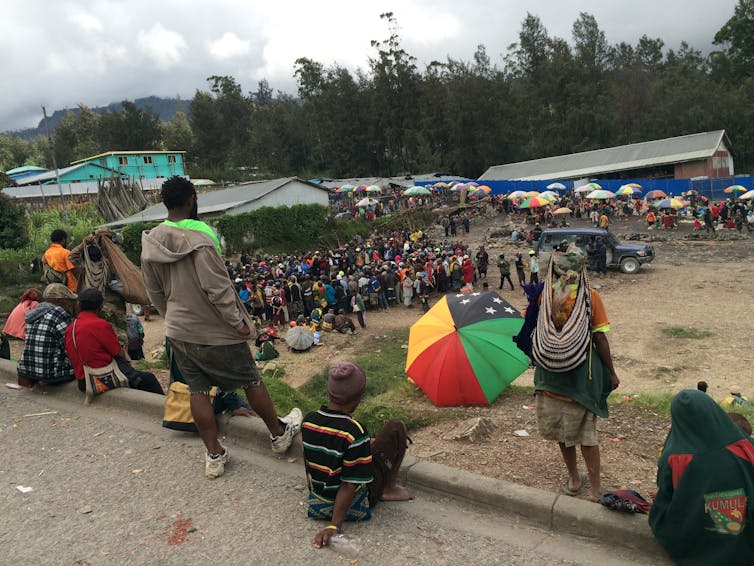
Papua New Guinea has had a difficult year, beginning with serious rioting and looting in the capital, Port Moresby, and several other towns.
After a payroll glitch led to a stop-work action by police, the so-called Black Wednesday riots on January 10 resulted in burned-out stores and at least 20 deaths.
In February, an inter-group conflict in the troubled Highlands province of Enga led to around 70 killings.
And late last month, a marauding gang of young men calling themselves “I don’t care” terrorised rural villagers in East Sepik province. According to reports, at least 26 were killed, unconfirmed numbers of women and girls were raped and several homes were torched.
It’s time for a fresh look at how and why these issues are boiling over, and why a different approach is needed.
A spotlight on policing
While sparse data makes accurate measurement difficult, most would agree violence and lawlessness are increasing in many parts of PNG.
The broader context for this violence includes:
- rural decay
- lack of economic opportunities
- exploitative resource extraction
- a debilitating cost of living crisis, and
- frustrations with a political system that has failed to deliver services or development to a youthful and rapidly growing population.
Yet despite the multiple factors contributing to PNG’s “law and order” problems, it is common to focus on just one: the shortcomings of the country’s law enforcement agencies.
As a result, the solution is often simplistic: more robust policing.
Typically, this involves the deployment of heavily armed mobile squads, often long after events on the ground have got out of control.
This is usually followed by the abrupt withdrawal of these squads when the fighting ends.
This year, again, national leaders were calling for reactive and militarised policing, including the use of lethal force. In February, police were warning, “We will shoot to kill anyone brandishing a weapon.”
There is a superficial appeal to the logic of violent policing responses. After all, rather than bows and arrows, today’s warriors are armed with high-powered firearms.
As seen in conflicts around the world, the temptation to respond to violence with more violence is incredibly strong. Yet we also have decades of experience indicating such approaches in PNG simply do not bring about positive change.
Worse, such responses often exacerbate trauma and undermine ongoing local peace-building efforts.
A different approach
Perhaps we should instead turn for inspiration to Bougainville. This autonomous region of PNG, wracked by conflict in the 1980s and 90s, has since become a poster-child for post-conflict peacebuilding.
Bougainville’s peace process was driven by local actors – traditional leaders, women’s organisations, church groups and others – who creatively adapted older forms of peacemaking and reconciliation to new circumstances.
This approach is working in numerous micro-experiments around the country, including informal regulation in urban settlements.
For example, Gerehu, a sprawling suburb of Port Moresby, was once characterised by carjackings, burglaries, drugs and violence. It has turned into a relative oasis in recent years. This is due to work by motivated individuals driving local transformation, linking together scattered state resources and civil society energy.
It’s time for PNG as a whole to adopt such an approach, with policing seen as part of a shared governance agenda that involves civil society as active partners.

Changing the framing of violence
An important first step is to change the way violence is framed in PNG.
Portraying it as the preserve of unruly tribes, lawless individuals or criminal gangs disconnected from society and state is inaccurate and unhelpful.
It suggests these groups are “out there” needing to be “civilised” by the state.
However, some reports suggest PNG’s political and business elites may be implicated in resourcing such violence.
They may perceive electoral advantage from violence and insecurity, or economic gain such as land-grabbing.
State failures are also a major contributor to violence. The erosion of services such as health, education and justice have accentuated societal frustration across the board, not least among disenfranchised youth who are often blamed for violence and disorder.
This frustration has been fuelled by the sheer lack of economic opportunities for the growing youth population.
It has also been reported that protagonists of contemporary criminality in PNG come from outside its borders, with growing issues of drug and arms trafficking.
The problem of violence needs to be seen as one driven by both state and society. The responsibility for finding a peaceful way forward must also be shared.
This requires genuine work with local leaders, including women leaders, to address existing and new security threats.
There is hope investment in such long-term partnerships will be supported by at least some of PNG’s most senior leaders. Encouragingly, the PNG police commissioner, David Manning, said in January this year that “police needed to start empowering community-based leaders.”
Another high priority is bringing courts and other justice services into areas where they often have a limited and fleeting presence. Local leaders often need state back-up to resolve small disputes before they escalate into warfare.
If violent forms of self-help are to be avoided, people need to see perpetrators of violent crime face the consequences. This includes the entrepreneurs and beneficiaries of conflict, and not just the fighters on the ground.
Bringing peace to PNG requires so much more than simply demanding it through the barrel of a gun.
Authors: Miranda Forsyth, Professor in the School of Regulation and Global Governance, Australian National University


















