

your neighbour’s choice to go solar might have influenced you more than you think
- Written by: Kaveh Khalilpour, Associate Professor in Engineering and IT, University of Technology Sydney
What made you decide to go solar? Was it a sober assessment of the return on investment? Did you want to cut your power bills? Did you want to do your bit on climate change?
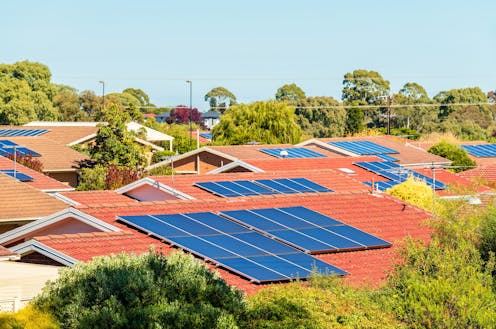
While these reasons are common, another factor might be in play: your neighbours. The more solar panels you see around your neighbourhood, the more likely you are to have them installed yourself. It’s a form of social license – seeing solar near you legitimises the idea. As more people in the same area install solar, it creates a ripple effect.
There is ample research showing humans are social animals and do care about what their peers are doing. In our new research, we explored this neighbourhood effect in the context of solar panel installations – and found we can quantify it. The effect leads to an extra 15-20 solar installations per postcode per year, on average. Scaled up, that means about 18% of new solar installs come from the neighbourhood effect.
Now that we know this, authorities can use this technique to accelerate Australia’s world-leading uptake of rooftop solar even further.
How do my neighbours affect what I do?
Two decades ago, solar panels were a rare sight on Australian rooftops. Now, around a third of all households have them. Solar now has 36.5 gigawatts of capacity across Australia. Residential solar contributes substantially to this. More than half of our solar output is residential (52%), followed by 35% from solar farms and 12% from commercial buildings, according to data from the Australian PV Institute.
Australia’s solar journey began in the early 2000s, when government subsidies and rebates were first offered. This made solar panels more appealing to homeowners. Over time, solar prices dropped rapidly, encouraging more households to take it up.
That’s the big picture. But at a local scale, how did this happen?
We might like to think we make decisions logically and in isolation. But we are more affected by other factors than we might think.
In our research, we set out to find what factors nudged people to take up solar over time. We took an enormous data set – rooftop solar installations between 2001 and 2022 across Australia’s 2,641 postal areas (the geographic area roughly corresponding to postcodes) and looked for trends within and across postal areas.

Was it wealth – did high income households and suburbs put solar on faster? What about education levels or home ownership versus renters?
We found income and education mattered. But it mattered less than we had expected. Gender and land size played no significant role. Older households and married households were more likely to install solar. And we found areas with higher unemployment actually installed solar faster, perhaps as a way to reduce energy bills. Factors such as these influenced about 80% of individual decisions to go solar, we found.
What about the remaining 20%? Here, what mattered was the presence of other solar panels. That is, once a few houses in a neighbourhood had solar, solar got installed faster – translating on average to 15-20 extra solar installations per postal area per year.
That’s substantial. In 2018, for example, we estimate the neighbourhood effect contributed an estimated 18% of that year’s total number of installations (224,850 installations). Each postal area added an average of 85 new solar installations in 2018.
Why would this be? Let’s say an early adopter decided to go solar back when the technology was substantially more expensive. Once they had solar installed, people in their neighbourhood passing by could see the array on their roof. Solar became tangible and visible.
Over time, the simple presence of solar nudged a few neighbours to consider whether solar would stack up for them. Some chose to go solar too, and the effect continues.
Neighbourhood effects are not new. But they’re of increasing interest as Australia works towards net zero. Neighbourhood effects are being seen in the uptake of electric vehicles – if you see them round your neighbourhood, you’re more likely to buy one.
 Neighbourhood effects are also at work in the uptake of electric vehicles. The more you see them round your neighbourhood, the more likely you are to consider it.
mastersky/Shutterstock
Neighbourhood effects are also at work in the uptake of electric vehicles. The more you see them round your neighbourhood, the more likely you are to consider it.
mastersky/Shutterstock
What should we take from this?
The neighbourhood effect is real, and quite influential. For policymakers and industry stakeholders, the question will be how to use it. Our public tool lets policymakers and residents look at how specific areas have taken up solar and at what rate.
In Tasmania’s cooler climate, for example, solar uptake is much lower than elsewhere. To encourage more rooftop solar, authorities could support early adopters to share their experiences. Targeted campaigns in specific suburbs could help accelerate the renewable transition.
While we normally think of Australia’s embrace of solar as an economic choice, it’s more than that – it’s also about the choices of our neighbours and being able to see the technology with our own eyes.
We do care what our peers are doing. This is nothing to be ashamed of. As we work to secure a liveable climate, the neighbourhood effect can play an important role.
Marty Fuentes was the lead author of the research. He now works for Transport for NSW and contributed to this article
Authors: Kaveh Khalilpour, Associate Professor in Engineering and IT, University of Technology Sydney


















