

If Australia wants to fast-track 100% renewables, it must learn from Europe’s risky path
- Written by: Anne Kallies, Senior Lecturer in Energy Law, RMIT University
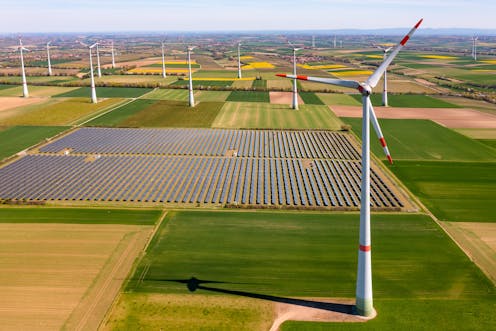
Even after decades encouraging the growth of renewables, we’re still too reliant on coal and gas power stations.
The problem isn’t in our ability to generate clean power. It’s what happens after that. Major roadblocks include the need for 10,000 kilometres of new transmission lines to connect rural renewable farms with city consumers. Another oft-cited reason is the need to store power from renewables so it can be drawn on as needed. This is why the Australian Energy Market Operator sees such a big role for large-scale storage coupled with some flexible gas as a backup.
Last year, renewable investment actually shrank in Australia. Reasons for the slowdown are wide-ranging. Some are local, such as rural communities lobbying against new transmission lines, the need for planning and environmental approvals and the slow pace of creating new regulations. Others are global, such as increased competition for engineers and electricians, clean tech and raw materials.
As climate change worsens, frustration about the slow pace of change will intensify. But when we look around the world, we see similar challenges cropping up in many countries.

European Union
Transmission line hold-ups are by no means a delay unique to Australia. Data from the International Energy Agency shows building new electricity grid assets takes ten years on average in both Europe and the United States.
In 2022, the European Union introduced laws expressly aimed at speeding up the clean energy transition by fast-tracking permits for renewables, grid investment and storage assets. These investments, the laws state, are:
presumed as being in the overriding public interest […] when balancing legal interests in the individual case.
That is, when the interests of other stakeholders – including local communities and the environment – clash with clean energy plans, clean energy has priority.
Germany has gone further still with domestic laws designed to further streamline planning and approvals and favour energy transition projects over competing interests. These changes were sweetened with financial incentives for communities participating in clean energy projects.
This is a risky path. European leaders have chosen to go faster in weaning off fossil fuels at the risk of inflaming local communities. The size of the backlash became clear in the EU’s elections in June, where populists gained seats and environmental parties lost.
United States
In 2022, the US government passed a huge piece of green legislation known as the Inflation Reduction Act. Rather than introducing further regulations, the US has gone for a green stimulus, offering A$600 billion in grants and tax credits for companies investing in green manufacturing, electric vehicles, storage and so on. To date, this approach has been very effective. But money isn’t everything – new transmission lines will be essential, which means approvals, planning, securing the land corridor and so on.
This year, the US Energy Department released new rules bundling all federal approvals into one program in a bid to accelerate the building of transmission lines across state borders.
Australia could borrow from this. The government’s Future Made in Australia policy package takes its cues from US green stimulus, but at smaller scale. What America’s example shows us is these incentives work – especially when big.
US-style streamlining and bundling of approvals could address delays from overlapping state and federal approvals. Supporting local green manufacturing can create jobs, which in turn encourages community buy-in.
China
Even as Australia’s clean energy push hit the doldrums and emission levels stagnated, China’s staggering clean energy push began bearing fruit. Emissions in the world’s largest emitter began to fall, five years ahead of the government’s own target.
They did this by covering deserts with solar panels, building enormous offshore wind farms, rolling out fast rail, building hydroelectricity, and taking up electric vehicles very rapidly. In 2012, China had 3.4 gigawatts of solar and 61 GW of wind capacity. In 2023, it had 610 GW of solar and 441 GW of wind. It’s also cornered the market in renewable technologies and moving strongly into electric vehicles.
Of course, China’s government has far fewer checks and balances and exerts tight control over communities and media. We don’t often see what costs are paid by communities.
China has also used industrial policy cleverly, with government and industries acting in partnership. In fact, the green push in the US, EU, Australia and other Western jurisdictions takes cues from China’s approach.
There’s still a long road ahead for China. But given its reliance on energy-intensive manufacturing, it’s remarkable China’s leaders have managed to halt the constant increase in emissions.
 China has rolled out renewables at a staggering rate – enough to stop emissions increasing.
Jenson/Shutterstock
China has rolled out renewables at a staggering rate – enough to stop emissions increasing.
Jenson/Shutterstock
Acceleration has a cost
These examples show how it is possible to accelerate the energy transition. But often, it comes at a cost.
Costs can be monetary, such as when governments direct funding to green stimulus over other areas. But it can also be social, if the transition comes at the cost of community support or the health of the local environment.
This comes with the territory. Big infrastructure projects benefit many but disadvantage some.
While Australian governments could place climate action above all else as the EU is doing, they would risk community and political blowback. Long-term progress means doing the work to secure local support.
For instance, Victoria’s new Transmission Investment Framework brings communities to the fore, focusing on their role and what they will stand to gain early on.
Yes, this approach may slow the rate at which wind turbines go up and solar is laid down. But it may ensure public support over the long term.
No one said the shift to green energy would be easy. Only that it is necessary, worthwhile – and possible.
Read more: We urgently need $100bn for renewable energy. But call it statecraft, not 'industry policy'
Authors: Anne Kallies, Senior Lecturer in Energy Law, RMIT University


















