

Wild weather is costing billions of dollars and putting the future of insurance in doubt
- Written by: Paula Jarzabkowski, Professor in Strategic Management, The University of Queensland
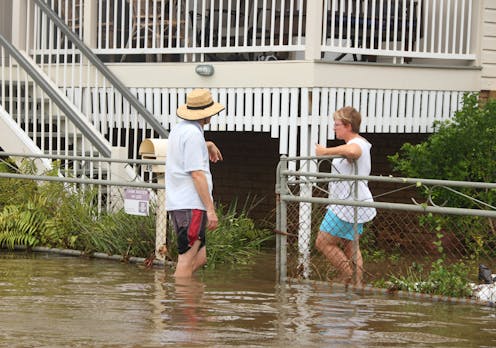
Late winter and early spring has been marked by wild weather sweeping large parts of Australia, damaging homes and businesses and causing power outages.
Such unpredictable weather is also occurring around the world and driving huge rises in premiums to the point where the future of insurance is in doubt.
In 2022, floods, hurricanes, hailstorms, winter storms and droughts amounted to more than A$149 billion in insured losses globally with losses growing five years prior.
The full impact and cost of the latest events in Australia will not be known for some time, but it can be expected to be significant.
Extreme weather
As one of the world’s most climate exposed nations, Australia is at the forefront of extreme weather effects on insurance premiums.
In the “great deluge” of 2022, flooding in Queensland and New South Wales amounted to A$5.56 billion in insured losses from 236,000 individual claims.
As extreme weather generates ever-greater losses, insurers are reluctant to provide cover in higher-risk locations. Increasingly they are not offering policies, making insurance unavailable, or raising premiums to unaffordable levels.
One insurer reported between 2020 and 2023, their average household premium rose by 56%.
And the situation is worsening.
Insurance stress
In 2022, 10% of Australian households faced extreme insurance stress, defined as paying more than four weeks’ gross household income for a policy.
By 2024, this rose to 15% of Australian households, with the most stressed households facing premiums of up to 9.6 weeks, or 18% of their gross income.

This measure of insurance stress is based on gross household income. Yet premiums are paid from net income after tax. Many households simply cannot afford insurance with the Insurance Council of Australia estimating 23% of households are uninsured.
In June 2024, the Australian Bureau of Statistics noted insurance is one of the main contributors to rising living costs across all household types.
Unsurprisingly, when needing to pay energy bills, put food on the table, and fuel in the car, many Australians have little choice but to let insurance lapse, or buy less insurance than they need to recover after a weather event.
Why we can’t rely on insurance
Even for those who are insured, widespread loss from extreme weather means they cannot necessarily rely on their insurance claims to bounce back from disaster.
Large numbers of claims can result in lengthy settlements, as insurer resources are stretched by the complexity of assessing damage, and the increased demand on trades and services, including temporary accommodation.
Excess demand following widespread loss has effects beyond emotionally charged claims processes, as insurers are using cash settlements to resolve claims quickly.
Cash settlements can be offered when the homeowner is underinsured and the policy will not cover full repairs, when there is a lack of trades and services to complete the work, or when homeowners are desperate to get some compensation to help them move on from disaster.
However, there are serious financial implications for homeowners in accepting cash. Recent research reveals cash settlements are often under-quoted and homeowners lack appropriate knowledge and experience to accurately assess the offer.
As a result, this can leave homeowners without enough money to fix their property, potentially leaving them with an unlivable home and large debt.
Economic impacts
A lack of affordable insurance also has significant negative consequences for Australia’s economy.
Home insurance is usually required to take out a mortgage. However, about 5% of Australian households with a mortgage are experiencing insurance stress.
Such insurance-stressed homeowners are in a precarious financial situation following extreme weather losses, as they have insufficient funds to repair their home and/or repay their mortgage.
 One in 25 homes is expected to be uninsurable by 2030.
Brisbane/Shutterstock
One in 25 homes is expected to be uninsurable by 2030.
Brisbane/Shutterstock
Potential homeowners are also affected, as they may be unable to get a mortgage in higher-risk locations, as banks anticipate insurance will be unavailable or unaffordable.
With as many as one in 25 homes across Australia expected to be uninsurable by 2030 and one in seven homes in the most at-risk localities, this looming mortgage crisis will have wide-reaching implications beyond home ownership.
Mortgages are critical for business lending, to support the rental market and ensure viable communities.
A bleak forecast
The compounding effects of insurance stress, extreme weather, and pressure on banks to take account of climate exposure is likely to limit lending to small business, constrain housing supply, and affect jobs, especially in higher-risk locations.
This complex situation is already evident across cyclone-exposed northern Australia, where the impact of rapidly rising premiums, or a lack of insurance availability, means small business owners, such as tourism and hospitality operators, struggle to meet licensing and regulatory requirements.
This is forcing many to reconsider their future viability.
Given Australia’s reliance on home ownership for economic security, a robust rental market to support jobs, and viable small businesses to support vibrant communities, the effects of extreme weather on insurance availability and affordability are set to affect us all.
Authors: Paula Jarzabkowski, Professor in Strategic Management, The University of Queensland


















