

how can we better protect species important to Indigenous people?
- Written by: Bradley J. Moggridge, Professor of Science, University of Technology Sydney
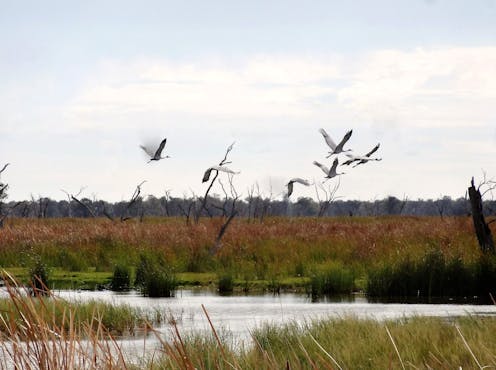
Kamilaroi Country lies in far northwest New South Wales, past Tamworth and crossing over the Queensland border. Here, the bunyip bird (Australasian bittern, Botaurus poiciloptilus), and the brolga (Grus rubicunda or burraalga in Kamilaroi) have been part of life, lore, spirit, dance and culture with Country for thousands of generations.
In this Country, these two species are now rare. Kamilaroi people want to turn this around. But to do that, we come up against a gap between Western conservation laws and culturally significant species/entities.
Under Australia’s conservation laws, a species is considered threatened when its numbers fall so low, or its distribution shrinks so much, it might not recover. But the threatened species legal protections – and any recovery funding it provides – are focused on the Western approach of countable nature, not the Indigenous focus on nature-with-culture.
We are not splitting hairs. The difference is momentous, as we document in recent research. It determines whose environmental research and management is considered legitimate and resourced, and the terms on which knowledge is shared and exchanged.
Understanding this helps find common ground between ecological and Indigenous priorities. It will also be crucial to the now-delayed major overhaul of Australia’s nature laws.

Threatened species on Country
To list a species as threatened under federal and New South Wales law, two things must be determined.
The first is how many animals or plants of a given species are still in their habitat and how consistent this is over generations.
Second is how widespread the species is compared to the past, and how much habitat is left.
This formula – abundance plus distribution – determines if the species is in decline and if it needs urgent attention.
Kamilaroi Country is home to the Gwydir wetlands, an immensely sacred place where brolgas and bunyip birds were once present in great numbers.
Brolgas are known for their elaborate mating dances, and embodying their spirit is an important Indigenous dance. With long legs and necks, Brolgas are this continent’s largest water bird. But their presence has fallen sharply in southern Australia. These days, brolgas appear in the Kamilaroi wetlands less often.
It’s also rarer to see or hear the well-hidden bunyip bird. The Kamilaroi believe the bittern’s’ booming cry signals the presence of the bunyip, a creature from ancestral times whose songs and stories keep people away from sacred water holes.
 Waterbirds flock to the Gwydir wetlands in their thousands. These wetlands form where the Gwydir river empties into an inland valley.
Jor/Flickr, CC BY-NC-ND
Waterbirds flock to the Gwydir wetlands in their thousands. These wetlands form where the Gwydir river empties into an inland valley.
Jor/Flickr, CC BY-NC-ND
Buruuugu (Dreaming) stories passed down from the old people connect these birds with Kamilaroi people and freshwater life, encompassing culture, lore, language, dance, meaning and existence.
The brolga is listed as vulnerable in New South Wales and the bunyip bird is endangered. Both species have been found or their presence predicted in regions close to Kamilaroi Country.
Because these species are present close by, it makes it harder for Kamilaroi people to access Country, government funding, resources and protections for these species.
The problem is worse where culturally significant species / entities are generally abundant, but on a shrunken range. Species important to Indigenous people may be lost entirely from Country where they belong, yet government programs offer very few options for protection or resources.
 When the Gywdir river overtops its banks, floodwaters refill the Gywdir wetlands near Moree.
Bradley Moggridge, Author provided (no reuse)
When the Gywdir river overtops its banks, floodwaters refill the Gywdir wetlands near Moree.
Bradley Moggridge, Author provided (no reuse)
When one plus one does not equal two
There is a growing openness among ecologists, governments and Western land managers to foreground and include Indigenous knowledge in decision making, Indigenous people are ready and waiting. This respectful knowledge exchange is often called two-way learning.
It’s common to think of these different value sets as additive: ecological values plus Indigenous values equals better conservation. At times, reports on threatened species will include a section on Aboriginal people’s cultural values. And Indigenous caring for Country is seen as a vital tool in the toolkit for recovering threatened species.
But Kamilaroi knowledge is not just a management tool. And these species are not separate from the people who care for them. For Kamilaroi, the brolga and the bunyip bird are culture and kin. This is not nature plus culture, two categories alongside each other, but nature with culture – a transformation rather than an addition.
Typically these two categories are divided for study and management, as in the natural and social sciences. But Country weaves nature and culture together and focuses on which relationships are important and why. From this viewpoint, ecological species and habitats become folded into Country, which also includes its people.
 Bunyip bird at rest: the Australasian bittern is hard to spot – but unmistakable if you hear it.
Imogen Warren/Shutterstock
Bunyip bird at rest: the Australasian bittern is hard to spot – but unmistakable if you hear it.
Imogen Warren/Shutterstock
So what do we suggest?
Our current conservation policies look for ways for Indigenous peoples to fit in with biodiversity conservation approaches. Instead, we need to find protections and resources to support Indigenous people’s knowledge and relationships with Country. The significant growth of Indigenous Protected Areas is a start, as these large areas of land and sea are managed by Indigenous groups and rangers.
But we need our environmental laws, reporting frameworks and levels of resourcing to include support for Indigenous governance across their systems. These matters go well beyond protected area boundaries.
It could mean writing laws to recognise and invest in culturally significant species under Indigenous guidance. It could mean programs supporting Indigenous peoples to set their own priorities and measures of success for Country and culture, and set the terms of how knowledge about Country is used and exchanged.
And it could mean flipping governance so conservation is increasingly led by Indigenous people, to be the voice for and with responsibilities to Country – the enfolded relationships of brolga and bunyip bird and Kamilaroi people – at the fore rather than an afterthought.
When the migrating brolga arrives in the Gwydir Wetlands to perform its hopping, swooping dance, to nest and mate, you get an ecological outcome: a vulnerable species is breeding. But you can also witness how and why the world’s oldest living culture keeps brolgas close, as kin.
The authorship order for citing this article is Moggridge, Weir, Morgain and Moon.
Authors: Bradley J. Moggridge, Professor of Science, University of Technology Sydney


















