

Where did all these dragonflies come from?
- Written by: Caitlyn Forster, Associate Lecturer, School of Life and Environmental Sciences, University of Sydney
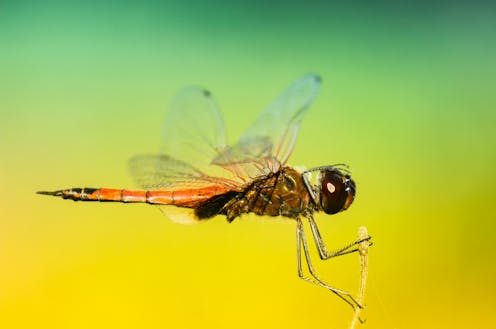
If you’ve spent much time outdoors along the east coast of Australia in the past week, particularly near waterways, you’ve probably seen something quite interesting emerging: dragonflies, whether in ones and twos or what feel like clouds and swarms.
Where did they come from? What are they up to? And why are there so many dragonflies all of a sudden?
Why are there so many dragonflies around?
The short answer is the weather. A warm start to spring has meant a lot of dragonfly nymphs have decided it’s a good time to take the leap into adulthood. Adult dragonflies are the highly visible winged predators we see buzzing around everywhere at the moment.
In cities, where bodies of water may be relatively small – think ponds and creeks rather than lakes and rivers – water temperatures rise more quickly as winter ends. When the weather is warmer, dragonflies may emerge earlier in the year.
But where did they come from?
These dragonflies have been hiding in local waterways, in nymph form. Dragonflies begin their lives as eggs then hatch into an aquatic nymph stage, and finally an adult flying form.
The wingless, water-dwelling nymphs don’t look much like the familiar adults. However, dragonflies are nymphs for most of their lives.
Some species live as nymphs for up to two years, though this may be less depending on weather and light conditions.
Dragonfly nymphs are fantastic predators. They have a kind of hinged jaw that can be extended like an arm to grab food – sometimes including small fish – at high speeds.
The nymphs are also fantastic swimmers, using an unusual technique first described in 1975:
Jet-propulsion in dragonfly larvae is achieved by the rapid ejection of water from a specialised rectal chamber via the anus.
With this method, nymphs can swim at speeds up to ten centimetres per second.
Why are dragonflies such fierce predators?

When days get longer, the nymphs begin to emerge as adults.
When a nymph is ready to emerge she will crawl out of the water and hang around on the surface, waiting to moult. Once the adult has moulted, it will wait for its wings to inflate, before taking off on a single, short flight.
Once the young adult has grown used to its wings, it will continue being a menace to surrounding wildlife – only now in the air.
Adult dragonflies have a knack for high-speed aerobatics, and they feed on even the fastest of flying insects.
Dragonflies can reach speeds of up to 55 kilometres per hour. Relative to the dragonfly’s size, that’s like a human moving at close to 900km an hour.
They can also fly backwards and even do flips in the sky. Some species also have impressive long-distance flight capabilities, with the common green darner undertaking a cycle of multigenerational migration in which individuals travel almost 700km.
 Dragonflies’ large compound eyes give them powerful vision to track prey.
Dustin Iskandar / Wikimedia, CC BY-SA
Dragonflies’ large compound eyes give them powerful vision to track prey.
Dustin Iskandar / Wikimedia, CC BY-SA
Dragonflies’ aerial acrobatics, combined with amazing vision, make them powerful predators.
One study found dragonflies can catch prey from about half a metre away in half a second. They are also clever enough to attack prey from behind, so even fast-reacting flies don’t stand a chance. Some species also use what is called “motion camouflage”, approaching a target along a path that disguises the fact they are getting closer and closer.
What does climate change mean for dragonflies?
Much of the dragonfly’s life cycle is linked to changes in weather, so there’s little doubt climate change will affect them. One UK study looking at when dragonflies emerged from 1960 to 2004 found this event was becoming earlier in the year, likely due to warming temperatures.
Changes in length and timing of life cycles isn’t the only effect climate change has had on dragonflies. Another recent study found they are also changing colour as temperatures rise.
It’s not yet clear what the knock-on effects of this earlier emergence will be. However, dragonflies are not alone among insects in this new behaviour – so the premature predators will at least have something to eat.
Should we get rid of dragonflies?
Sometimes people complain about dragonflies in their yards, and even take steps to get rid of them. That’s a big mistake.
Not only are these beautiful creatures harmless to humans, their aerobatics are also very fun to watch.
And if you want a more direct reason not drive dragonflies away, their diet is a good one. The average dragonfly nymph eats around 40 mosquito larvae a day, and adult dragonflies also love to chow down on adult mosquitoes.
So keeping dragonflies around – and even encouraging them – can have plenty of benefits.
Authors: Caitlyn Forster, Associate Lecturer, School of Life and Environmental Sciences, University of Sydney
Read more https://theconversation.com/where-did-all-these-dragonflies-come-from-238087



















.JPG)
.jpg)