

Local papers are central to our democracy. We must do more to bring them out of crisis
- Written by: Kristy Hess, Professor (Communication), Deakin University
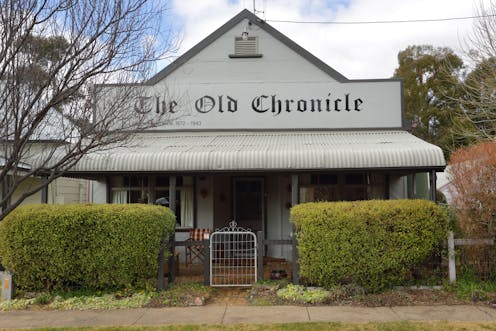
This is the second piece in a series on the Future of Australian media. You can read the first piece in the series here.
Australians who are unaware of stories about social disorder and crime gripping Alice Springs must surely have been hiding under a rock as big as Uluru.
The town has been the focus of national media attention and (at times toxic) social media commentary, prompting many in Alice Springs to crave the return of an “old-fashioned” communications asset to help quell negativity – a local newspaper.
In 2023, the Mparntwe Alice Springs Community Foundation was established with a key mission of bringing back a local masthead after News Corp closed its long-running newspaper, the Centralian Advocate, in 2020. To the foundation, a newspaper was a way of helping to re-establishing a sense of community connection and have constructive conversations on issues that matter to people in town.
The new Centralian Today celebrated its one-year anniversary this week in Alice Springs. Our research into this venture – to be launched this month – suggests that despite issues with recruitment and resourcing, the venture has been met with optimism from advertisers and audiences. It also provides a novel way of thinking about the future of news sustainability.
The Alice Springs example emphasises what academic literature has reinforced for decades – local news matters to audiences. When done well, local news providers play a role in keeping people safe and upholding social order (think natural disasters), hold power to account and foster public conversation. They also contribute to wellbeing, social connection and sense of “community”. Local newspapers in Australia are also expected to be non-partisan, but advocate and champion the shared interests of the geographic communities they serve.
Local papers in crisis
Yet, across the board, Australia’s local news sector is in crisis, as the traditional business model sustaining journalism – advertising – continues to shift towards digital platforms. Dozens of local news outlets (newspapers particularly) closed up shop across Australia during the lockdowns of COVID-19, in part due to a sudden loss of advertising.
This created what has been termed news “deserts” – geographic areas that have no local news provisions. This week Australian Community Media (ACM) – which publishes almost 70 daily and non-daily mastheads across metropolitan and rural Australia, continued its wave of cuts and newspaper sell-offs by announcing it will shed 35 editorial jobs and close a suite of country newspaper titles from the Tenterfield Star to the Dungog Leader. The Public Interest Journalism Initiative notes there are 31 local government areas in Australia without a local publisher, from Broken Hill in New South Wales to Upper Gasgoyne in Western Australia.
There have been attempts to support local news with federal government subsidies and initiatives totalling more than $70 million since 2018. While helpful, these have been short-term, and have not provided the solutions needed to address systemic challenges. The future of the mandatory bargaining code, which has forced Google and Facebook to pay publishers for news content that appeared on their platforms, is on a precipice. Meta, owner of Facebook, has announced it will not renew its news deal when it expires this year.
Targeted interventions and support for local news has been challenging because it is difficult to accurately gauge how much of Australia is in a news black hole. News coverage can be highly uneven, with some areas relatively well served when it comes to news access, especially in Victoria.
We have witnessed the rise of zombie newspapers, which carry mostly syndicated content and “pink slime” publications. These are fake, partisan publications masquerading as local news outlets that push a particular party line, misinformation or conspiracy theories.
In a sign of hope, new start-ups have emerged to fill voids, but they have qualified for only minimal government support. In addition, major media companies claim to serve particular local areas as part of their licence areas or circulation reach. But in reality they may only offer only tokenistic coverage to meet content quotas, attract subsidies or demonstrate “reach” to major advertisers.
Local media need targeted support
This makes it vital that support for the sector is directly targeted at areas that need it most, and are more than short term. Solutions that offer promise include:
tax cuts or support for journalistic salaries, especially recruitment of experienced journalists to the regions
a tech levy to distribute funds towards supporting local and community journalism
support for printed newspapers especially in areas with poor broadband coverage
engaging philanthropic support to specifically support journalism practice
responsible advertising spend – from government, not-for-profit and big business – to support local news outlets that invest in public interest journalism.
A new Australian Research Council Linkage project, for example, led by Deakin University in partnership with Griffith University and the ABC, is examining how local news producers can work together with the ABC to support vulnerable areas of the news ecology. This would form Australia’s version of the BBC’s successful Local Democracy Reporting Service.
News companies themselves must also carry some of the responsibility. For the current crisis, ACM’s announcement that the Tenterfield Star would close and reporters would now do their best to “cover the regions from a distance” should be scrutinised. It is important to note that the Tenterfield Star’s existing editorial office is 200km away from the town in Armidale. A newspaper that once lobbied for Federation in its heyday has minimal journalistic presence on the ground in Tenterfield (according to our research), with a photographer to capture events and happenings. The death knell had arguably been sounding for The Star long before ACM’s announcement this week.
In the debate about how to save local news, we have previously suggested that too much emphasis has been placed on generating social media metrics and reach, and predicting the impending doom of radio and print, at the expense of investing in and supporting relevant and reliable local content.
Most importantly, we suggest Facebook is no friend of public interest journalism in Australia. News outlets’ continued dependency on these platforms to build community and conversation is at their own peril.
Authors: Kristy Hess, Professor (Communication), Deakin University


















