

As cities axe shared e-scooters, the many more personally owned ones are in a blind spot
- Written by: Ferdinand Balfoort, PhD Candidate in Law, Charles Darwin University
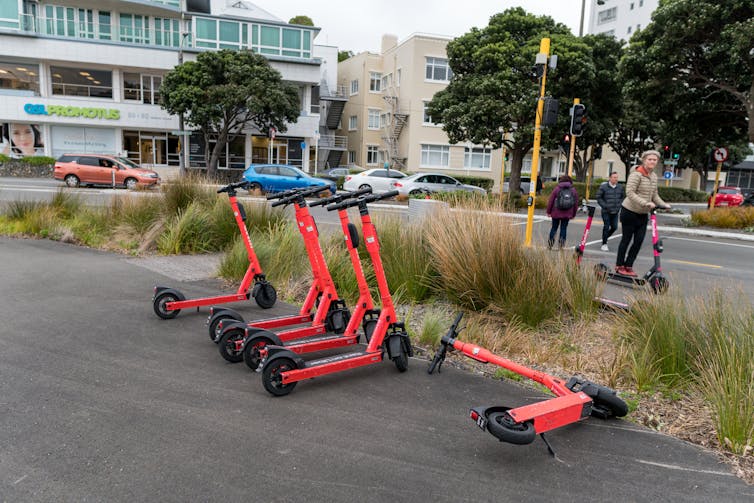
Recent decisions by the Melbourne City and Sunshine Coast councils to end contracts with operators of shared e-scooters have reignited debate around this form of transport. It ticks many sustainability boxes, yet continues to make headlines for the wrong reasons.
In addition to “reckless” rider behaviour, a more recent concern has involved allegations of e‑scooter schemes exceeding contracted caps on numbers and misreporting data. This has prompted Brisbane, Canberra and Townsville in Australia and Auckland and Wellington in New Zealand to cancel the operator Beam’s licence in their cities. Beam Mobility has said it is unable to comment until a legal firm it appointed has completed an investigation.
Embroiled within the e‑scooter debate is a more fundamental issue: are we talking about shared e‑scooters for hire, or personal e‑scooters, which people can buy online for as little as a few hundred dollars? The report to the Sunshine Coast Council noted:
Community sentiment does not appear to differentiate between personally owned and hired e‑scooters.
In the case of the Sunshine Coast, and elsewhere globally, hospital emergency departments, regulators, councillors and council staff demonstrated a high level of uncertainty about e‑scooters. This likely reflects a lack of data and informed understanding of the challenges and benefits of personal e‑scooters.
The Melbourne and Sunshine Coast councils have purportedly dealt with public concerns about shared e-scooters. But don’t personal e-scooters also shoulder some blame?
Why bans are not the answer
At present, New South Wales and South Australia prohibit the riding of private e‑scooters in public places (though this is set to change in SA). But bans are ultimately not the answer: e‑scooters are here whether we like it or not.
Despite ongoing questions around their legality, sales of personal/private e‑scooters have grown by around 20% a year since 2018. An estimated 250,000 e-scooters and personal mobility devices were in use in 2022. Assuming a similar rate of growth, we estimate Australians own 350,000 to 400,000 personal e-scooters and personal mobility devices. This means around 2% of adults own one.
Rates of e-scooter ownership in inner-urban areas could be much higher. The City of Sydney reports 10% of residents own an e-scooter .
Banning shared types, while allowing unregulated personal e‑scooters, sends mixed signals. It overlooks the potentially greater burdens from personal e‑scooters, which are capable of higher speeds than shared e‑scooters, which are speed-limited.
There is also no enforcement to date of quality control standards for personal e‑scooters and their chargers. These have been linked to e-battery fires in Australia and overseas.
Lessons from New Zealand
In New Zealand, our team’s research, which we’ll present at a conference in November 2024, suggests 5-7% of people own e‑scooters. Around 400,000 e‑scooters were imported from 2018 to 2023, according to New Zealand Statistics. That’s vastly more than the 6,439 shared e‑scooters operating in the country.
Yet most academic research globally has focused on shared e‑scooters. The neglect of personal ones is likely due to the lack of concrete data on the users, their behaviours and vehicle types and specifications.
These data are difficult to collect because personal e‑scooters are unregistered and unconnected to any GPS-based technology. Shared e‑scooters are tracked, which potentially provides valuable data, despite recent concerns about its reliability.
The 252 respondents to our NZ study provide insights into personal e‑scooter owners and behaviours. Some of the handful of prior studies had already identified significant potential issues. For instance, a majority (58.4%) of these scooters would be able to exceed 25km/h speed limits.
These studies also found using shared e‑scooters often leads to personal ownership. Our study suggests shared modes may complement personal e‑scooter use.
New Zealand has comparatively standardised laws on how personal e‑scooters are classified and used. An e‑scooter with an engine capacity exceeding 300 Watts (W) is classed as a motor vehicle and must be registered, though our research suggests there is a lack of enforcement. Council licensing limits shared e‑scooter engines to 300W.
Australian rules vary wildly
In Australia, state regulations do not explicitly limit engine size. We have seen “catch-up” policies and rules that vary greatly across the country.
These range from outright bans on using personal e‑escooters in public spaces to a myriad of different rules around the country. In some states, people can ride e‑scooters on footpaths, shared paths, bike lanes and certain roads. In others, footpaths and shared paths are off-limits. Depending on the location, speed limits may be 10km/h, 12km/h, 15km/h, 20km/h or 25km/h.
Enforcement in New Zealand, and likely in Australia, is not very effective. for personal e‑scooters with an engine capacity over 300W. One enforcement action in New Zealand was reported in 2018 and one in 2023.
In Australia, e‑scooters are regulated based on speed limits, among other things. But the speed of shared e‑scooters is easier to determine than for unregistered and unmonitored personal e‑scooters. In New Zealand, there are no speed limits on e‑scooters apart from those set by the licensing conditions for shared e‑scooters.
In this context, New Zealand personal e‑scooters occupy a legal blind spot. They get a free pass, as their speed is not a violation of existing rules, whereas their engine capacity is. But it can be hard for an observer to detect an e‑scooter that’s over the engine limit, unless it’s being ridden at extreme speeds.
We can’t afford to keep ignoring personal e-scooters
As long as personal e‑scooters remain unregistered and enforcement action is limited, their high numbers in Australia and New Zealand, compared to shared e‑scooters, are likely to have an oversized impact in terms of engine capacity, speed and the potential for accidents.
It is high time for researchers and regulators to recognise the significant potential impacts of personal e‑scooters – both benefits and burdens.
Council decisions to end the operation of shared e‑scooters may be addressing only part of the problem based on incomplete data and reporting.
Authors: Ferdinand Balfoort, PhD Candidate in Law, Charles Darwin University


















