

Government's population plan is more about maximising 'win-wins' than cutting numbers
- Written by: Nick Parr, Professor and Demographer, Macquarie University
The Morrison government’s new population plan will have little effect on Australian population growth. Appropriately, it looks to reduce the concentration of this growth in our biggest cities and to raise the benefit-to-cost ratio of population change more broadly.
Australia’s population is growing at five times the average rate for more developed countries. That’s mainly because of its net (immigration minus emigration) migration rate. For 2010-15 Australia’s net migration rate was the second highest (after Saudi Arabia) in the world for a country with over 10 million population.
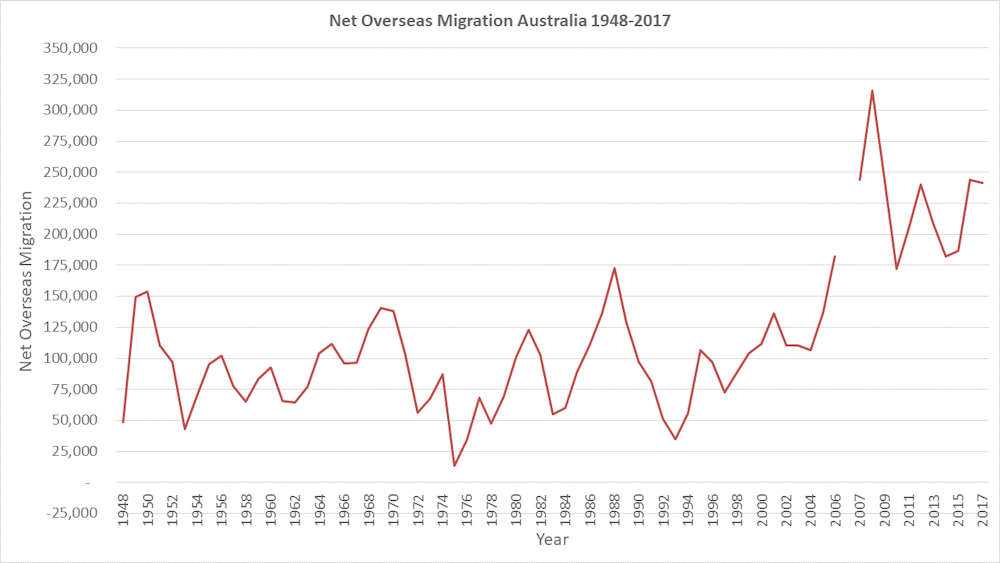 Net overseas migration to Australia 1948-2017 (break in line is because of a change in the measurement series).
ABS, Historical Population Statistics
Net overseas migration to Australia 1948-2017 (break in line is because of a change in the measurement series).
ABS, Historical Population Statistics
Read more: Settling migrants in regional areas will need more than a visa to succeed
Net overseas migration, currently 240,100 a year, is high compared to historical levels. It is four times the 58,000 “replacement” rate needed to keep our population above the current 25.3 million, assuming the current fertility rate and life expectancy stay the same.
The major elements of net overseas migration are:
permanent migrants granted visas under the Migration Program (skilled and family combined) and the Humanitarian Program
temporary migrants who stay in Australia for at least 12 months in a 16-month period, mainly students, working holidaymakers and other work-related temporary visa holders
New Zealand and returning Australian citizens
(minus) permanent and temporary emigrants.
The reduction in the Migration Program ceiling to 160,000 is small relative to the previous 190,000 ceiling. And it’s a tiny cut relative to the 162,417 places actually filled for 2017-18. This reduction may affect the number who stay in Australia on temporary visas (or without any current visa), and will have flow-on effects on births, deaths and emigration.
Bottom line, the reduced ceiling won’t change population growth much.
Adding to pluses, reducing minuses
Well-targeted increases in immigration can raise labour force participation and productivity, slow population ageing and increase per person taxation revenue. This is partly because of the young, working-age profile of new immigrants.
For the same reason, higher immigration, and hence population growth, increases peak-hour transport use in total and per head.
Population growth also adds to need for all sorts of goods and services, including housing, education and water. Larger city size is associated with higher congestion time delay and cost. Other growth-related issues include public transport crowding, increased housing density, house price inflation, concerns about housing quality, school place shortages, and loss of farmland and native biodiversity.
Read more: City planning suffers growth pains of Australia's population boom
A “best” choice of location to house increased population based on one criterion sometimes can be a “worst” based on another. For example, locating new housing in CBD areas near to opportunities for work, shopping and other activities may be “best” for reducing car use, but “worst” in terms of locally available, affordable sites for new schools with spacious, ground-level playgrounds.
Good population policy should look for “win-win” solutions that take away the minuses of population growth and add to its pluses.
Easing the big city squeeze
In 2018, Sydney, Melbourne and Brisbane combined accounted for 51% of Australia’s population, 67% of population growth and 72% of net overseas migration. ABS mid-range projections show Sydney’s population reaching 9.7 million in 2066, Melbourne’s 10.2 million and Brisbane’s 4.8 million. These are challenging prospects.
Read more: Migrants want to live in the big cities, just like the rest of us
Responding to a large majority view, the government’s plan aims to reduce city population growth, congestion and other pressures. It intends to fill job vacancies in regional Australia by settling immigrants there and developing transport and other infrastructure.
The proportion of people in the 55-69 age range is much higher outside the capital cities and in Hobart and Adelaide than in Sydney, Melbourne, Brisbane and Perth. This means Baby Boomer retirements can be expected to result in higher percentages leaving the workforce outside the four largest cities, and a related need to recruit migrant (and Australian resident) replacements for these retiring workers.
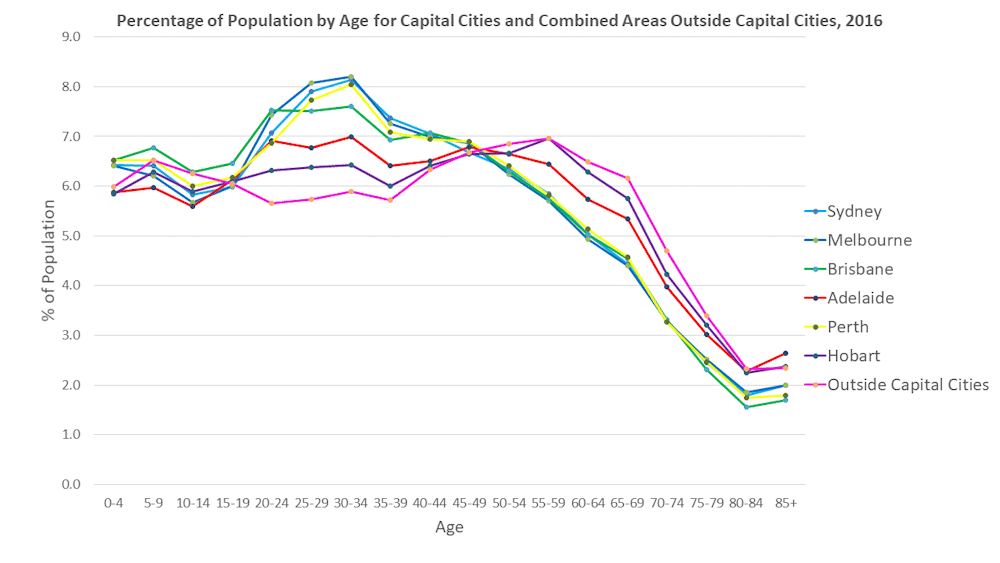 ABS, 2016 Census
The government’s proposed measures include:
23,000 Migration Program places for regional migration schemes
extension of Temporary Graduate Visas for former international students at regional university campuses
4,720 scholarships attached to study at regional campuses.
The definition of “regional” is broad. It extends from sparsely populated inland areas to the Sunshine Coast (2017-18 growth rate 2.58%), the NSW Central Coast, Geelong and all of Adelaide. Current international student locations suggest Adelaide will at first gain the most from the changes for “regional” international students.
Children, a pointless answer
Places in the skilled migration program include spouses and children, as well as primary applicants. The population plan proposes to allocate extra skilled migration points to applicants without dependants.
This change should reduce the immediate effect of the cut to the Migration Program on labour supply (and travel to work), and additions to (currently large) school age groups. Down the track, this will reduce new entrants to the labour market and could add to births in Australia, as immigrants who were childless when they arrived have children later in life.
Fertility and mortality receive only passing mention in the population plan. In retrospect, fluctuations in the fertility rate have been artefacts of changes to the ages of childbirth. There is no clear evidence of substantial and sustained increase to lifetime family size for Australia.
Read more:
Australians want more children than they have, so are we in the midst of a demographic crisis?
There is no need to increase fertility to prevent Australia’s population falling. Even if our fertility rate were to halve our population would remain above 25 million, as long as net migration and life expectancy did not fall.
Research needed to better match migration with needs
Welcome recognition of the need for research and consultation to inform policy is apparent from the government’s proposed Centre for Population to “pursue opportunities to improve data and research on population and facilitate collaboration on population planning across Commonwealth, State, Territory and Local governments”.
A majority of migrants work in the mostly professional occupations that skilled migration is designed to supplement. However, a substantial minority work in less-skilled occupations that have never been eligible occupations for visas, or else are unemployed.
Achieving a better match between migrant employment outcomes and national employment priorities is desirable. This requires improvements to data availability.
ABS, 2016 Census
The government’s proposed measures include:
23,000 Migration Program places for regional migration schemes
extension of Temporary Graduate Visas for former international students at regional university campuses
4,720 scholarships attached to study at regional campuses.
The definition of “regional” is broad. It extends from sparsely populated inland areas to the Sunshine Coast (2017-18 growth rate 2.58%), the NSW Central Coast, Geelong and all of Adelaide. Current international student locations suggest Adelaide will at first gain the most from the changes for “regional” international students.
Children, a pointless answer
Places in the skilled migration program include spouses and children, as well as primary applicants. The population plan proposes to allocate extra skilled migration points to applicants without dependants.
This change should reduce the immediate effect of the cut to the Migration Program on labour supply (and travel to work), and additions to (currently large) school age groups. Down the track, this will reduce new entrants to the labour market and could add to births in Australia, as immigrants who were childless when they arrived have children later in life.
Fertility and mortality receive only passing mention in the population plan. In retrospect, fluctuations in the fertility rate have been artefacts of changes to the ages of childbirth. There is no clear evidence of substantial and sustained increase to lifetime family size for Australia.
Read more:
Australians want more children than they have, so are we in the midst of a demographic crisis?
There is no need to increase fertility to prevent Australia’s population falling. Even if our fertility rate were to halve our population would remain above 25 million, as long as net migration and life expectancy did not fall.
Research needed to better match migration with needs
Welcome recognition of the need for research and consultation to inform policy is apparent from the government’s proposed Centre for Population to “pursue opportunities to improve data and research on population and facilitate collaboration on population planning across Commonwealth, State, Territory and Local governments”.
A majority of migrants work in the mostly professional occupations that skilled migration is designed to supplement. However, a substantial minority work in less-skilled occupations that have never been eligible occupations for visas, or else are unemployed.
Achieving a better match between migrant employment outcomes and national employment priorities is desirable. This requires improvements to data availability.
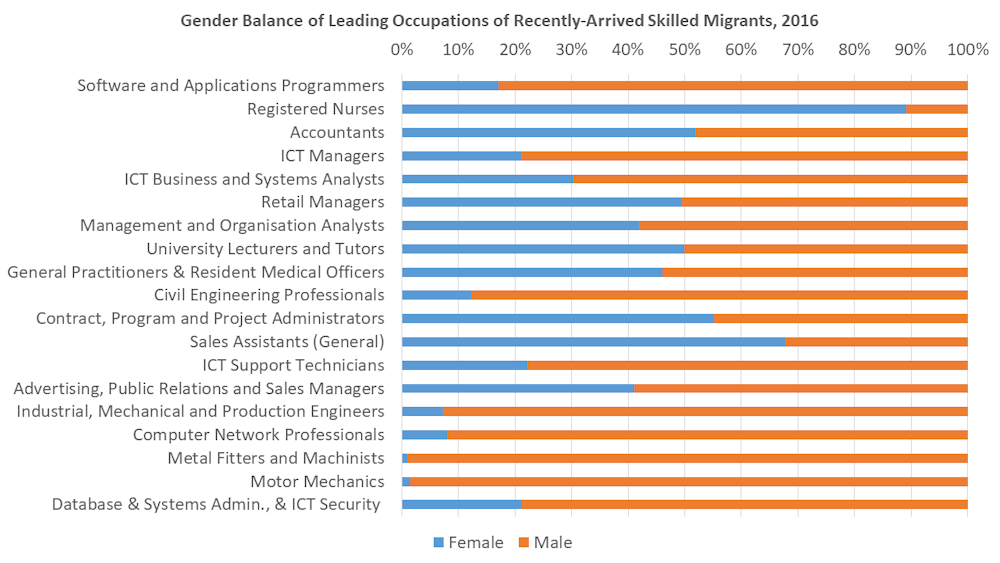 ABS, 2016 Census
Other key areas the Centre for Population might study include:
improvement of population and transport use forecasting
harmonising change to skilled migration numbers with change to domestic graduate numbers
retention and employment of immigrants in regional areas
settlement experiences in regional Australia of new movers from overseas and from Australia’s cities
prospects for change to the significant gender imbalance of most occupations into which skilled migrants are recruited, and the implications for Australia’s future need for immigration.
ABS, 2016 Census
Other key areas the Centre for Population might study include:
improvement of population and transport use forecasting
harmonising change to skilled migration numbers with change to domestic graduate numbers
retention and employment of immigrants in regional areas
settlement experiences in regional Australia of new movers from overseas and from Australia’s cities
prospects for change to the significant gender imbalance of most occupations into which skilled migrants are recruited, and the implications for Australia’s future need for immigration.
Authors: Nick Parr, Professor and Demographer, Macquarie University


















