

The importance of sports in recovery from trauma: lessons from and for Christchurch
- Written by Holly Thorpe, Professor in Sociology of Sport and Physical Culture, University of Waikato
Sport may seem trivial in times of tragedy. But research shows its power during recovery from a traumatic experience.
We draw on international research in spaces of conflict and following disaster to explain the benefits of engaging in physical activity after traumatic events.
As Muslim communities around the world and many New Zealanders are grieving and trying to make meaning of the horrific events in Christchurch, we look at how informal sport and recreation can help process complex emotions.
Read more: Pushing casual sport to the margins threatens cities' social cohesion
Sport for peace building
In 2001, UN Secretary-General Kofi Annan founded the Office on Sport for Development and Peace (SDP), advocating sport as having “an almost unmatched role to play in promoting understanding, healing wounds, mobilising support for social causes, and breaking down barriers”.
Since then, the SDP movement has continued to proliferate with organisations using sport and physical activity to help improve the health and well-being of individuals and communities around the world. Of the 1,000-plus organisations currently working under the SDP umbrella, many are focused in sites of war and conflict with the aim of peace building.
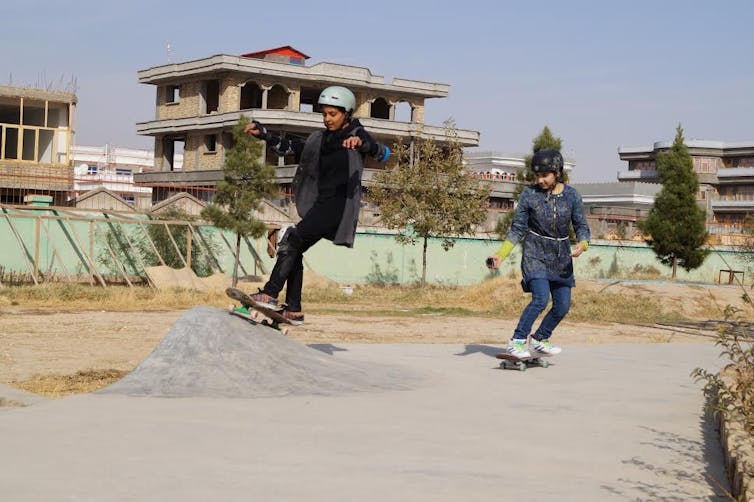 Skateboarding helps young people in conflict zones overcome the stress and despair of their everyday lives.
Skateistan, CC BY-SA
Skateboarding helps young people in conflict zones overcome the stress and despair of their everyday lives.
Skateistan, CC BY-SA
There is growing interest in the potential of sports programmes as psycho-social interventions following natural disaster, and in the lives of refugee and migrant communities. SDP organisations such as Football 4 Peace, Right to Play, Hoops 4 Hope, Peace Players International, and Capoeira4Refugees have made valuable contributions to the quality of many people’s lives in contexts of war, conflict and poverty.
The UN Department of Economic and Social Affairs is in the process of strengthening the global framework for leveraging sport for development and peace, and it is exploring how sport may be implemented towards the 2030 Sustainable Development Goals.
Sports in trauma recovery: lessons from Christchurch
In 2016, one of us (Holly Thorpe) began a three-year comparative study, focusing on young people’s engagement with non-competitive action sports in regions of political instability and ongoing conflict. The research included interviews with nearly 100 young people using informal sports and recreation to help improve their own and others’ lives in challenging contexts.
Case studies focused on Skateistan, a non-governmental skateboarding and educational school for disadvantaged children in Afghanistan, Cambodia and South Africa, and a grassroots parkour group in Gaza. Parkour is a sport that involves moving rapidly through an area, typically an urban landscape, negotiating obstacles by running, jumping and climbing.
Two other cases explored the significance of action sports for youth living in communities devastated by natural disaster, such as New Orleans following Hurricane Katrina in 2005 and Christchurch following the 2010 and 2011 earthquakes.
Sporting activities will seem insignificant during the immediate emergency response phase. But in the weeks and months following a natural disaster, as communities begin the slow process of rebuilding their lives, recreational sports can play a valuable role. They help people cope and re-establish networks or make new social connections.
The 2011 earthquake in Christchurch killed 185 people and injured many more. It damaged or destroyed almost 200,000 homes, as well as vital infrastructure and sporting facilities. As Emma, a passionate surfer, explained:
Once we got most of the chores done, we started to realise that something huge was missing from our lives.
Finding new rhythms and routines
For skateboarders, the city centre’s “red zoning” meant the loss of a favourite urban playground. Climbers lost access not only to their indoor climbing facility, but also to hundreds of climbing routes, while mountain bikers lost hundreds of trails in the area. Extensive damage to major sewer lines forced the Christchurch City Council to release untreated wastewater into rivers, closing local beaches for nine months and disrupting the daily routines of local surfers and other beach users.
Cultural geographer Tim Edensor writes that individuals often minimise the effects of a major disruption by trying to “restore familiar spaces, routines and timings”. Building on this work and using French sociologist and philosopher Henri Lefebvre’s notion of “rhythmanalysis, the earthquakes can be described as an "arrhythmic experience”, disrupting all sense of normalcy.
For some Christchurch residents, sporting participation helped restore rhythms and escape (if only temporarily) from the stresses of daily life. Participant Caitlin described the importance of her relationships within the climbing community.
Once I got back into it, I found in climbing a way to carry on, move forward.
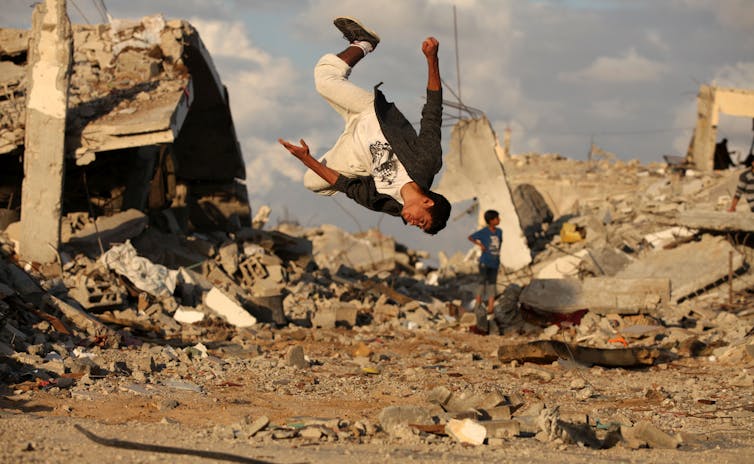 Informal sports such as parkour can help people living in conflict zones to cope with frustrations and fear, and build resilience.
Gaza Parkour, CC BY-SA
Informal sports such as parkour can help people living in conflict zones to cope with frustrations and fear, and build resilience.
Gaza Parkour, CC BY-SA
Sports in conflict zones: lessons from Gaza
In our research on informal sports in Gaza, we found some youth adopted unique strategies to overcome the stress and despair of their everyday lives. We revealed how youth (particularly, young men) in Gaza developed their own unique parkour group, despite various social, economic, physical and psychological obstacles. The following comments from Mohammed Al Jakhbeer, cofounder of Parkour Gaza, are revealing:
When I was young, I could not imagine that anything would dominate our consciousness more than our isolation or the occupation. All of Gaza was a series of obstacles, closures and checkpoints. Today, all and any obstacles are my point of departure. With free running, I overcome.
The team advocates the socio-psychological benefits of their everyday parkour experiences, including its value for their resilience with frustrations and fears of living in the Khan Younes refugee camp. The late Gazan psychologist Eyad Al Sarraj said:
Many young people in Gaza are angry because they have very few opportunities and are locked in. An art and sports form such as free-running gives them an important method to express their desire for freedom and allows them to overcome the barriers that society and politics have imposed on them. It literally sets them free.“
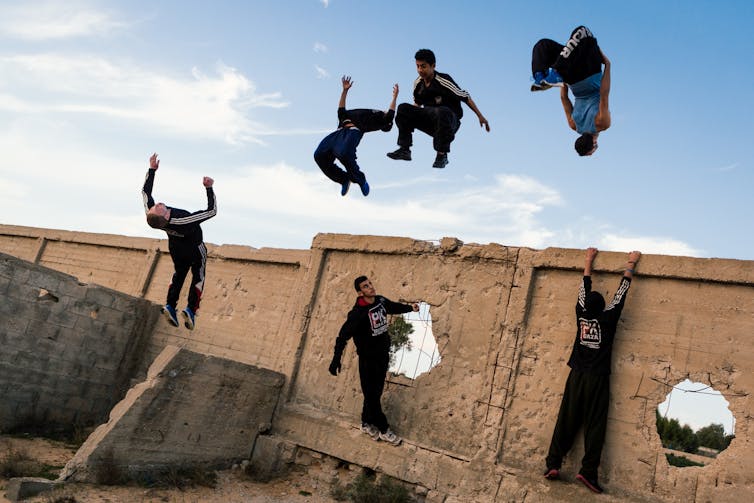 Parkour at the Khan Younis refugee camp in Gaza.
Mohammed Salem, CC BY-SA
Parkour at the Khan Younis refugee camp in Gaza.
Mohammed Salem, CC BY-SA
Action sports for development
In contrast to competitive sports, informal sports like parkour, skateboarding and surfing offer participants an opportunity to gain a sense of achievement without having to physically beat an opponent. The non-competitive, creative and play-based nature of such activities is particularly important in contexts of conflict where war and violence is an ever-present part of children and youth’s lives and memories.
Informal activities also offer opportunities for unique social dynamics. Research shows that, when well facilitated, the sharing of social spaces with people of different backgrounds, ages, sexes and ability levels, can offer a valuable space for learning about inclusion, diversity and respecting difference.
For Muslim communities in New Zealand and around the world, participating in sport in public spaces may be associated with a heightened sense of risk and fear. For those seeking to help, we might consider how to create public and sporting spaces that offer safe and accessible "therapeutic landscapes” over the coming months, years and beyond.
Authors: Holly Thorpe, Professor in Sociology of Sport and Physical Culture, University of Waikato


















