

What is a trained clown and what does the training look like?
- Written by: Anna-Sophie Jürgens, Senior Lecturer in Science Communication (Pop Culture Studies), Australian National University
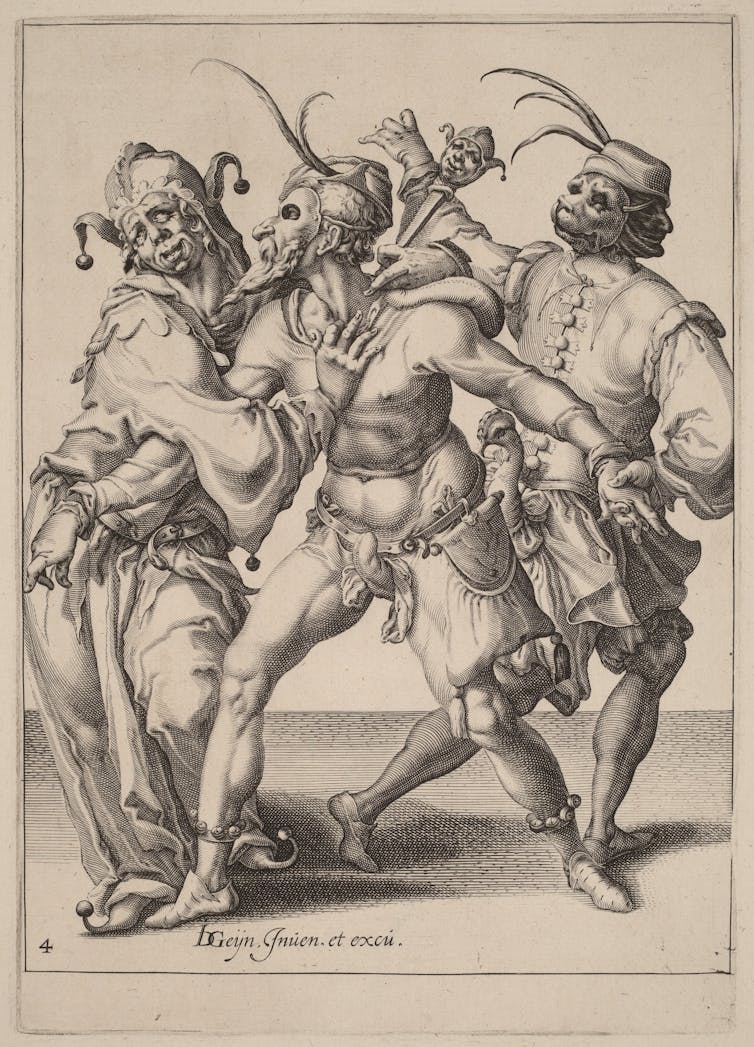
Where do clowns come from? In popular culture, they may come from alien worlds, such as Killer Klowns from Outer Space, peer out from drains like Pennywise from Stephen King’s It, or emerge from a vat of chemicals or a lab accident, like The Joker in DC comics.
In real life, however, they often come from clown schools, theatre institutes or universities.
Clown education is often long, rigorous and very physically demanding. Many clown courses are quite hard to get into.
So, how are they trained and what are some of the main institutions?
We’ve always had clowns
The clown is an anthropological constant, a phenomenon that exists across cultures and time.
From “ritual clowns” in indigenous cultures, to the “court bufoons” that traditionally entertained Pacific chiefs and royal jesters in medieval Europe, there are many different types of clowns. And they serve different purposes in society.

Clowns are often afforded special privilege to say or do what would be unthinkable for most of us. As one research paper notes:
The earliest record of clowns or jesters appear to date back to Ancient Egypt over 4,000 years ago, where a ‘Danga’ is recorded as a fool at the court of the Pharaoh Dadkeri-Assi […] his activities, dances and diversions were treated not only with tolerance but also with privilege.
Clowns also appear in the literature on ancient Greece and ancient Rome, again enjoying positions of relative privilege at the time.
The stock characters and themes explored in the Commedia dell'arte – a theatre tradition that flourished between the 16th and 18th centuries in Europe – became the source of many Harlequins and Pierrots, Punches and Judies.
 Giovanni Domenico Tiepolo, The Triumph of Pulcinella, 1760-1770.
Statens Museum for Kunst
Giovanni Domenico Tiepolo, The Triumph of Pulcinella, 1760-1770.
Statens Museum for Kunst
In the 18th century, with the rise of the modern circus and pantomime, the mischievous clown became popular. This was most famously personified by English clown Joseph Grimaldi, who wore white face paint and is described by one report as having “invented the creepy clown” with his unsettling acts of mischief.
Since then, many more whiteface clowns and mimes (such as clowning legend, Lindsay Kemp, who studied mime with France’s Marcel Marceau and worked with David Bowie and Kate Bush), Auguste clowns (who wear red noses and are often in grotesquely mismatched costumes), character clowns (such as The Three Stooges or The Marx Brothers), tramps (such as Charlie Chaplin) and many other clown incarnations have populated our cultural imagination.
 Dancer, choreographer and mime Lindsay Kemp is a famous trained clown.
EPA/ALESSIA PARADISI
Dancer, choreographer and mime Lindsay Kemp is a famous trained clown.
EPA/ALESSIA PARADISI
Today’s clowns may be entertainers, political activists, boundary-pushers, or even medical clowns performing to relieve people’s physical and emotional pain in hospitals or aged care settings.
All of these require different skills and training.
How are clowns trained?
The methods, techniques and schools of clowning are as diverse as the cultural history of clowns itself.
Not surprisingly, many circuses train clowns.
Among the well-known schools in the United States was Ringling Bros. and Barnum & Bailey Clown College, which educated clowns until it closed in 1997 (one famous graduate is Penn Jillette from the magic-performing duo Penn and Teller).
 Ringling Circus clown Emmett Kelly in Sarasota, Florida, in 1947.
Library of Congress
Ringling Circus clown Emmett Kelly in Sarasota, Florida, in 1947.
Library of Congress
Theatre schools often train clowns, too. One example is Accademia Dimitri in Switzerland, founded by Swiss clown Dimitri, his wife Gunda, and Czech-born actor and mime Richard Weber. The program they designed focuses on teaching students pantomime, dance, theatrical improvisation, acrobatics and other skills.
Universities also train clowns. The University of Alberta in Canada, for example, has a Movement, Dance and Clowning stream.
In fact, there are clown and physical theatre hubs all around the world that train clowns.
 Henri de Toulouse-Lautrec, Seated Clowness (La Clownesse assise), 1896.
National Gallery of Art
Henri de Toulouse-Lautrec, Seated Clowness (La Clownesse assise), 1896.
National Gallery of Art
The Budapest Circus Arts and Contemporary Dance College, for example, offers a three-year clown training programme. Students learn skills in “preparing the body, the mind and the spirit for creation”, improvisation techniques, circus studies, juggling, clowning technique and acrobatics.
There’s also the famous École Internationale de Théâtre Jacques Lecoq in France. One well-known graduate is Australian actor Geoffrey Rush, who studied mime and movement there.
There’s Sydney’s Clown Institute, which describes itself as a “fun-tastic outlet to ditch stress”.
Then there are also mentoring-based approaches to clown training that tap into literature and art (see, for example, the International School for Acting And Creativity).
All of these approaches help future clowns develop their artistic and expressive pathways by combining technical skills with personal artistic sensibilities.
But it is the clown’s purpose that shapes the direction of the training.
How purpose shapes training
If you want to become a professional mime (with or without whiteface), you will likely learn the techniques developed by groundbreaking artists such as France’s Marcel Marceau and Étienne Decroux, who spearheaded a type of physically demanding performance known as corporeal mime.
 Marcel Marceau was an expert at using corporeal mime techniques.
AAP Image/Laura Friezer
Marcel Marceau was an expert at using corporeal mime techniques.
AAP Image/Laura Friezer
A mime may also study improvisation, ballet, modern dance, acrobatics and fencing.
If you want to become a circus clown, your training may include classical acting techniques, interdisciplinary circus arts and dance, physical comedy, acrobatics, yoga, stage combat, juggling and storytelling.
Clown doctors often undertake specialist training in performing arts such as physical theatre, pantomime or puppetry, as well as learning practical skills in nursing, hospital practices and procedures. They must adapt their clowning to a therapeutic profession in a medical setting.
One medical clowning organisation, Dream Doctors, says that after inital training, their graduates undertake about 200 hours of ongoing professional development seminars, courses and workshops every year.
Clowns master the body as a storyteller
Trained clowns create engaging experiences for audiences, generate memorable moments and harness the power of creativity for wellbeing and social change.
 Henri-Gabriel Ibels, Clowns, 1893.
National Gallery of Art
Henri-Gabriel Ibels, Clowns, 1893.
National Gallery of Art
Through institutionalised programmes, mentoring by senior colleagues and the study of routines they admire, future clown performers must discover and unfold their own inner clown.
Trained clowns master the body as a storyteller, fostering new artistic creation and stimulating creative intelligence.
Authors: Anna-Sophie Jürgens, Senior Lecturer in Science Communication (Pop Culture Studies), Australian National University
Read more https://theconversation.com/what-is-a-trained-clown-and-what-does-the-training-look-like-237123


















