

National parks and other protected areas often fail to conserve Earth’s forests, research finds
- Written by: Timothy Neal, Senior lecturer in Economics / Institute for Climate Risk and Response, UNSW Sydney
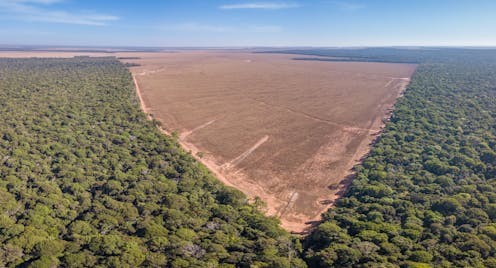
The destruction of nature is a global crisis. Establishing protected areas of forest is a common policy governments use to tackle the problem.
Indeed most countries, including Australia, have signed a global agreement to protect 30% of land by 2030. But to what extent do protected areas, such as national parks and nature reserves, actually preserve forests?
My new research examined this question. The findings are the first global-scale estimate of where protected areas are succeeding and failing.
Alarmingly, I found protected areas fail to prevent forest loss in many parts of the world. Clearly, we must make these areas more effective to conserve the remaining diversity of Earth’s plants and animals.
Probing protected areas
Forests are often destroyed through human activity such as logging with chainsaws or the deliberate use of fire. The aim is usually to extract timber, or to clear land for agriculture, roads, housing or other human purposes.
Natural bushfires can also damage forests. In some cases, ecosystems are so badly burnt they cannot recover. There’s a link to human activity here too, because human-caused climate change is leading to more severe, frequent, and wider-ranging bushfires in places such as Australia.
I wanted to know how well protected areas prevent forests from being lost.
To work this out, I first took a map that covers the precise boundaries of about 300,000 of the world’s protected areas. I overlaid it with high-resolution satellite data from between 2001 and 2022 showing forest loss just inside and just outside these boundaries.
This method assumed if forest loss was much higher just outside the boundary of a protected area than inside, the protection was working.
Conversely, if forest loss was relatively similar inside and outside the boundary, that shows the protection did not have a strong effect.
This idea can apply even if forest loss on both sides of the boundary is low – because it suggests the area is remote or otherwise not sought-after for human activity. In these cases, we have no evidence that protection is effective, because the forest probably would have been retained even if the protection wasn’t in place.
What I found
I found protected areas prevent an average 30% of forest loss that would have occurred if the policy was not in place. Forest loss occurred in protected areas in all countries – including Australia – but less frequently than in unprotected forest.
The 30% figure is discouragingly low. But it does indicate protected areas are effective to some degree. And effectiveness varies significantly across countries, as the below graphic shows.

The policy is almost completely ineffective in many countries, including Indonesia, the Democratic Republic of the Congo, Bolivia, Venezuela, Madagascar, Russia and Gabon. Several of these countries house vast amounts of the planet’s remaining biodiversity. Most, but not all, are developing economies.
In the case of forest loss due to fire, protected areas in advanced economies were also ineffective in some cases.
Australia is a good example. Protected areas here were fairly effective from 2001 to 2018. But the horrific 2019–20 Black Summer fires burned indiscriminately through large swathes of protected forest.
In better news, protected areas were highly effective in some areas, such as New Zealand, Canada, Scandinavia and the Baltic states (Estonia, Latvia and Lithuania).
What this all means
My research illustrates the large improvements needed in many protected areas across the globe to genuinely conserve forests. More research is also needed to understand the best policies to achieve this, before it’s too late.
Developing countries clearly need help to protect their forests. Corruption, political instability, and a lack of resources can make it difficult for governments in these nations to enforce forest conservation laws. Government indifference can also play a role.
How do we turn this around? Schemes such as REDD+, which pays local communities to conserve forest that may otherwise be cleared, could be scaled up.
Foreign aid for forest conservation, from countries such as Australia, can also help. And non-government organisations such as African Parks can put rangers on the ground to help patrol and enforce the integrity of protected areas.
Technology such as real-time deforestation alerts from satellite data can also help.
My findings also highlight the threat climate change poses to forest ecosystems in Australia and elsewhere. Obviously, fire does not respect the boundaries of a national park or other protected area.
So yes, it’s great to see governments around the world signing up to protect 30% of their land. But my work shows attention is needed to make sure those protected areas are working.
Authors: Timothy Neal, Senior lecturer in Economics / Institute for Climate Risk and Response, UNSW Sydney


















