

‘Pirate birds’ force other seabirds to regurgitate fish meals. Their thieving ways could spread lethal avian flu
- Written by: Simon Gorta, PhD Candidate in ecology, UNSW Sydney
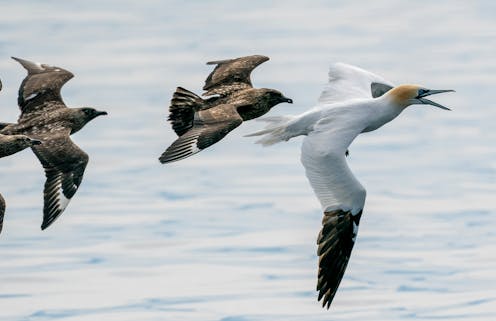
It’s not easy finding food at sea. Seabirds often stay aloft, scanning the churning waters for elusive prey. Most seabirds take fish, squid, or other prey from the first few metres of seawater. Scavenging is common.
But there are other tactics. Frigatebirds, skuas, and gulls rely on the success of other seabirds. These large, strong birds chase, harry, and attack their targets until they regurgitate or drop the prey they’ve just caught. They’re the pirates of the seabird world, stealing hard-earned meals from other species. This behaviour is known as kleptoparasitism, from the Ancient Greek word kléptēs, thief.
The strategy is brutal, effective, and a core behaviour for these important seabirds. But as our new research shows, it comes with major risks for the thieves. The new strain of avian flu is killing birds by their millions – and we found kleptoparasitism could spread the virus very easily.

Food thieves at sea
It’s not that frigatebirds, skuas, and gulls can’t hunt. They can and do catch their own food. But hunting fish and squid is hard work. It’s much easier to use extortion tactics to win the food from other seabirds.
These tactics have made these birds very successful as foragers. They hang around the breeding sites of birds such as gannets and terns waiting for a tired parent to return from the sea with a crop of food.
For the seabirds being targeted, these kleptoparasitic birds are just one more threat. The world’s 362 species of seabird can be found across every ocean and many islands. At sea, they prey on fish and squid. When they nest or rest on islands, their nutrient-rich guano shapes soil and plant communities, defining entire ecosystems.
But they are not doing well. Just under half of all seabird species (155) are now classified between “near threatened” and “critically endangered” on the world’s list of threatened species, the IUCN Red List. Of those with known trends, 56% have populations in decline.
The threats they face are daunting. Invasive predators such as mice and rats eat eggs or chicks on breeding islands. Many are caught by fishing boats as accidental bycatch, while overfishing depletes their prey. Then there’s climate change, habitat loss, and many other threats, including disease.
Seabirds are generally long-lived. They often raise only one chick every one or two years. Many species breed in only a few locations. They take many years to mature. Put together, these traits make recovery from population declines slow.
 Kleptoparasitism is an effective way to get food.
Simon C Stobart/Shutterstock
Kleptoparasitism is an effective way to get food.
Simon C Stobart/Shutterstock
Of parasites and viruses
Three years ago, a more lethal strain of avian influenza virus emerged. This HPAI H5N1 2.3.4.4b strain has spread around the world, killing at least 280 million wild birds. The strain can also infect and kill marine mammals such as seals.
“HPAI” stands for Highly Pathogenic Avian Influenza, meaning the virus can more readily cause severe disease and death. The strain has become an animal pandemic (formally, a panzootic). It’s made it to Antarctica, but not yet to Australia or the rest of Oceania.
We know seabirds are particularly at risk. Our new research has shown kleptoparasites are at an even higher risk relative to other seabirds.
During the 2022 northern hemisphere summer, the virus killed roughly half of the world’s great skua (Stercorarius skua).
Food-stealing behaviour can enable the virus to spread. When a great skua harasses a gannet and makes it regurgitate food, the skua gets a fish meal – coated in saliva. If the gannet is infectious, its saliva will likely have a high viral load.
Once infected, these pirate birds can drive spread faster. Skuas, frigatebirds and gulls can cover great distances across polar regions and the tropics. They can transmit the disease to their mates, chicks, and other seabirds.
This means we could see outbreaks in new populations or places, hundreds or even thousands of kilometres apart. We have already seen signs of this in skua populations in the northern and southern hemispheres, with brown (Stercorarius antarcticus) and great skuas being some of the first detected H5N1 infections at new locations.
Skuas more often steal food from other seabirds when away from their breeding sites – including when they’re migrating back to these areas. If skuas get infected en route, they could bring the disease to their breeding sites and then beyond.
Frigatebirds are known for the red pouches on the necks of the males, which they inflate during breeding season. But they have other remarkable traits, such as travelling tens of thousands of kilometres across oceans outside breeding season. These travels are often broken up by “island-hopping”, where they will encounter and potentially infect other seabirds.
 Frigatebirds are known for the large red pouches male birds have on their necks.
buteo/Shutterstock
Frigatebirds are known for the large red pouches male birds have on their necks.
buteo/Shutterstock
Frigatebirds and skuas have already suffered mass deaths from this strain of avian influenza.
While the virus is now almost everywhere, it hasn’t reached Australia, New Zealand, Oceania, and parts of Antarctica and the subantarctic. We can monitor skuas, frigatebirds and gulls for signs of illness to give us early warning that the virus has arrived.
By itself, avian influenza is a major threat to seabirds. But the outlook is even more dire when this is compounded with further human-caused threats. Identifying, managing, and reducing these threats is critical for their conservation, and the health of our islands and oceans.
Authors: Simon Gorta, PhD Candidate in ecology, UNSW Sydney


















