death on the Darling, colonialism’s final encounter with the Barkandji
- Written by: Heidi Norman, Professor, Faculty of Arts and Social Sciences, University of Technology Sydney
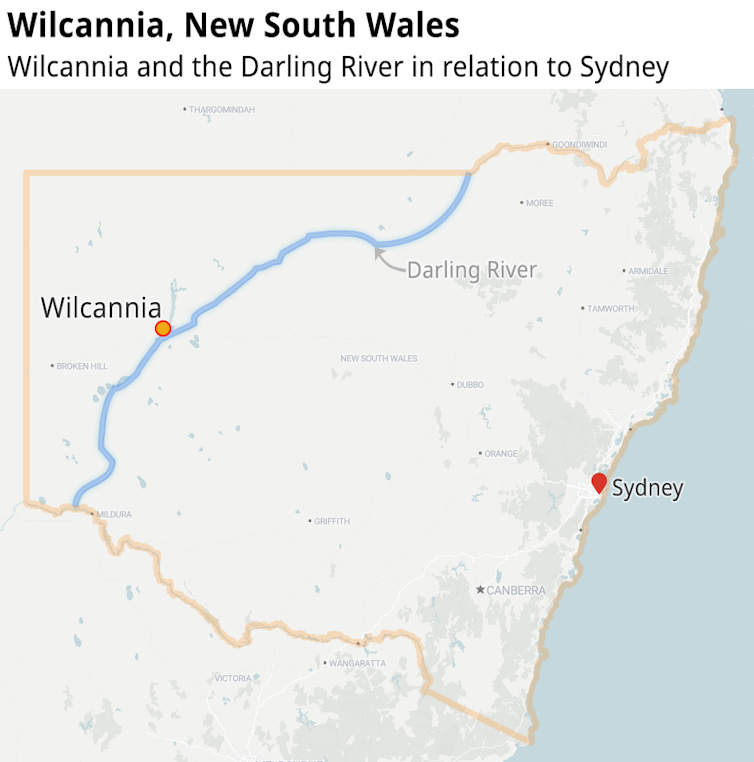
Driving the 200-kilometre round trip from Broken Hill to Wilcannia, the country opens up before us; the sky fills most of the horizon, save for a few hills and in every direction, red dust devils, like mini-tornados, pepper the landscape.
Some whirl towards the bitumen strip, snatching at the car. The underbellies of the few high clouds are tinged pink by the swept-up dirt. Kangaroos, trampled and dragged by freight trucks, litter the road surface. Crows and eagles hover over their carcasses, parting only just in time for us to pass through.
In Wilcannia, we drive directly to see the much talked about Darling River. On the eastern side of town, we drive past the campsite caretaker cottage. It appears abandoned: the fence is missing panels and tall prickly weeds break through the bitumen and concrete drive.
 Out of the car, the sun is scorching. The air is quiet and still, save for the black cockatoos sitting high in the river gums gulping out an occasional half-hearted and awkward squawk. One solo, sun weary, white Australian traveller is a surprising sight. He sits by the door of his caravan making the most of the short shadow it casts.
Heading towards the river bank, we step gingerly around tall weeds and fallen gum branches. Leaves crunch and snap at each move we make. We wave and shout out hello to the traveller. Shaking his head in resignation, as if to prepare us for the sight about to be revealed, he warns: “There’s no water.”
Read more:
The Darling River is simply not supposed to dry out, even in drought
The sandy river bed is baked dry. Freshwater mussels, the size of your outstretched hand, have withered and died in their shells, weeds cover parts of the bed and bits of glass from the colonial heyday are exposed in the sand. We repeat, “Jeezus”, under our breath to no one in particular.
Out of the car, the sun is scorching. The air is quiet and still, save for the black cockatoos sitting high in the river gums gulping out an occasional half-hearted and awkward squawk. One solo, sun weary, white Australian traveller is a surprising sight. He sits by the door of his caravan making the most of the short shadow it casts.
Heading towards the river bank, we step gingerly around tall weeds and fallen gum branches. Leaves crunch and snap at each move we make. We wave and shout out hello to the traveller. Shaking his head in resignation, as if to prepare us for the sight about to be revealed, he warns: “There’s no water.”
Read more:
The Darling River is simply not supposed to dry out, even in drought
The sandy river bed is baked dry. Freshwater mussels, the size of your outstretched hand, have withered and died in their shells, weeds cover parts of the bed and bits of glass from the colonial heyday are exposed in the sand. We repeat, “Jeezus”, under our breath to no one in particular.
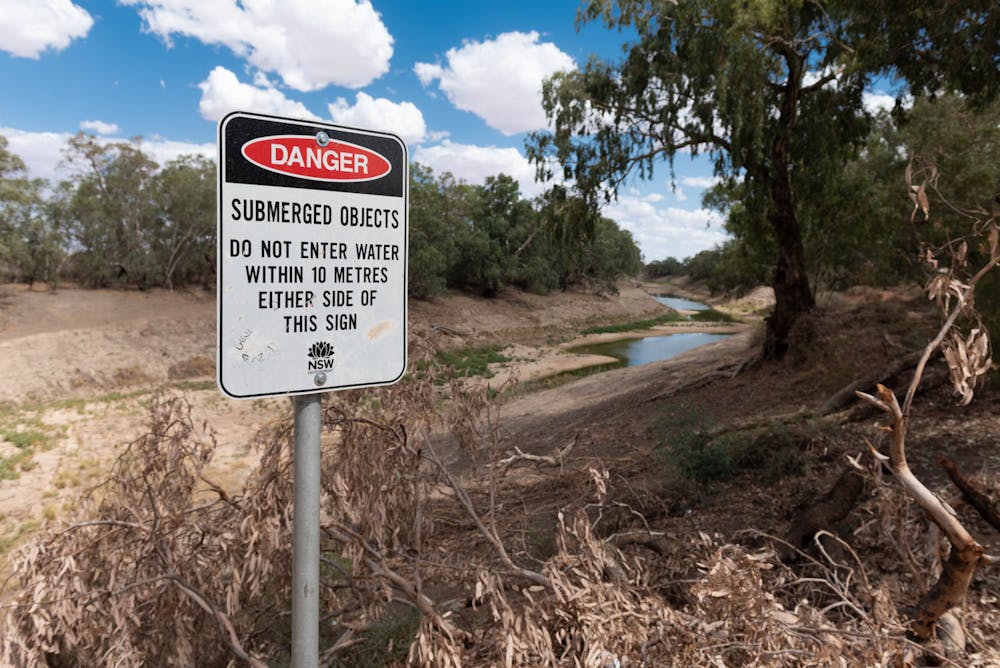 A sign of former times at Wilcannia: the Darling River recedes into the distance.
John Janson-Moore
Bone dry
In March 2019 the Darling River at Wilcannia, once “Queen of the Desert”, colonised by merino, from where millions of wool bales travelled under steam to South Australia and onto the global market, is bone dry. The nation’s longest river system (at 2750 kms) and 15th largest in the world, is lifeless. This river, the equivalent of several storeys deep, has supported Barkandji people for thousands of generations; the last five or so alongside Europeans. They say the river Barka is mother.
Along the Barwon-Darling, at the top end of the river system, the majority Aboriginal-populated towns despair at the state of the river and its heavy impact on their health, recreation, future and sense of being.
A sign of former times at Wilcannia: the Darling River recedes into the distance.
John Janson-Moore
Bone dry
In March 2019 the Darling River at Wilcannia, once “Queen of the Desert”, colonised by merino, from where millions of wool bales travelled under steam to South Australia and onto the global market, is bone dry. The nation’s longest river system (at 2750 kms) and 15th largest in the world, is lifeless. This river, the equivalent of several storeys deep, has supported Barkandji people for thousands of generations; the last five or so alongside Europeans. They say the river Barka is mother.
Along the Barwon-Darling, at the top end of the river system, the majority Aboriginal-populated towns despair at the state of the river and its heavy impact on their health, recreation, future and sense of being.
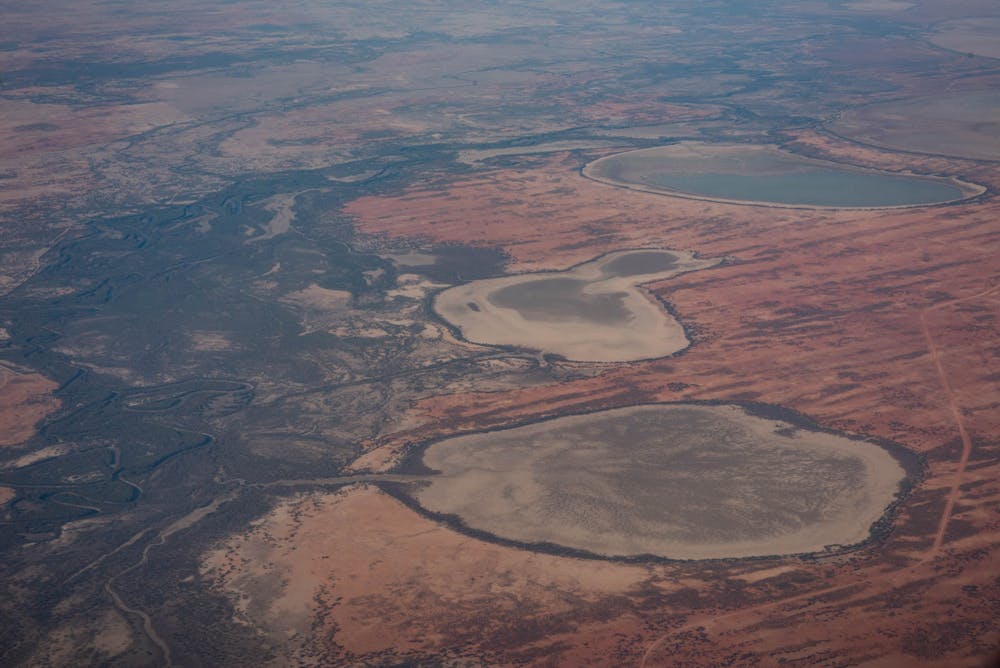 An aerial shot of Menindee Lakes.
John Janson-Moore
When we visited, those towns were without reliable, safe drinking water but had a keen register of their limited social capital, political voice or economic power to affect change.
In the far west of NSW, Aboriginal people have engaged with the settler political-economy for a period of 150 years and not been eliminated. Still, the impact of colonisation cannot be measured as a moment, but rather as an enduring process. As we came to understand from Barkandji people, the crisis on the Barwon-Darling represents the biggest threat to their continued survival on country since the sheep invaded. It calls for a new order of government, with alternative economies and a central role for the Barkandji world view.
Barkandji and the settler economy
Colonial invasion over Barkandji and these far western lands is sometimes described as “invisible” – like a disease – and “creeping” in the way that waves of station owners, miners, itinerant labourers, Catholic nuns, Chinese market gardeners and South Asian cameleers passed through. Stories of settler violence struck fear in areas yet to feel the full brunt of it. From the 1850s, a more organised settler capitalist order emerged with the large pastoral stations’ highly profitable wool production.
By the 1880s, Wilcannia was the third largest river port in NSW; many grand sandstone buildings from this era still stand in the town. After the 1890s drought and recession, struggling stations were portioned off. Later, the allocation of smaller soldier settlement grants, mostly family farmed, meant a shrinking demand for Aboriginal labour.
An aerial shot of Menindee Lakes.
John Janson-Moore
When we visited, those towns were without reliable, safe drinking water but had a keen register of their limited social capital, political voice or economic power to affect change.
In the far west of NSW, Aboriginal people have engaged with the settler political-economy for a period of 150 years and not been eliminated. Still, the impact of colonisation cannot be measured as a moment, but rather as an enduring process. As we came to understand from Barkandji people, the crisis on the Barwon-Darling represents the biggest threat to their continued survival on country since the sheep invaded. It calls for a new order of government, with alternative economies and a central role for the Barkandji world view.
Barkandji and the settler economy
Colonial invasion over Barkandji and these far western lands is sometimes described as “invisible” – like a disease – and “creeping” in the way that waves of station owners, miners, itinerant labourers, Catholic nuns, Chinese market gardeners and South Asian cameleers passed through. Stories of settler violence struck fear in areas yet to feel the full brunt of it. From the 1850s, a more organised settler capitalist order emerged with the large pastoral stations’ highly profitable wool production.
By the 1880s, Wilcannia was the third largest river port in NSW; many grand sandstone buildings from this era still stand in the town. After the 1890s drought and recession, struggling stations were portioned off. Later, the allocation of smaller soldier settlement grants, mostly family farmed, meant a shrinking demand for Aboriginal labour.
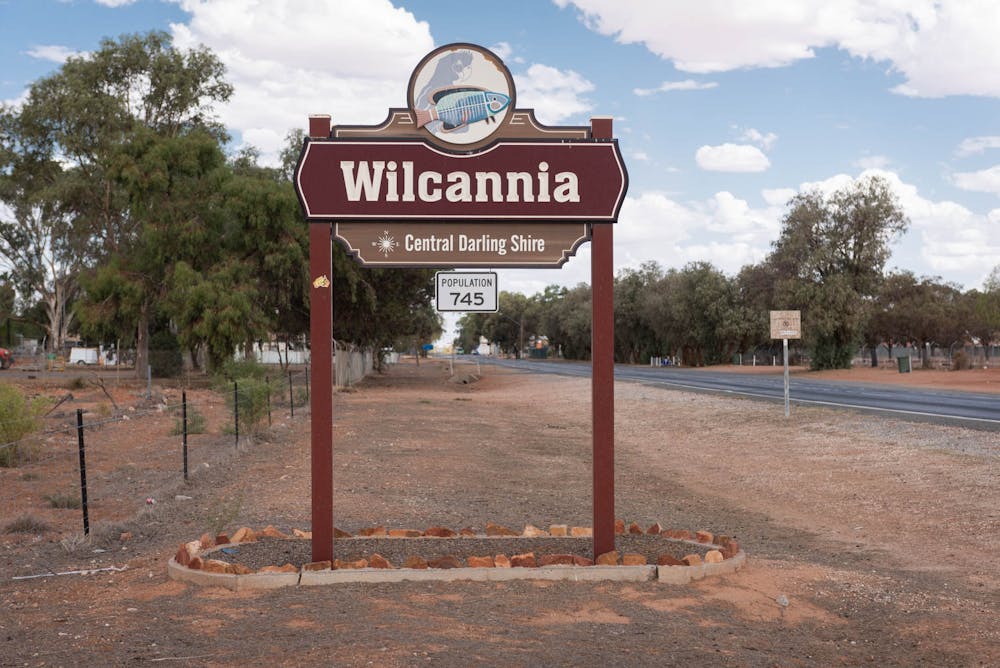 Wilcannia, has a population of around 745, mostly Barkandji people.
John Janson-Moore
From the 1930s, Barkandji settled in more permanent camps and humpies, which stretched from Wilcannia for kilometres along the eastern (and lower, flood prone) side of the Darling, and to supervised government missions at Menindee. As anthropologist Jeremy Beckett has detailed, Aboriginal men and women continued to work in the region’s settler pastoral economy.
But from the 1970s, for-profit sheep farming collapsed in the region, and Wilcannia in particular. This was caused in part by land degradation, the advent of equal wages, mechanisation and a decline in state-funded enterprises. Along with the emergence of the Department of Commonwealth Aboriginal Affairs, these factors ushered in a welfare-based economy. From the 1970s, white people literally shifted to greener pastures. Aboriginal houses were built on the north-west edge of town (locally known as “the Mallee”). At the same time, government initiatives to “relocate” Aboriginal families meant many moved to Albury and Cobar.
Defending the Darling
In the last 18 months, Barkandji people have held three rallies during which they briefly blocked the Barrier Highway, which passes from the east through Wilcannia to Adelaide. But their campaign and concern for the river goes back decades (if not since 1850). In recent months they have grown increasingly despairing as they watch the water levels get lower and lower.
Wilcannia, has a population of around 745, mostly Barkandji people.
John Janson-Moore
From the 1930s, Barkandji settled in more permanent camps and humpies, which stretched from Wilcannia for kilometres along the eastern (and lower, flood prone) side of the Darling, and to supervised government missions at Menindee. As anthropologist Jeremy Beckett has detailed, Aboriginal men and women continued to work in the region’s settler pastoral economy.
But from the 1970s, for-profit sheep farming collapsed in the region, and Wilcannia in particular. This was caused in part by land degradation, the advent of equal wages, mechanisation and a decline in state-funded enterprises. Along with the emergence of the Department of Commonwealth Aboriginal Affairs, these factors ushered in a welfare-based economy. From the 1970s, white people literally shifted to greener pastures. Aboriginal houses were built on the north-west edge of town (locally known as “the Mallee”). At the same time, government initiatives to “relocate” Aboriginal families meant many moved to Albury and Cobar.
Defending the Darling
In the last 18 months, Barkandji people have held three rallies during which they briefly blocked the Barrier Highway, which passes from the east through Wilcannia to Adelaide. But their campaign and concern for the river goes back decades (if not since 1850). In recent months they have grown increasingly despairing as they watch the water levels get lower and lower.
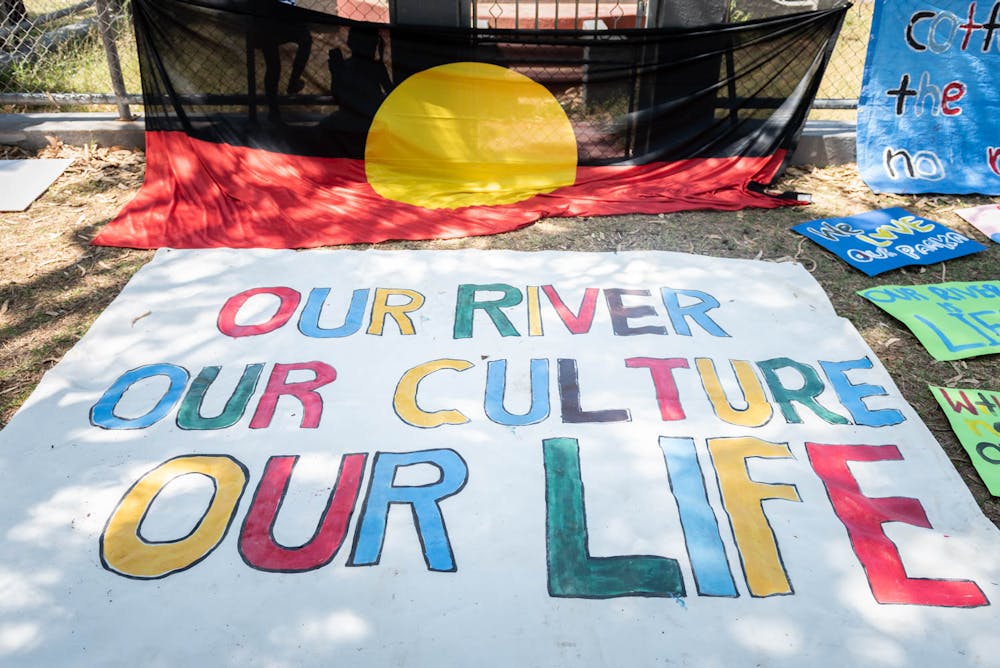 Banners from the day’s protest march at Wilcannia.
John Janson-Moore
The mass fish kills downstream at Menindee Lakes in late January brought the horror to a national audience. Television images of cod fish cradled as if slain children in the arms of grieving farmers reverberated with a concerned public. But for Barkandji people, this underscored their powerlessness in the debate over their river.
Banners from the day’s protest march at Wilcannia.
John Janson-Moore
The mass fish kills downstream at Menindee Lakes in late January brought the horror to a national audience. Television images of cod fish cradled as if slain children in the arms of grieving farmers reverberated with a concerned public. But for Barkandji people, this underscored their powerlessness in the debate over their river.
 Dead fish in the Menindee weir pool in January.
Supplied by Graeme McCrabb/AAP
As Wilcannia Local Aboriginal Land Council’s Kevin Cattermole told us,
It’s so sad that it took a million or more fish to die for people to really listen, when we’ve been saying this, we’ve been fighting for this for a number of years now. Well before the fish kill in Menindee. Well before that we tried to get people to listen…
Interview with Kevin Cattermole.He went on to say, “We have no water … there’s nothing there … All the water gets taken out of Bourke and us poor buggers in the middle, we’ve got nothing. That’s why we jumped up and down. We’re tired of having no water”.
Wilcannia has a population of around 745. The land council, and everyone we spoke to including workers at the petrol station, supermarket and café shared the same view as to the cause of this problem. They say upstream big irrigators are storing water on feeder rivers and over extracting. Low rainfall and record temperatures (48.5 degrees in January, 2019) were also cited as factors but secondary to water regulation. A “man-made disaster” was the shared view.
Interview with Jenny Thwaites.Long-time Wilcannia resident and Local Aboriginal Land Council CEO, Jenny Thwaites observed that:
A few years back we had two years in a row where we had high rivers. In the time that I lived here, when we had a high river it used to last for months, now it’s up for a couple of weeks and then it’s gone. And since then, we’ve gradually seen the water getting lower and lower and lower …
Dead fish in the Menindee weir pool in January.
Supplied by Graeme McCrabb/AAP
As Wilcannia Local Aboriginal Land Council’s Kevin Cattermole told us,
It’s so sad that it took a million or more fish to die for people to really listen, when we’ve been saying this, we’ve been fighting for this for a number of years now. Well before the fish kill in Menindee. Well before that we tried to get people to listen…
Interview with Kevin Cattermole.He went on to say, “We have no water … there’s nothing there … All the water gets taken out of Bourke and us poor buggers in the middle, we’ve got nothing. That’s why we jumped up and down. We’re tired of having no water”.
Wilcannia has a population of around 745. The land council, and everyone we spoke to including workers at the petrol station, supermarket and café shared the same view as to the cause of this problem. They say upstream big irrigators are storing water on feeder rivers and over extracting. Low rainfall and record temperatures (48.5 degrees in January, 2019) were also cited as factors but secondary to water regulation. A “man-made disaster” was the shared view.
Interview with Jenny Thwaites.Long-time Wilcannia resident and Local Aboriginal Land Council CEO, Jenny Thwaites observed that:
A few years back we had two years in a row where we had high rivers. In the time that I lived here, when we had a high river it used to last for months, now it’s up for a couple of weeks and then it’s gone. And since then, we’ve gradually seen the water getting lower and lower and lower …
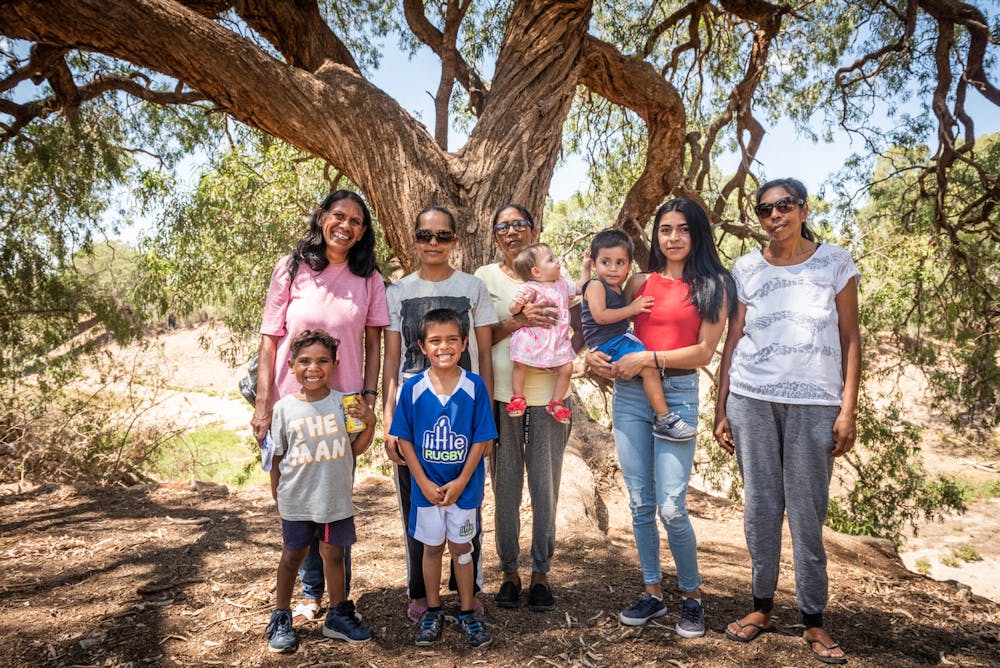 Members of the King family from Wilcannia stand under a river gum beside the Darling River, which they may never see in flow again.
John Janson-Moore
The impact on Barkandji worlds was explained as social and cultural.
Michael Kennedy, chair of Wilcannia Local Aboriginal Land Council, said:
… all along the river there were families. Every day of the week there were people fishing on the river… Everyone was happy. You had something to do, something that you loved… Traditional food, it was always eaten … it’s just not there anymore. It’s like … everything is dying out.
Both Kennedy and Cattermole are at pains to detail the non-human impact too. Kennedy said,
Everything’s dying with it … The fish, the mussels the yabbies; the bird life isn’t here anymore like it used to be. You hear a few birds chirping now but that’s nothing compared to what it used to be. Everything, it’s affecting everything. Kangaroos, emus, the people. Everything.
Cattermole says local parrots and kingfishers are gone now. “Even our kookaburras have gone quiet.”
Interview with Michael Kennedy.Kennedy recalls the river when he was a child:
For me growing up, it always had … flowing water in it; you could always come down to the river and catch a feed of fish or yabbies or duck eggs. It was so easy to find duck eggs. But now, I haven’t had a feed of fish in probably 12 months.
He bows his head in grief as he recites, yet again, the conditions on the river. We stand in the dry river bed, pushing the coarse sand around with our feet. It is baking hot. We stand close, listening intently to each other. He gestures to the desolate chasm,
…our people lived here for thousands of years. They drank the water from out of this river, they lived off this river, this river fed us. It gave us water, it gave us life. And now, you know in the last 200 years, it’s gone to nothing, it’s just a dry, dead river bed.
Members of the King family from Wilcannia stand under a river gum beside the Darling River, which they may never see in flow again.
John Janson-Moore
The impact on Barkandji worlds was explained as social and cultural.
Michael Kennedy, chair of Wilcannia Local Aboriginal Land Council, said:
… all along the river there were families. Every day of the week there were people fishing on the river… Everyone was happy. You had something to do, something that you loved… Traditional food, it was always eaten … it’s just not there anymore. It’s like … everything is dying out.
Both Kennedy and Cattermole are at pains to detail the non-human impact too. Kennedy said,
Everything’s dying with it … The fish, the mussels the yabbies; the bird life isn’t here anymore like it used to be. You hear a few birds chirping now but that’s nothing compared to what it used to be. Everything, it’s affecting everything. Kangaroos, emus, the people. Everything.
Cattermole says local parrots and kingfishers are gone now. “Even our kookaburras have gone quiet.”
Interview with Michael Kennedy.Kennedy recalls the river when he was a child:
For me growing up, it always had … flowing water in it; you could always come down to the river and catch a feed of fish or yabbies or duck eggs. It was so easy to find duck eggs. But now, I haven’t had a feed of fish in probably 12 months.
He bows his head in grief as he recites, yet again, the conditions on the river. We stand in the dry river bed, pushing the coarse sand around with our feet. It is baking hot. We stand close, listening intently to each other. He gestures to the desolate chasm,
…our people lived here for thousands of years. They drank the water from out of this river, they lived off this river, this river fed us. It gave us water, it gave us life. And now, you know in the last 200 years, it’s gone to nothing, it’s just a dry, dead river bed.
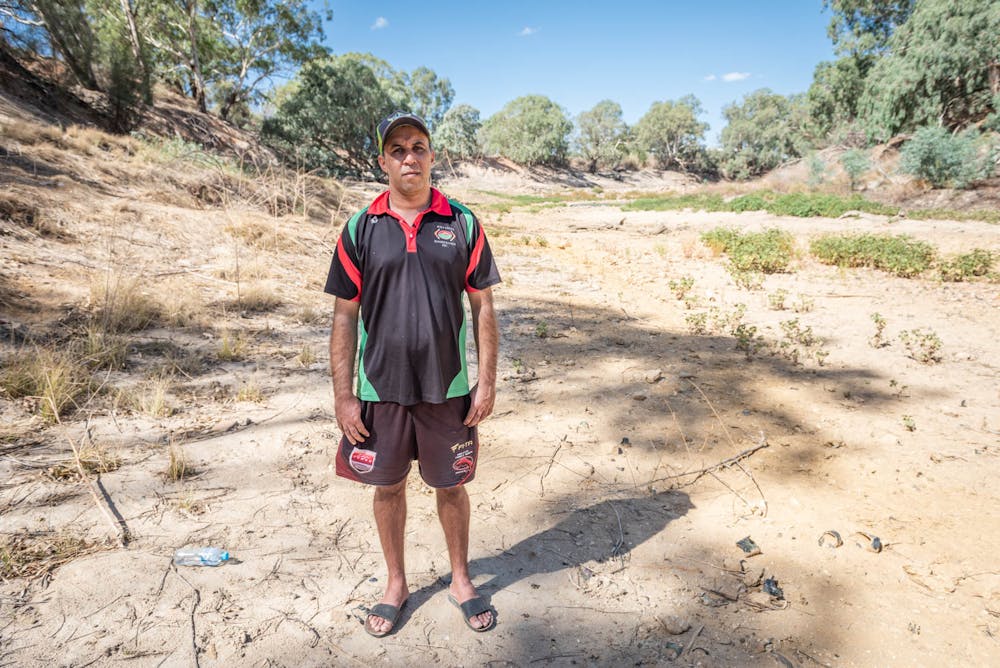 Michael Kennedy, chairperson of the Wilcannia Local Aboriginal Land Council, on the Darling riverbed.
John Janson-Moore
Kennedy regularly returns in our conversation to his memories of the river as a child. He explains how “heaps of us” would build fish traps and haul the fish out by hand at the weir, before and after school. He laments the inability to do this with his own son.
The Future
Cattermole fears for the future of the town and for the Barkandji. He says,
If nothing gets done with this river, I think this place will end up becoming a ghost town … If this river doesn’t get fixed a lot of people … they’ll just drift off to other places where they used to be before. Probably down to Lake Cargelligo or Broken Hill … What’s the good of staying here when there’s no water? You can’t live without water!
Michael Kennedy, chairperson of the Wilcannia Local Aboriginal Land Council, on the Darling riverbed.
John Janson-Moore
Kennedy regularly returns in our conversation to his memories of the river as a child. He explains how “heaps of us” would build fish traps and haul the fish out by hand at the weir, before and after school. He laments the inability to do this with his own son.
The Future
Cattermole fears for the future of the town and for the Barkandji. He says,
If nothing gets done with this river, I think this place will end up becoming a ghost town … If this river doesn’t get fixed a lot of people … they’ll just drift off to other places where they used to be before. Probably down to Lake Cargelligo or Broken Hill … What’s the good of staying here when there’s no water? You can’t live without water!
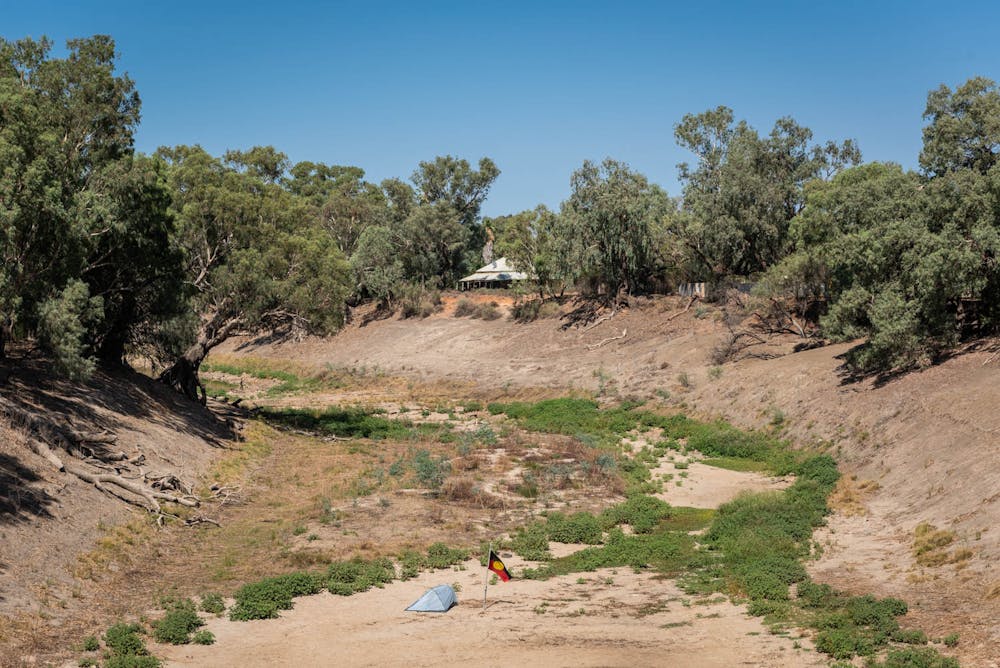 A view from the highway bridge at Wilcannia of the Aboriginal Tent Embassy on the Darling River, symbolically set up on the day of action in March this year.
John Janson-Moore
And, on the impact on Aboriginal stories of place, Cattermole says,
It’ll die out. It’ll die. There will be no stories for the kids. All they’ll be hearing is how the white people destroyed our culture, our way of life, our self-being. There will be nothing for them. They won’t be able to pass stories on because they won’t have nothing to tell about the river.
A protest in Wilcannia on March 3.The future for anyone living in Wilcannia today is uncertain. Still Kennedy, sensing the possibility of forced departure, was emphatic in saying, “We can’t move from here because this is our Country, this is where we belong, this is where we live. It breaks our heart.”
He connects the condition of the river to his own health, saying:
When you look at the river and you see how sick it is, and how disheartening it looks: that’s exactly how we feel. But when the river’s got plenty of water in it and it’s healthy and it’s flourishing, that’s how we feel. We feel happy, we feel good, we feel healthy.
Alternate economies
There are very few prospects of the Barwon-Darling river recovering any time soon. The collapse of the river system now almost certainly ends farming along the mid Darling and any remaining jobs. Surviving industries, cotton mostly, are largely mechanised and draw heavily on upstream water thereby exacerbating the mid-Darling water crisis.
A view from the highway bridge at Wilcannia of the Aboriginal Tent Embassy on the Darling River, symbolically set up on the day of action in March this year.
John Janson-Moore
And, on the impact on Aboriginal stories of place, Cattermole says,
It’ll die out. It’ll die. There will be no stories for the kids. All they’ll be hearing is how the white people destroyed our culture, our way of life, our self-being. There will be nothing for them. They won’t be able to pass stories on because they won’t have nothing to tell about the river.
A protest in Wilcannia on March 3.The future for anyone living in Wilcannia today is uncertain. Still Kennedy, sensing the possibility of forced departure, was emphatic in saying, “We can’t move from here because this is our Country, this is where we belong, this is where we live. It breaks our heart.”
He connects the condition of the river to his own health, saying:
When you look at the river and you see how sick it is, and how disheartening it looks: that’s exactly how we feel. But when the river’s got plenty of water in it and it’s healthy and it’s flourishing, that’s how we feel. We feel happy, we feel good, we feel healthy.
Alternate economies
There are very few prospects of the Barwon-Darling river recovering any time soon. The collapse of the river system now almost certainly ends farming along the mid Darling and any remaining jobs. Surviving industries, cotton mostly, are largely mechanised and draw heavily on upstream water thereby exacerbating the mid-Darling water crisis.
 Exposed water height markers on the Darling River reveal the depth of the crisis at Wilcannia.
John Janson-Moore
Prospects of Aboriginal land repossession under the 1983 NSW Aboriginal Land Rights laws sustaining an economy in far western NSW are also limited. Properties held by the Wilcannia land council, including Weinteriga sheep station, were purchased in the late 1980s. With Darling River frontage it had been celebrated as offering employment and training opportunities and profitable enterprise, not unlike the old pastoral station days.
With no water in the river, the property has been emptied of sheep and the sole caretaker runs a feral goat enterprise. Tough and hardy, the goats will eat anything – and everything – and need little water. But their voracious and indiscriminate appetite carries environmental risks.
Says Kennedy:
It’s almost like when your mum or your dad is laying in hospital sick, ready to pass on and there is nothing you can do about it. And you just sit there with them and watch them pass on. It’s the same way we feel about the river. Our river is dying and we’re dying with it.
At the headwaters of the Barwon-Darling down to Wilcannia, the towns that sit along the river are majority Aboriginal populations: Mungindi, Walgett, Brewarrina, Bourke and Wilcannia.
At the recent NSW recent election, the electorate of Barwon, which includes these towns and covers some 44% of the state, was wrestled from the National Party by The Shooters, Fishers and Farmers with a swing of 17.8%. Within Barwon, Aboriginal people make up nearly 17% of the population.
In 2015, after 18 years of litigation, the Federal Court recognised Barkandji people’s connection to country in far western NSW covering 128,000 square kilometres. This Native Title determination, while significant, delivers limited land interest or repossession. But it does reference water rights and the potential to recognise a form of Aboriginal government and with the right resources and capacity, perhaps the ability to engage new economies on damaged landscapes.
The environmental catastrophe of the river holds in its grip the future of Barkandji people. The dystopia is now and they need the support of all Australians in order to survive with and on their Country.
Author Heidi Norman and filmmaker John Janson-Moore acknowledge the generous assistance of Barkandji people and Wilcannia Local Aboriginal Land Council and community.
Exposed water height markers on the Darling River reveal the depth of the crisis at Wilcannia.
John Janson-Moore
Prospects of Aboriginal land repossession under the 1983 NSW Aboriginal Land Rights laws sustaining an economy in far western NSW are also limited. Properties held by the Wilcannia land council, including Weinteriga sheep station, were purchased in the late 1980s. With Darling River frontage it had been celebrated as offering employment and training opportunities and profitable enterprise, not unlike the old pastoral station days.
With no water in the river, the property has been emptied of sheep and the sole caretaker runs a feral goat enterprise. Tough and hardy, the goats will eat anything – and everything – and need little water. But their voracious and indiscriminate appetite carries environmental risks.
Says Kennedy:
It’s almost like when your mum or your dad is laying in hospital sick, ready to pass on and there is nothing you can do about it. And you just sit there with them and watch them pass on. It’s the same way we feel about the river. Our river is dying and we’re dying with it.
At the headwaters of the Barwon-Darling down to Wilcannia, the towns that sit along the river are majority Aboriginal populations: Mungindi, Walgett, Brewarrina, Bourke and Wilcannia.
At the recent NSW recent election, the electorate of Barwon, which includes these towns and covers some 44% of the state, was wrestled from the National Party by The Shooters, Fishers and Farmers with a swing of 17.8%. Within Barwon, Aboriginal people make up nearly 17% of the population.
In 2015, after 18 years of litigation, the Federal Court recognised Barkandji people’s connection to country in far western NSW covering 128,000 square kilometres. This Native Title determination, while significant, delivers limited land interest or repossession. But it does reference water rights and the potential to recognise a form of Aboriginal government and with the right resources and capacity, perhaps the ability to engage new economies on damaged landscapes.
The environmental catastrophe of the river holds in its grip the future of Barkandji people. The dystopia is now and they need the support of all Australians in order to survive with and on their Country.
Author Heidi Norman and filmmaker John Janson-Moore acknowledge the generous assistance of Barkandji people and Wilcannia Local Aboriginal Land Council and community.
Authors: Heidi Norman, Professor, Faculty of Arts and Social Sciences, University of Technology Sydney