

Why are the violins the biggest section in the orchestra?
- Written by: Laura Case, Lecturer in Musicology, Sydney Conservatorium of Music, University of Sydney
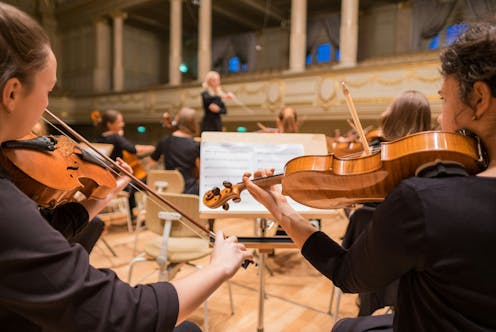
As the largest section of the orchestra, sitting front and centre of the stage performing memorable melodies, it’s easy for violinists to steal the limelight. Ask any violinist why there are so many in an orchestra, and we’ll often reply, tongue-in-cheek: “obviously it’s because we’re the best”.
The real answer is a bit more complex, and combines reasons both logistical and historical.
How we got the modern orchestra
During the Baroque period between around 1600 and 1750, the composition of the orchestra was not standardised, and often used instruments based on availability. Monteverdi’s opera L'Orfeo, which premiered in 1607, is one of the earliest examples of a composer specifying the desired instrumentation.
The size of the orchestra also varied. Johann Sebastian Bach wrote for and worked with ensembles of up to 18 players in Germany. At Palazzo Pamphili in Rome, Corelli directed ensembles of 50–80 musicians – and, on one notable occasion to celebrate the coronation of Pope Innocent XII, an ensemble of 150 string players.
The modern-day violin was also developed around this time, and eventually replaced the instruments of the viol family. The violin has remained a staple member of the orchestra ever since.

Music of this period was created on a smaller scale than much of the repertoire we hear today, and often placed a strong focus on string instruments. As the orchestra became more standardised, members of the woodwind family appeared, including the oboe, bassoon, recorder and transverse flute.
During the classical period from around 1730 to 1820, orchestral performances moved from the royal courts into the public domain, and their size continued to grow. Instruments were organised into sections, and bowed strings formed the majority.
Composers began to use a wider range of instruments and techniques. Beethoven wrote parts for the early double bassoon, piccolo flute, trombone (which was largely confined to church music beforehand), and individual double bass parts (where previously they had often doubled the cello part).
 Marco Ricci, 1676–1729, Italian, active in Britain (1708–10; 1711–16), Rehearsal of an opera, ca. 1709, Oil on canvas.
Yale Center for British Art, Paul Mellon Collection, B1981.25.523.
Marco Ricci, 1676–1729, Italian, active in Britain (1708–10; 1711–16), Rehearsal of an opera, ca. 1709, Oil on canvas.
Yale Center for British Art, Paul Mellon Collection, B1981.25.523.
During the romantic period of the 19th century, composer Hector Berlioz, author of a Treatise on Instrumentation and Modern Orchestration (1841), further developed the symphony orchestra by adding instruments such as the tuba, cor anglais and bass clarinet.
By the end of the 19th century, many orchestras reached the size and proportions we recognise today, with works that require more than 100 musicians, such as Wagner’s Ring Cycle.
What’s size got to do with it?
As increasing numbers of performers and instruments became standard in orchestral repertoire, ensembles became louder, and more string players were needed to balance the sound. The violin is a comparatively quiet instrument, and a solo player cannot be heard over the power of the brass.
Having violinists at the front of the stage also helps the sound reach the audience’s ears without competing to be heard over the louder instruments.
The typical layout of the orchestra has not always been standard. First violinists (who often carry the melody) and second violinists (who typically play a supportive role) used to sit opposite each other on stage.
US conductor Leopold Stokowski rearranged the position of the first and second violinists during the 1920s so they sat next to each other on the left of the stage. This change meant the voices of each string section were arranged from high to low across the stage.
This change was widely adopted and has become a standard setup for the modern orchestra.
Stokowski is known for experimenting with the layout of the orchestra. He once placed the entire woodwind section at the front of the orchestra ahead of the strings, receiving widespread criticism from the audience and musicians. The board of the Philadelphia Orchestra allegedly said the winds “weren’t busy enough to put on a good show”.
Sound, texture and timbre
String players do not need to worry about lung capacity or breaking for air. As such, violinists can perform long melodic passages with fast finger work, and our bows allow for seemingly endless sustain. Melodies written for strings are innumerable, and often memorable.
Having several violinists play together creates a specific sound and texture that is distinct from a solo string player and the other sections of the orchestra. Not only is the sound of every violin slightly different, the rate of each string’s vibration and the movement of each player’s bow varies. The result is a rich and full texture that creates a lush effect.
Today, symphony orchestras are expected to perform an incredibly diverse range of repertoire from classical to romantic, film scores to newly commissioned works. Determining the number of violinists who will appear in any given piece is a question of balance that will change depending on the repertoire.
A Mozart symphony might require fewer than ten wind or brass players, who would be drowned out by a full string section. However, a Mahler symphony requires more than 30 non-string players – meaning far more string players are needed to balance out this sound.
Room for experimentation
Notable exceptions to the orchestra’s standard setup include Charles Ives’ 1908 The Unanswered Question for string orchestra, solo trumpet and wind quartet spread around the room; Stockhausen’s 1958 Gruppen, pour trois orchestres, in which three separate orchestras perform in a horseshoe shape around the audience; and Pierre Boulz’s 1981 Répons featuring 24 performers on a stage surrounded by the audience, who are in turn surrounded by six soloists.
Despite experimentation, the placement and number of instruments in an orchestra has remained relatively standard since the 19th century.
Many aspects of the traditional orchestra’s setup make sense. However, many of the orchestra’s habits come down to tradition and perhaps unconscious alignment with “just the way things are done”.
Authors: Laura Case, Lecturer in Musicology, Sydney Conservatorium of Music, University of Sydney
Read more https://theconversation.com/why-are-the-violins-the-biggest-section-in-the-orchestra-236596


















