

Scientists discover heat-tolerant corals hidden in plain sight. Could it help protect the Great Barrier Reef?
- Written by: Melissa Naugle, PhD Candidate in Coral Ecology, Southern Cross University
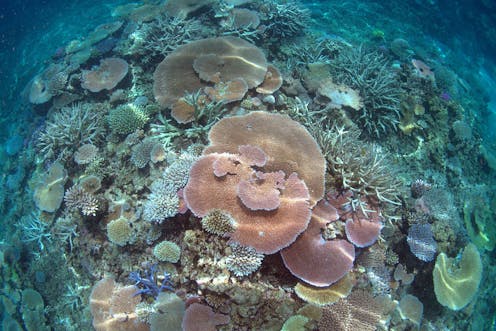
Just as individual humans handle stress differently, so do corals. Even coral colonies of the same species, growing side by side, vary in their tolerance to pressures such as heatwaves.
In research published today, we discovered surprising new evidence of variable heat tolerance in corals. As the world’s oceans warm, these differences are important.
Earlier this year, the world’s fourth global mass bleaching event was declared. The Great Barrier Reef has suffered five mass bleachings since 2016 – most recently this past summer. The declarations followed the world’s warmest year on record.
To keep the world’s coral reefs healthy and functioning, global carbon emissions must be dramatically curbed to reduce the rate of ocean warming. As humanity works towards that goal, interventions may buy time for corals to survive in their warming environments.
What we did
The heat tolerance of corals can be measured by analysing their responses to elevated water temperatures. Our research involved measuring the bleaching thresholds of more than 500 colonies of the tabular coral, Acropora hyacinthus.
Acropora hyacinthus is a common coral that forms “tables” of tiny branchlets. This species is both ecologically important and highly vulnerable to heat waves, making it a prime candidate for conservation.
The characteristic colour of coral is provided by algae living inside its tissue. The algae also provide most of the coral’s nutrition. When water temperatures get too high for too long, the coral expels the algae, causing it to bleach and starve.
While at sea, we visited 17 reefs to scuba dive and search for Acropora hyacinthus. We then brought samples of these corals on board a research vessel to conduct experiments.
Our specially designed portable experiment system contained 12 tanks set to four different temperatures. Coral fragments were placed in each tank and subjected to short-term heat stress at different temperatures.
Afterwards, we measured the amount of pigment left in the coral fragments, which directly aligns with the amount of algae left in the coral’s cells.
We then determined each coral’s bleaching thresholds - in other words, the temperature at which the coral’s pigmentation drops to 50% of its healthy level. This allowed us to understand how much variation exists and where the most heat-tolerant colonies live.
So what did we find? Under our experiments, the amount of pigment retained under high temperatures varied from 3% to 95%. This means at high temperatures, some coral colonies completely bleached while others seemed barely affected.
Of the 17 reefs we studied, 12 contained colonies with bleaching thresholds in the top 25%. This means heat-tolerant corals could be found at most of the reefs we sampled.
Nature versus nurture
Corals handle stress differently for two reasons: nature and nurture.
Each coral has a unique “nature” or genetic makeup that can affect its heat tolerance. Our results suggest corals found across the entire Great Barrier Reef may hold unique genetic resources that are important for recovery and adaptation.
However, aspects of the marine environment may nurture, or hinder, a coral’s heat stress response. These include water temperatures, nutrient conditions, and the symbiotic algae living inside coral tissue.
We found corals living in warmer regions, such as the northern Great Barrier Reef, can handle higher water temperatures. However, because the water is so warm in these areas, the corals are already pushed close to their temperature limits.
Corals in the southern Great Barrier Reef cannot handle temperatures as high as their northern neighbours. Our findings suggest these corals can tolerate more warming above their local temperatures than corals to the north.
These tolerance patterns may affect which corals survive marine heatwaves.
Giving our reefs a future
Our findings have potentially important implications for the ability of corals to adapt to warmer seas under climate change.
The results may also inform reef restoration and conservation efforts. For example, heat-tolerant parent corals could be selectively bred to produce offspring better suited to warmer waters.
The success of such programs depends on the extent to which a coral’s genetic makeup controls its tolerance to heat. So, the next step in this research is investigating these genetic differences.
Selective breeding trials are already underway, using the most heat-tolerant corals identified in this study.
When it comes to protecting our coral reefs, reducing greenhouse gas emissions is imperative. However, interventions such as selective breeding may be useful supplements to give coral reefs the best future possible.
Authors: Melissa Naugle, PhD Candidate in Coral Ecology, Southern Cross University


















