Mercury pollution from decades past may have been re-released by Tasmania's bushfires
- Written by: Larissa Schneider, DECRA fellow, Australian National University
Tasmania’s bushfires may have resulted in the release of significant amounts of mercury from burnt trees into the atmosphere. Our research shows that industrial mercury pollution from decades past has been locked up in west Tasmanian trees.
Mercury occurs naturally in Earth’s crust. Over the past 200 years, industrial activities have mobilised mercury from the crust and released it into the atmosphere. As a consequence, atmospheric mercury concentrations are now three to four times higher than in the pre-industrialisation era.
Mining is the largest source of the global atmospheric mercury, accounting for 37% of mercury emissions. When Europeans first arrived in Australia, there was, of course, no Environmental Protection Act in place to limit emissions from industrial activities. In western Tasmania, where mining has occurred for more than a century, this meant mercury was being released without control into the local atmosphere until changes in technology, market conditions, and later, regulation, conspired to reduce emissions.
Read more: Australia emits mercury at double the global average
Because mercury is also very persistent in the environment, past mining activity has generated a reservoir of mercury that could be released to the atmosphere under certain conditions. This is a concern because even small amounts of mercury may be toxic and may cause serious health problems. In particular, mercury can threaten the normal development of a child in utero and early in its life.
How much mercury has been released into the Australian environment and when has remained largely unknown. However, in a new study we show how mercury levels in Tasmania have dramatically changed over the past 150 years due to mining practices. Long-lived Huon pine, endemic to western Tasmania, is one of the most efficient bioaccumulators of mercury in the world. This makes it a good proxy for tracking mercury emissions in western Tasmania. If concentrations of mercury in the atmosphere are high in a given year, this can be detected in the annual ring of Huon pine for that year.
Mercury pollution from past mining practices in western Tasmania has left a lasting environmental legacy. The sampled trees contained a significant reservoir of mercury that was taken up during the peak mining period in Queenstown. Changes in mercury concentrations in the annual rings of Huon pine are closely aligned with changes in mining practices in the region.
Increased concentrations coincide with the commencement of pyritic copper smelting in Queenstown in 1896. They peak between 1910 and 1920 when smelting was at its height. In 1922, concentrations begin to decline in parallel with the introduction of a new method to separate and concentrate ores. This method required only one small furnace instead of 11 large ones. In 1934, a new dust-collection apparatus was installed in the smelter’s chimney, coinciding with the further decrease in mercury concentrations in nearby Huon pine.
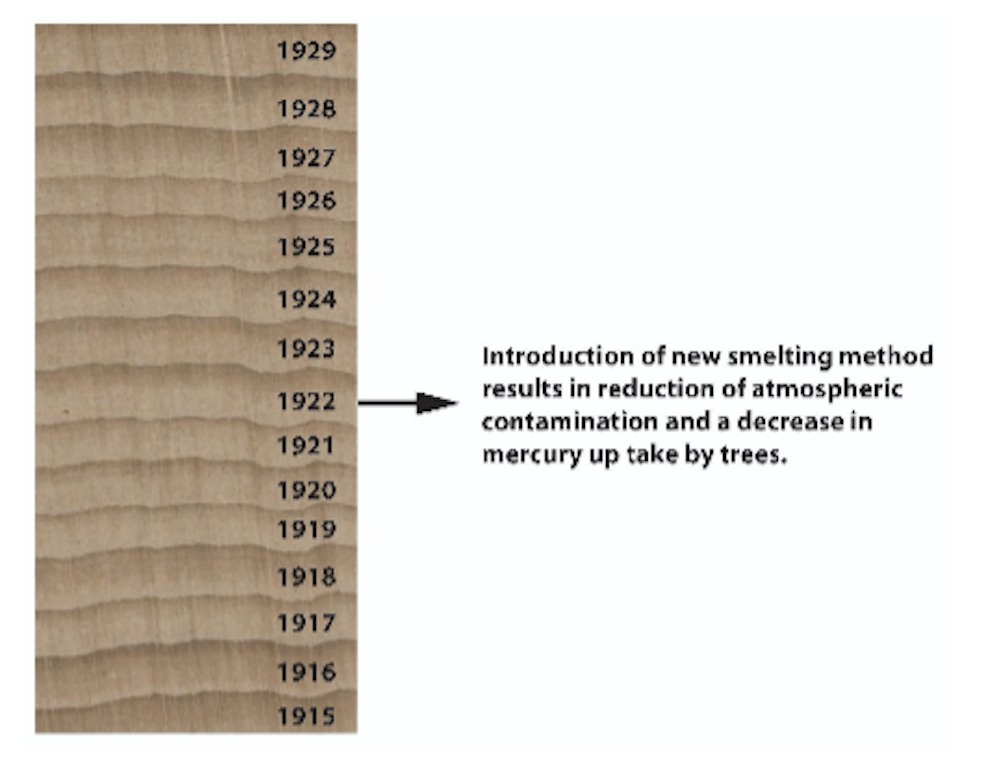 Temporal tree rings of Huon pine, revealing historical mercury pollution.
Author provided
Temporal tree rings of Huon pine, revealing historical mercury pollution.
Author provided
Toxic elements or compounds taken up by vegetation can also be released back into the local environment. Bushfires that burn trees that have accumulated mercury may release this mercury as vapour, dust or fine ash, potentially exposing people and wildlife to the adverse effects of mercury. It is estimated that bushfires release 210,000kg of mercury into the global atmosphere each year. As these fires become more frequent and ferocious in Australia, mercury concentrations in the atmosphere are likely to increase. Mercury released by bushfires can persist in the atmosphere for a year, allowing for long-distance transportation depending on wind strength and direction. This means that mining activity from over a century ago may have regional implications in the near future. The Tasmanian fires in December-February burned almost 200,000 hectares, including areas around Queenstown.
It is not currently possible to know how much mercury has been released by these recent fires. Our results simply highlight the potential risk and the need to better understand the amount of mercury taken up by vegetation that may one day be released back to the atmosphere via bushfires.
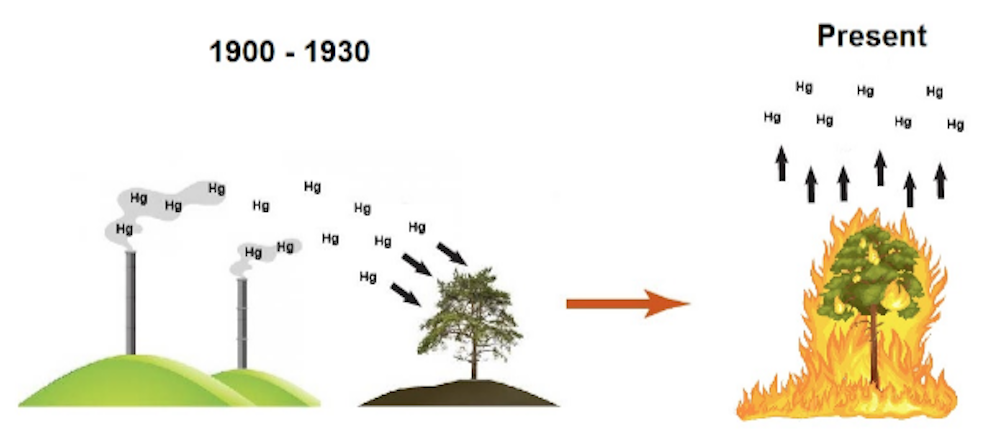 Re-release of historical mercury emissions by bushfires.
Author provided
Re-release of historical mercury emissions by bushfires.
Author provided
Read more: Dry lightning has set Tasmania ablaze, and climate change makes it more likely to happen again
Although there is no simple way to remove bio-accumulated mercury from trees, the history of mercury contamination recorded in tree rings provides important lessons. Decreased uptake of mercury after upgrades to the Queenstown copper smelter operations demonstrates the positive impact that good management decisions can have on the amount of mercury released into the environment.
To control mercury emissions globally, the United Nations Environment Programme (UNEP) has developed the Minamata Convention on Mercury. Its primary goal is to protect human health and the environment from the negative effects of mercury. Australia has signed the convention and but has yet to ratify it. Once ratified, Australia would be required to record sources of mercury and quantify emissions, including those from bushfires.
But to do this, the government must first be able to identify environmental reservoirs of mercury. Our study, the first of its kind in the Southern Hemisphere, shows that the long-lived Huon pine can be used to for this purpose. Further work to determine what other tree species record atmospheric emissions of mercury and other toxic elements in other regions of Australia is required.
Authors: Larissa Schneider, DECRA fellow, Australian National University