

Where do we stash the equivalent of 110 Sydney harbour bridges? That’s the conundrum Australia faces as oil and gas rigs close
- Written by: Darryn Snell, Associate professor, School of Management, RMIT University
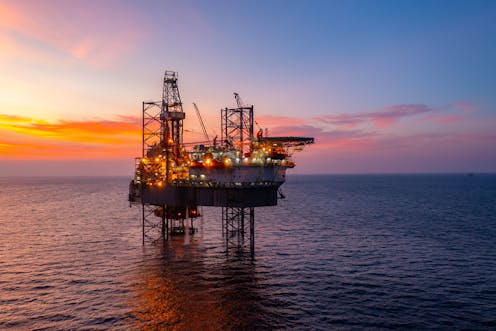
Oil and gas wells are dotted off Australia’s shores. They involve huge steel structures fixed firmly to the sea floor, and thousands of kilometres of pipelines.
Most of Australia’s offshore oil and gas projects will be decommissioned in the next 30 years – some in the next decade. An estimated 5.7 million tonnes of material will need to be removed – the equivalent of 110 Sydney harbour bridges.
Australia desperately needs the skills and equipment to conduct these complex decommissioning operations. The Albanese government says a high-capacity decommissioning facility is required by the early 2030s. At present, no such facilities exist.
We hope the nation welcomes the opportunity to build a new multi-billion dollar demolition and recycling industry, with skilled jobs for workers. Rather than letting companies abandon structures for so-called “artificial reefs”.
What would a decommissioning industry look like?
Australia has two main offshore oil and gas producing areas: the North West Shelf in Western Australia and the Bass Strait off Gippsland, Victoria.
WA and the Northern Territory have 35 platforms, 11 floating facilities and 6,076km of pipelines offshore. Victoria has 22 platforms and 2,089km of pipelines. Altogether, more than a thousand wells will need to be plugged and abandoned.
Many of these facilities have already reached the end of their lives, or soon will. Less demand for fossil fuels in the future means we don’t need to refurbish or extend them. The only other option is to decommission them.
Federal law requires the complete removal of offshore oil and gas infrastructure and plugging of wells, unless companies can come up with a better option.
About 60% of the material requiring removal is steel, which could be recycled. A further 25% is concrete. The remainder includes plastics, hazardous metals and naturally occurring radioactive materials.
But decommissioning is expensive, complex and time consuming, and the weak regulations are poorly enforced. Companies often present proposals that fail to meet community expectations.
The Australasian Centre for Corporate Responsibility argues “further regulation is needed to ensure greater transparency, disclosure, and public consultation on decommissioning”.
The Albanese government has been developing a plan for a decommissioning industry in Australia. It would be worth A$60 billion over the next 30 to 50 years.
The industry would reclaim the materials and transport them to dismantling yards, for safe sorting and recycling. It would create highly skilled jobs, many of which overlap with skills needed for building offshore wind farms. These include:
- electricians and mechanical fitters
- specialist engineering roles
- various management and contract management roles
- health, safety and environmental specialists
- specialist offshore operators, including for cranes and drilling activities.
Currently only a few countries such as Norway and Turkiye have such dedicated decommissioning industries. Some also accept materials from oil and gas fields further afield. Scottish oil and gas rigs, for example, were controversially transported to Turkiye for dismantling and recycling in 2022-23.
Plenty of work to be done
In Gippsland, there may be ways to decommission not just offshore oil and gas, but also coal-fired power stations in the Latrobe Valley, which are scheduled to close in coming years.
Some 30,000 tonnes of steel and 65,000m³ of asbestos was removed when Hazelwood Power Station was demolished. A further 100,000 tonnes of steel and 100,000 tonnes of concrete was recycled.
Much recycling work was done on site. This provided more than 1.1 million hours of work employment badly needed in a region that had lost one of its largest employers.
The WA state government allocated $5 million to a local decommissioning industry in its 2022-23 budget. This funds the Centre of Decommissioning Australia’s research, including a study investigating how to develop a dismantling hub in WA.
Unfortunately, Victoria has not shown similar interest. This is despite decommissioning work by Esso in Bass Strait raising ongoing community concerns. They relate to the marine environment, human safety – for fishing, beach and tourism activities – and the loss of other potential industry and job opportunities.
Whether to remove oil and gas structures or leave them in place is hotly debated. Some people argue the structures should be left to serve as artificial reefs. Others say the material is dangerous and potentially toxic.
Given the immense size and number of oil and gas platforms around the world, a lot of material could be left to decay in the oceans with unknown consequences.
Gas in the Bass Strait is running out but what will happen to the offshore rigs? | 7.30.Challenges and opportunities
Renewable energy promises to create jobs and revitalise many fossil-fuel dependent regions. Setting up a decommissioning industry in the oil and gas regions of WA and Victoria would provide further opportunities during the transition.
Ideally, the decommissioning process would deliver positive social and environmental benefits, not just cost savings. But that requires managing decommissioning as part of policies aimed at supporting workers and communities to adjust to a low carbon economy.
The Future Made in Australia policy, for instance, could consider including support for a decommissioning industry.
Regulations for decommissioning of oil and gas infrastructure must be strengthened. Environmental groups and unions are increasingly campaigning for these changes. Australia’s oil and gas companies are powerful and will likely resist further regulation.
Abandoning oil and gas infrastructure on the ocean floor would result in lost opportunities for regions, communities and workers. It would also set a precedent for the dumping of yet more industrial waste into the ocean.
We must get decommissioning right. Otherwise, it may prove another environmental harm imposed on the planet by the oil and gas industry.
Authors: Darryn Snell, Associate professor, School of Management, RMIT University


















