

When even fringe festival venues exclude people with disability, cities need to act on access
- Written by: Shane Clifton, Associate Professor of Practice, School of Health Sciences and the Centre for Disability Research and Policy, University of Sydney
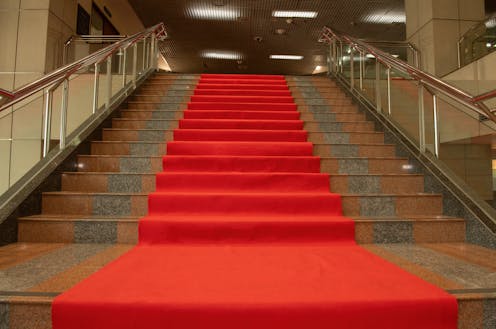
It’s about time city councils did more to make our cities accessible. I recently tried to buy tickets to two Sydney Fringe Festival events, only to be told by the box office that the venues were not wheelchair-accessible.
Sydney remains a place where people with disability feel like they don’t belong. The same is true of other Australian cities. But local councils don’t bear all the blame.
Event organisers are responsible for selecting venues. In the case of the Fringe Festival, they chose locations inaccessible to wheelchair users and others with mobility challenges. It’s a bitter irony that a fringe festival, which ostensibly empowers artists and creatives on the margins, would exclude people with disability.
If event organisers (and every one of us) decided never to hire inaccessible venues, then the market might solve the issue. But those of us with disability are realistic enough to know most people don’t care – or don’t give us a thought. The market hasn’t solved the problem, so it’s up to governments.
The problems go beyond arts venues
Inaccessible venues are only the tip of the iceberg. Countless restaurants, shops and offices are inaccessible, with steps on entry, inaccessible bathrooms and narrow and cluttered aisles.
“Spend the day in my wheelchair” programs are sometimes criticised for trivialising the challenge of disability. However, they do unmask how frustrating and alienating our cities and towns can be.
Google Maps now indicates whether premises are accessible. Those that are bear the universal symbol of disability access – the stylised blue wheelchair. Even then, a person with a disability is just as likely as not to turn up and discover a lift has broken down, a doorway has been blocked off, a bathroom has been used for storage, or a venue is only partially accessible (it’s always the cool spaces that are out of reach).
The Commonwealth and states brought in disability discrimination laws in the 1990s. These have made some difference, but their many exemptions let businesses off the hook. (See the Disability Royal Commission’s recommendations to amend the Disability Discrimination Act 1992.)
More than 30 years down the track, our cities and towns remain bastions of exclusion.
Read more: What does a building need to call itself 'accessible' – and is that enough?
Better access benefits everyone
Landowners and businesses typically complain providing access for the few affected people is too costly. In reality, making our public spaces accessible often requires little more than determined creative design. The costs are a mere fraction of what we spend on other things we judge as more important.
We also underestimate the value added by accessible design.
The Kerb-Cut Effect, for example, describes how designing for people with disability often benefits everyone. The term refers to the impact of activist action in California in the 1970s. Disability advocates in the city of Berkeley poured concrete onto road kerbs to create ramps giving wheelchair users access to footpaths.
These ramps also proved valuable to parents pushing children in strollers, older people and cyclists. Refined into kerb cuts, they spread rapidly around the world.
There are many other examples. Television captioning, developed for people who are deaf and hard of hearing, is now widely used by non-disabled people. Audiobooks, developed for people who are blind, are now a common way that many other people enjoy books.
Accessible venues will not just benefit wheelchair users. Older people, those with impaired mobility and people who push prams and tow suitcases all benefit. Indeed, if we make venues accessible to those on the margins, no one is excluded.
The UN Convention on the Rights of Persons with Disabilities highlights the importance of universal design. The convention insists on
the design of products, environments, programs and services to be usable by all people, to the greatest extent possible, without the need for adaptation or specialised design.
Why use steps that exclude some people when everyone can use a ramp or a lift?
Why councils must lead the way
Accessibility in cities is about more than just wheelchairs; it requires a comprehensive approach to urban planning to meet the varied needs of all citizens. This includes providing sensory aids like audio signals, braille signage and visual measures for people who are blind, deaf or hard of hearing. It’s also crucial that information on public services and events is easily available to everyone in formats they can access and understand.
My focus has been on access to public spaces, but we also need to turn our attention to private homes. Wheelchair users and people with other mobility impairments can’t access most private houses in Australia. There is a drastic lack of accessible housing for people with disability and the cost of retrofitting access is exorbitant.
New South Wales is yet to follow the lead of other states and territories by signing up to the Silver Liveable Housing Design Standards. These standards are part of the revised National Construction Code. They require new housing developments to offer basic accessibility for all people.
We can and must do better. Every level of government can contribute to change.
However, new builds and renovations are often decided upon at the regional level. This means local councils should bear much of the responsibility.
A determined effort by our mayors and councillors to insist premises are accessible will be better for everyone. From a selfish perspective, it might mean I could go out to dinner or a festival without worrying if I can get in the door.
Authors: Shane Clifton, Associate Professor of Practice, School of Health Sciences and the Centre for Disability Research and Policy, University of Sydney


















