

Google AI


Modern Australian

Physics Nobel awarded to neural network pioneers who laid foundations for AI

  • Written by: Aaron J. Snoswell, Research Fellow in AI Accountability, Queensland University of Technology
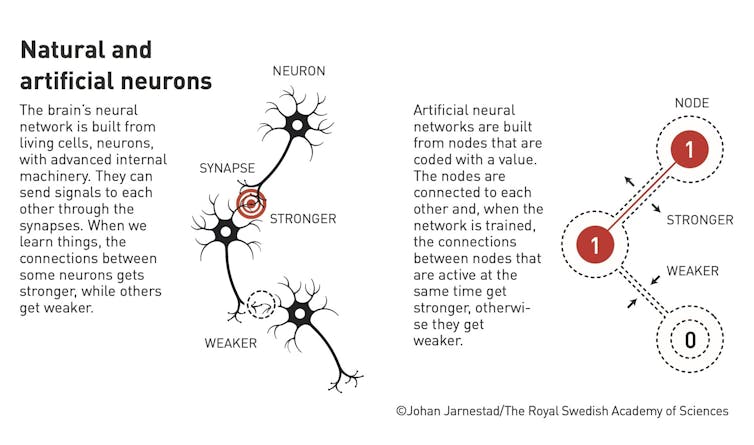
Infographic comparing natural and artificial neurons.

The 2024 Nobel Prize in Physics has been awarded to scientists John Hopfield and Geoffrey Hinton “for foundational discoveries and inventions that enable machine learning with artificial neural networks”.

Inspired by ideas from physics and biology, Hopfield and Hinton developed computer systems that can memorise and learn from patterns in data. Despite never directly collaborating, they built on each other’s work to develop the foundations of the current boom in machine learning and artificial intelligence (AI).

What are neural networks? (And what do they have to do with physics?)

Artificial neural networks are behind much of the AI technology we use today.

In the same way your brain has neuronal cells linked by synapses, artificial neural networks have digital neurons connected in various configurations. Each individual neuron doesn’t do much. Instead, the magic lies in the pattern and strength of the connections between them.

Neurons in an artificial neural network are “activated” by input signals. These activations cascade from one neuron to the next in ways that can transform and process the input information. As a result, the network can carry out computational tasks such as classification, prediction and making decisions.
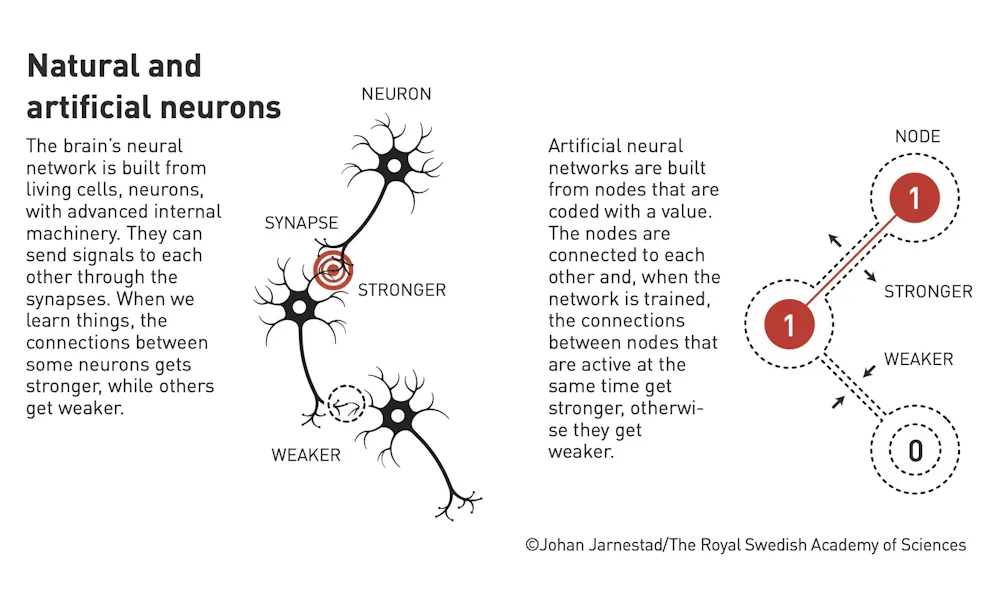
Infographic comparing natural and artificial neurons.
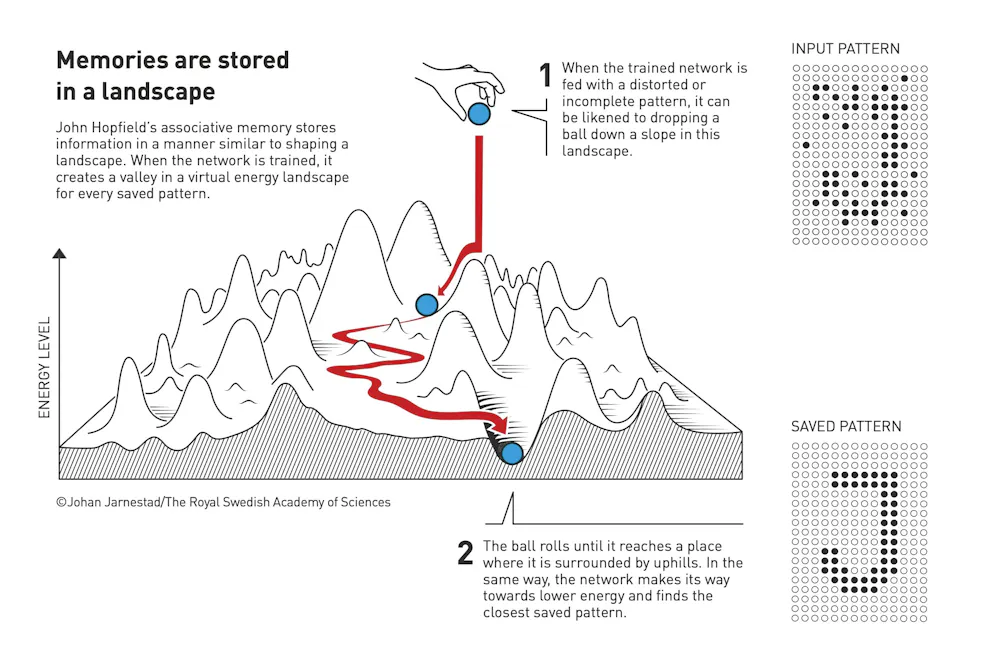
Johan Jarnestad / The Royal Swedish Academy of Sciences Most of the history of machine learning has been about finding ever more sophisticated ways to form and update these connections between artificial neurons. While the foundational idea of linking together systems of nodes to store and process information came from biology, the mathematics used to form and update these links came from physics. Networks that can remember John Hopfield (born 1933) is a US theoretical physicist who made important contributions over his career in the field of biological physics. However, the Nobel Physics prize was for his work developing Hopfield networks in 1982. Hopfield networks were one of the earliest kinds of artificial neural networks. Inspired by principles from neurobiology and molecular physics, these systems demonstrated for the first time how a computer could use a “network” of nodes to remember and recall information. The networks Hopfield developed could memorise data (such as a collection of black and white images). These images could be “recalled” by association when the network is prompted with a similar image. Although of limited practical use, Hopfield networks demonstrated that this type of ANN could store and retrieve data in new ways. They laid the foundation for later work by Hinton. Infographic showing how a neural network can store information as a kind of 'landscape'. Johan Jarnestad / The Royal Swedish Academy of Sciences Machines that can learn Geoff Hinton (born 1947), sometimes called one of the “godfathers of AI”, is a British-Canadian computer scientist who has made a number of important contributions to the field. In 2018, along with Yoshua Bengio and Yann LeCun, he was awarded the Turing Award (the highest honour in computer science) for his efforts to advance machine learning generally, and specifically a branch of it called deep learning. The Nobel Prize in Physics, however, is specifically for his work with Terrence Sejnowski and other colleagues in 1984, developing Boltzmann machines. These are an extension of the Hopfield network that demonstrated the idea of machine learning – a system that lets a computer learn not from a programmer, but from examples of data. Drawing from ideas in the energy dynamics of statistical physics, Hinton showed how this early generative computer model could learn to store data over time by being shown examples of things to remember. Infographic showing different types of neural network. Johan Jarnestad / The Royal Swedish Academy of Sciences The Boltzmann machine, like the Hopfield network before it, did not have immediate practical applications. However, a modified form (called the restricted Boltzmann machine) was useful in some applied problems. More important was the conceptual breakthrough that an artificial neural network could learn from data. Hinton continued to develop this idea. He later published influential papers on backpropagation (the learning process used in modern machine learning systems) and convolutional neural networks (the main type of neural network used today for AI systems that work with image and video data). Why this prize, now? Hopfield networks and Boltzmann machines seem whimsical compared to today’s feats of AI. Hopfield’s network contained only 30 neurons (he tried to make one with 100 nodes, but it was too much for the computing resources of the time), whereas modern systems such as ChatGPT can have millions. However, today’s Nobel prize underscores just how important these early contributions were to the field. While recent rapid progress in AI – familiar to most of us from generative AI systems such as ChatGPT – might seem like vindication for the early proponents of neural networks, Hinton at least has expressed concern. In 2023, after quitting a decade-long stint at Google’s AI branch, he said he was scared by the rate of development and joined the growing throng of voices calling for more proactive AI regulation. After receiving the Nobel prize, Hinton said AI will be “like the Industrial Revolution but instead of our physical capabilities, it’s going to exceed our intellectual capabilities”. He also said he still worries that the consequences of his work might be “systems that are more intelligent than us that might eventually take control”. Authors: Aaron J. Snoswell, Research Fellow in AI Accountability, Queensland University of Technology


Read more https://theconversation.com/physics-nobel-awarded-to-neural-network-pioneers-who-laid-foundations-for-ai-240833

Breach of Contract in Business: What Are Your Options?

Contracts are essential to business relationships. They establish expectations, allocate responsibilities and provide a framework for delivering goods...

How Pest Control Companies Can Rank for the Problems Customers Search First

Introduction SEO for Pest Control needs to start with the customer’s problem. Most people do not search for pest services in a neat or technical wa...

What Are the Benefits of Renovating an Older Home in Sydney?

Sydney has plenty of character homes, from Federation cottages to mid-century brick homes. Renovating rather than rebuilding can preserve what makes t...

Pool and Deck Design: How to Plan the Perfect Outdoor Living Space for Your Sydney Home

For many Australians, the backyard is where life happens. Summer barbecues, weekend swims and long evenings outdoors are all part of the lifestyle, ...

Is Solar Pool Heating Worth It? What Sydney Homeowners Should Know

There's nothing quite like a backyard pool on a hot Sydney day. But once autumn rolls in, many pools sit unused for months because the water is simp...

Planning a Luxury House Move: A Week-by-Week Timeline for Prestige Sydney Homes

Selling or buying a prestige home is a major milestone. Whether it's a waterfront residence in Birchgrove, a grand Federation home in Haberfield or ...

Downsizing or Upgrading Your Caravan? Here's How to Sell It Without the Hassle

Selling a caravan can feel like a major task, especially when you are unsure about its value, paperwork, or how to find a buyer. Whether you are dow...

The Best Overseas Adventure Holidays for Australians Who Love the Outdoors

Australia offers no shortage of incredible outdoor experiences, but sometimes the best way to satisfy your sense of adventure is to head overseas. A...

Cape Town Wine Shuttle: Winelands Tasting & Tours

Embark on an unforgettable journey through the picturesque Cape Winelands, where world-class wines and breathtaking scenery await. Our Cape Town Win...

Metal Fabrication: Choosing Metal Fabrication Melbourne Services for Custom Projects

What Modern Metal Fabrication Involves From individual components to complete structures, metal fabrication brings together processes such as desig...

Why Giant Rats Tail Grass Keeps Coming Back After Spraying

Giant Rats Tail Grass (GRT) is one of the most frustrating pasture weeds for farmers and lifestyle property owners. You spray an infested area, see th...

When Custom Cardboard Boxes Make Sense for Your Business

Custom cardboard boxes can be useful when a standard carton does not fit a product, packing method or presentation requirement particularly well. A ...

Full-Height vs. Pop-Top Caravan: Which Is Better for Family Travel across WA?

A pop-top caravan is an excellent choice for travellers who want the comfort of a caravan without committing to a larger, bulkier setup. With a lowe...

Bottle Label Printing: Key Factors for a Professional Finish

Why the Printing Method Matters When businesses need packaging or printed containers developed for a particular application, the right supplier can m...

Virtual Livestock Fencing and GPS Tracking: Improving Visibility Across Cattle Properties

What Virtual Livestock Fencing Means for Modern Cattle Management Managing cattle across extensive properties requires more than knowing where anim...

Sydney Pawnbrokers Explained: How Hocking Your Car Actually Works

Sometimes you need cash, and you need it soon. If you own a car, you may already have a way to get it. That's what people mean when they say they've...

Moving Interstate from the Gold Coast to Brisbane (or Back)? What Removalists Wish You Knew First

Have you talked to anyone who’s done the move? They say the same thing: the drive up the M1 is the easy part. It's everything around it that catches...

Why the Spring School Holidays Are a Great Time to Visit Coffs Harbour

The spring school holidays are a good time to spend a few days on the Coffs Coast. The weather is starting to warm up, there is plenty to do outdoor...
















