

Modern Australian
The Times

Clues left by the Alpine Fault’s last big quake reveal its direction – this will help NZ prepare for the inevitable next rupture

  • Written by Jesse Kearse, Postdoctoral Researcher in Seismology, Kyoto University
Clues left by the Alpine Fault’s last big quake reveal its direction – this will help NZ prepare for the inevitable next rupture

One of the world’s most anticipated earthquakes is the next major surface rupture of the Alpine Fault in the South Island of New Zealand.

With a 75% chance of it happening within the next 50 years, there is justified interest in the likely magnitude, extent and intensity of ground shaking and impacts on the landscape, infrastructure and buildings.

A key – and so far unanswered – question is which direction the fault rupture will take.

Our new research reveals for the first time that the Alpine Fault ruptured from south to north in the great magnitude 8+ earthquake of 1717.

We developed our technique to determine rupture direction based on the Kekerengu Fault after the 2016 Kaikōura earthquake. But our method is globally applicable for use in realistic earthquake scenarios and thus can contribute to better societal preparedness.

In an Alpine Fault earthquake, there’s no direction that’s good news for the West Coast of the South Island. But a north-to-south rupture would send excess seismic energy into the relatively unpopulated region of Fiordland and the Tasman Sea.

A south-to-north rupture on the other hand is forecast to cause higher intensity shaking in the populated regions of Canterbury, Marlborough, Tasman and the northern West Coast.

A simulation of the shaking of a south-to-north earthquake along the Alpine Fault. Credit: Brendon Bradley, University of Canterbury.

In the Kaikōura earthquake, Wellingtonians experienced this influence of rupture direction on shaking intensity. The south-to-north rupture meant more seismic energy was focused towards the capital city than, for example, Christchurch.

So, while rupture direction has been observed to make a big difference in modern earthquakes, it is not something geologists have been able to directly determine for past earthquakes.

The Kaikōura earthquake was well documented by seismographs. We know it started near Waiau in the south and travelled northwards to Cook Strait over a period of two minutes.

We observed markings that were scratched onto the fault plane. Like coarse sandpaper against wood, these scratches, or “slickenlines”, record movement as rock faces slipped past each other during the earthquake. Some of these markings were curved, and our method can tell us the direction the earthquake rupture was travelling.

Slickenlines from the Kekerengu Fault, taken days after the 2016 Kaikōura earthquake.
Slickenlines from the Kekerengu Fault, taken days after the 2016 Kaikōura earthquake. Kate Clark, CC BY-SA

Using computer models to simulate how the earthquake unfolded moment by moment, we were able to replicate the curved slickenlines observed in the field and relate them to rupture direction. This gave us the framework we needed to investigate rupture direction for past earthquakes on the Alpine Fault.

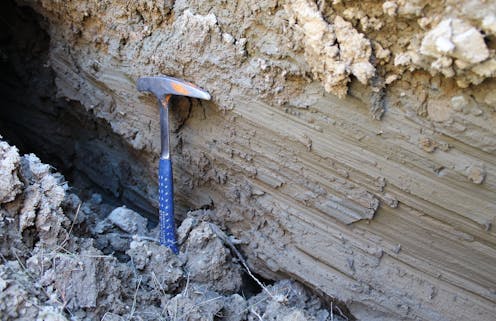
The Alpine Fault hasn’t had a major surface rupture since 1717. During field work, we visited three sites along the fault and examined natural outcrops, carefully exposing the fault plane using hand tools. We found 146 slickenlines, 30 of which were curved.

Geologist Tim Little measuring slickenlines on the Alpine Fault.
Geologist Tim Little measuring slickenlines on the Alpine Fault. Nic Barth, CC BY-SA

The curved geometry of slickenlines from the Alpine Fault’s most recent earthquake indicated it had travelled from the south towards the north. We also found evidence for rupturing in the opposite direction, suggesting that earthquakes can start both north and south.

On one outcrop, we found evidence of slickenlines from multiple earthquakes – a rare and tantalising find suggesting development of a longer history of rupture direction may be possible.

The technique we’ve applied is a novel, on-fault observational method for determining past rupture directions. Its full potential is yet to be tested, but already it’s applicable to faults worldwide.

Our research shows that the last Alpine Fault rupture was from the south, and that both directions are possible. New information about past earthquakes like this helps the scientific community produce realistic scenarios for the next major earthquake.

We now have direct evidence from the fault itself that we need to prepare for the scenario of very strong to severe shaking for the northern West Coast, Tasman, Marlborough and Canterbury regions in the next major Alpine Fault earthquake.

Authors: Jesse Kearse, Postdoctoral Researcher in Seismology, Kyoto University

Read more https://theconversation.com/clues-left-by-the-alpine-faults-last-big-quake-reveal-its-direction-this-will-help-nz-prepare-for-the-inevitable-next-rupture-240879

The Connection Between Visibility and Driver Confidence

Operating a vehicle safely requires an immediate, uncompromised stream of visual information from the surrounding road environment. A driver's decis...

Important Things To Know Before Starting An SMSF Setup

Planning for retirement requires careful financial decisions, and many Australians are now looking for more direct control over how their superannua...

Why Retail Cleaning Plays a Key Role in Customer Experience and Business Success

Professional retail cleaning services are an essential part of maintaining a welcoming, safe, and professional environment for customers and staff...

Simple Ways to Make a Commercial Property More Appealing to Buyers

Selling or leasing a commercial property isn’t just about listing the square metres, taking a few photos and waiting for the right person to appea...

What Café Owners Should Know Before Upgrading Their Display Setup

A café display fridge does a lot more than keep cakes cold and sandwiches fresh. It quietly shapes the way customers browse, the way staff move beh...

Creating a Backyard That Feels Comfortable All Year Round

A great backyard doesn’t need to be huge, expensive or perfectly styled. Most of the time, the spaces people actually use are the ones that feel e...

How Homeowners Can Make Smarter Energy Decisions Before Upgrading

Energy upgrades used to feel like something you only looked into after a power bill gave you a nasty surprise. These days, though, more homeowners a...

Why Retail CX Breaks During Peak Sales Events and How to Prevent It

Retail customer experience has become one of the most important drivers of revenue growth, especially during high-intensity sales periods. However, ev...

15 South Indian Dishes Everyone Should Try

If your only experience of "Indian food" is butter chicken and garlic naan, South Indian cuisine is going to feel like discovering an entirely new c...

What Every Homeowner Should Know About Roof and Drainage Maintenance

A home's roof and drainage system work together every day to protect the property from water damage. While many homeowners focus on visible areas such...

From Plans to Priced Quote: The Estimating Workflow Most Builders Skip

For a small one-off job, an experienced builder can size up the materials in their head. The problem is that most jobs are not small one-off jobs, and...

Organisational Experts Share Their Tips for Achieving a Clutter-Free Kitchen

They say the kitchen is the heart of a house which means a clutter-free kitchen not only makes your home in general look nicer, it also makes cookin...

10 Creative Ways AI Image Extenders Are Transforming Digital Content Creation in 2026

Introduction Artificial intelligence continues to reshape the digital landscape, and one of the most exciting innovations in 2026 is the rise of AI i...

What to Do When You're Arrested in Victoria

Most people have thought about this in the abstract. A knock at the door, a hand on the shoulder, a car pulled over on the Hume. In the abstract, th...

Common Financial Disputes During Separation

Separation hits on many levels, not just emotionally. When a partnership ends, untangling the financial side — assets, debts, and everything built t...

Why Posting More Content is Killing Your Brand

More content. More often. More platforms.Most brands have been running this playbook for three years. Most brands have nothing to show for it.Not be...

Garden Clean-Up vs. Regular Maintenance: Which Do You Really Need?

Most people ring a gardener and ask for a "tidy up." What they mean by that, and what the garden actually needs, are often two completely different ...

Solar Panel Maintenance Tips for Melbourne Homes

Three years in and the panels are still on the roof. The inverter is still blinking. The electricity bills are still lower than they used to be, rou...

















