

Ocean life, games and the digital revolution converge in Richard Powers’ Playground
- Written by: Julian Novitz, Senior Lecturer, Writing, Department of Media and Communication, Swinburne University of Technology
Richard Powers’ latest novel Playground draws a distinction between two different kinds of games. There are finite games that we play to win: the aim is to defeat others and demonstrate our superiority and excellence. Then there are infinite games, played for the pleasure of the game itself. The joy of infinite games is not competition, but the discovery of new strategies and moves that previously seemed impossible.
Review: Playground – Richard Powers (Hutchinson Heinemann)
The protagonists of Playground, Rafi Young and Todd Keane, are driven to explore both kinds of play. They connect as troubled teenagers at an elite Chicago private school through their shared love of board games. Rafi is a black scholarship student with an omnivorous love of literature. Todd, from an affluent white family, struggles with people but excels with computers.
Though very different, Rafi and Todd are fundamentally curious players, delighting in unexpected connections and the possibilities they give rise to. But they are also competitive, compelled to find ever-evolving paths to dominance and victory, in their relationships with the world and with one another.
These conflicting impulses create a question that seems to hang over the novel. Do we play to make the best moves that we possibly can? Or to wreck the game for someone else?
Converging plotlines
While Rafi and Todd’s complex friendship is at the heart of Playground, the novel has many slowly converging plotlines and characters.
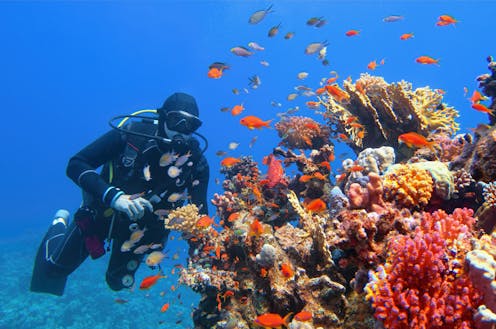
The present-day action focuses on the tiny island of Makatea in French Polynesia, where a now middle-aged Rafi, who works as a teacher, lives with his artist wife Ina and their two adopted children. The underpopulated island, scarred by the legacy of phosphorus mining and hydrogen bomb testing, is being visited by the 93-year old Evie Beaulieu, a famous oceanographer, who was once Todd’s childhood idol. Evie is there to explore the bountiful sea life in the reefs surrounding Makatea.
The isolated island has attracted other attention. An American conglomerate plans to use the island as a base for a “seasteading” venture, which will eventually launch floating, autonomous cities onto the open ocean.
Meanwhile, Todd, now a tech billionaire and AI pioneer, is wrestling with a diagnosis of Lewy body dementia, a condition that will come to affect his memory, communication and motor functions.

 Richard Powers.
Penguin Random House
To some extent, their contrasting attitudes derive from the turmoil of their respective backgrounds. Rafi has been propelled towards excellence by a broken home and a family tragedy, both of which he feels responsible for. He is driven by a maddening and eventually isolating desire for exactitude and precision in his writing. He insists, above all else, that he must win on his own terms.
Todd grew up in the middle of an endless hot-and-cold “wargame” played between his unhappy parents. He is therefore drawn to logic, rules and order. He ultimately seeks a different kind of perfection: the dispassionate calculations and movements of autonomous, self-playing machines.
These differing philosophies inform Rafi and Todd’s various cooperative and competitive games throughout their close friendship in high school and university. Their freewheeling play eventually inspires “Playground”, an early social media platform, which gamifies social interactions and the sharing of knowledge, and which becomes the basis of Todd’s fortune. But their differences prove to be irreconcilable. They slide into a distant long game, which plays out in the decades following the dramatic collapse of their friendship.
Wonder and complexity
Much like Powers’ earlier novel The Overstory (2018), Playground explores the deep enmeshment of human, environmental and technological territories, drawing together seemingly discrete subjects: games and play, ocean life, machine learning, art and literature. But the narrative strands of Playground do not converge as fluidly or as satisfyingly.
Richard Powers.
Penguin Random House
To some extent, their contrasting attitudes derive from the turmoil of their respective backgrounds. Rafi has been propelled towards excellence by a broken home and a family tragedy, both of which he feels responsible for. He is driven by a maddening and eventually isolating desire for exactitude and precision in his writing. He insists, above all else, that he must win on his own terms.
Todd grew up in the middle of an endless hot-and-cold “wargame” played between his unhappy parents. He is therefore drawn to logic, rules and order. He ultimately seeks a different kind of perfection: the dispassionate calculations and movements of autonomous, self-playing machines.
These differing philosophies inform Rafi and Todd’s various cooperative and competitive games throughout their close friendship in high school and university. Their freewheeling play eventually inspires “Playground”, an early social media platform, which gamifies social interactions and the sharing of knowledge, and which becomes the basis of Todd’s fortune. But their differences prove to be irreconcilable. They slide into a distant long game, which plays out in the decades following the dramatic collapse of their friendship.
Wonder and complexity
Much like Powers’ earlier novel The Overstory (2018), Playground explores the deep enmeshment of human, environmental and technological territories, drawing together seemingly discrete subjects: games and play, ocean life, machine learning, art and literature. But the narrative strands of Playground do not converge as fluidly or as satisfyingly.
 The voting and collective deliberation by the population of Makatea is the least interesting plotline. The diffusion of voices and viewpoints means that none of the characters feel particularly distinct. The awkward small-town comedy – despite the high stakes – sits uneasily alongside the deeper narratives of Evie and Todd.
The novel’s two central preoccupations – ocean life and gameplay – also feel quite tenuously linked, though their exploration is individually compelling. “If you want to make something smarter, teach it to play,” Evie notes at one point in relation to marine life. Todd expresses a similar sentiment about computers, which can learn to master complex games by playing against themselves millions of times.
The ocean is understood as its own “playground”, where the rules are seemingly infinite and unknown. But beyond this, the narratives of Evie’s underwater explorations and Todd and Rafi’s long-running games seem to run in parallel. They seldom overlap or comment on one another in a significant way. A late plot twist, which shifts the register of reality in the novel, does some work to connect these elements, but this development is curiously understated. Its ramifications for the questions Playground raises are not really explored.
While Playground is structurally underwhelming compared to Powers’ earlier works, it is as emotionally powerful as any of his previous offerings. Evie’s narrative captures the rapture of her encounters in the deep, and the sense of discovering a vast unknown world:
She wrote of swimming at night in the black, warm water of the South China Sea, where every paddle of her limbs triggered a swirling Milky Way of animals flashing blue and white. Three-quarters of ocean species, from zooplankton to giant squid, were signalling in a language of living light.
Playground is keenly aware of the threats faced by the ocean. Much of its abundant and mysterious life may disappear before we have had the chance to properly discover it. Through Evie, Powers focuses on the sheer joy of exploration.
Similarly, Rafi and Todd’s intertwined narratives are profoundly affecting. They are two extraordinarily different people, who come to understand one another through play – better than anyone else in the world, perhaps, but still, heartbreakingly, not well enough. Powers treats their contrasting philosophies of play with respect and sympathy, but does not shy from exploring the consequences of their respective endgames. The sense of endless possibility that once accompanied their movements, strategies and exchanges cannot be preserved forever. All human games inevitably become finite.
Powers’ strength as a novelist lies in his ability to express awe and wonder – towards nature, technology, or the often baffling complexities of the human mind. The depth and detail of his descriptions, whether of ocean life or gameplay, are used to share a sense of amazement. This extends to his frequent considerations of neurodiversity and different forms of consciousness and intelligence in animals, machines and fauna – themes which Playground touches upon, like its predecessors The Overstory and Bewilderment (2021).
Powers is remarkably generous in his varied considerations of the world and our place within it. He has a gift for making complexity feel majestic rather than overwhelming. Playground likens existence to a vast, infinitely variable game, governed by barely knowable, yet deeply interconnected rules. There are no perfect strategies, and the consequences of a single move may ripple across the entire board. Powers is able to reassure us that the human playing pieces, while small, are never insignificant.
Authors: Julian Novitz, Senior Lecturer, Writing, Department of Media and Communication, Swinburne University of Technology
The voting and collective deliberation by the population of Makatea is the least interesting plotline. The diffusion of voices and viewpoints means that none of the characters feel particularly distinct. The awkward small-town comedy – despite the high stakes – sits uneasily alongside the deeper narratives of Evie and Todd.
The novel’s two central preoccupations – ocean life and gameplay – also feel quite tenuously linked, though their exploration is individually compelling. “If you want to make something smarter, teach it to play,” Evie notes at one point in relation to marine life. Todd expresses a similar sentiment about computers, which can learn to master complex games by playing against themselves millions of times.
The ocean is understood as its own “playground”, where the rules are seemingly infinite and unknown. But beyond this, the narratives of Evie’s underwater explorations and Todd and Rafi’s long-running games seem to run in parallel. They seldom overlap or comment on one another in a significant way. A late plot twist, which shifts the register of reality in the novel, does some work to connect these elements, but this development is curiously understated. Its ramifications for the questions Playground raises are not really explored.
While Playground is structurally underwhelming compared to Powers’ earlier works, it is as emotionally powerful as any of his previous offerings. Evie’s narrative captures the rapture of her encounters in the deep, and the sense of discovering a vast unknown world:
She wrote of swimming at night in the black, warm water of the South China Sea, where every paddle of her limbs triggered a swirling Milky Way of animals flashing blue and white. Three-quarters of ocean species, from zooplankton to giant squid, were signalling in a language of living light.
Playground is keenly aware of the threats faced by the ocean. Much of its abundant and mysterious life may disappear before we have had the chance to properly discover it. Through Evie, Powers focuses on the sheer joy of exploration.
Similarly, Rafi and Todd’s intertwined narratives are profoundly affecting. They are two extraordinarily different people, who come to understand one another through play – better than anyone else in the world, perhaps, but still, heartbreakingly, not well enough. Powers treats their contrasting philosophies of play with respect and sympathy, but does not shy from exploring the consequences of their respective endgames. The sense of endless possibility that once accompanied their movements, strategies and exchanges cannot be preserved forever. All human games inevitably become finite.
Powers’ strength as a novelist lies in his ability to express awe and wonder – towards nature, technology, or the often baffling complexities of the human mind. The depth and detail of his descriptions, whether of ocean life or gameplay, are used to share a sense of amazement. This extends to his frequent considerations of neurodiversity and different forms of consciousness and intelligence in animals, machines and fauna – themes which Playground touches upon, like its predecessors The Overstory and Bewilderment (2021).
Powers is remarkably generous in his varied considerations of the world and our place within it. He has a gift for making complexity feel majestic rather than overwhelming. Playground likens existence to a vast, infinitely variable game, governed by barely knowable, yet deeply interconnected rules. There are no perfect strategies, and the consequences of a single move may ripple across the entire board. Powers is able to reassure us that the human playing pieces, while small, are never insignificant.
Authors: Julian Novitz, Senior Lecturer, Writing, Department of Media and Communication, Swinburne University of Technology 

















