

This beautiful peacock spider was only found two years ago. Now it could be dancing its last dance
- Written by: Lizzy Lowe, Vice Chancellor's Research Fellow in Ecology and Entomology, Edith Cowan University
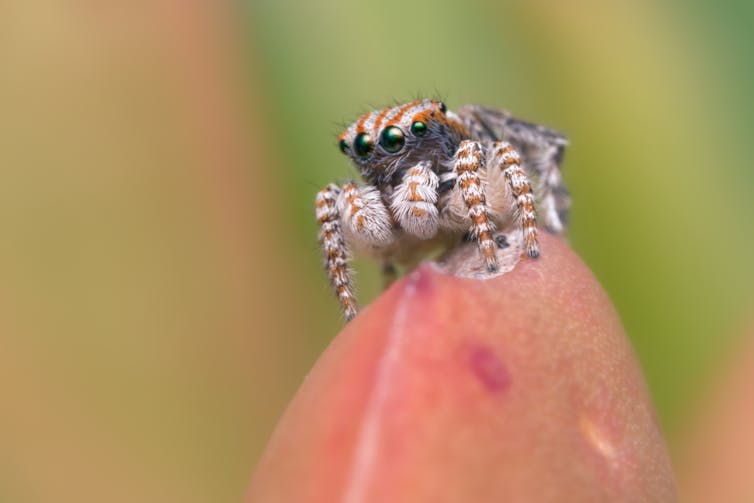
If you notice a tiny, strikingly coloured spider performing an elaborate courtship dance, you may have seen your first peacock spider.
New species of peacock spider are discovered every year; the tally is now 113. One newly discovered species, Maratus yanchep, is only known to exist in a small area of coastal dunes near Yanchep, north of Perth.
As Perth’s suburbs sprawl ever further north and south, it means one problem – the housing crisis – is worsening another, the extinction crisis.
The dunes which are home to Maratus yanchep are just 20 metres from land being cleared for large new estates.
If the species was formally listed as threatened, it could be protected. But the spider was only described in 2022 and has not been listed on state or federal threatened species lists. That means Maratus yanchep has no protection, according to the state government.
What’s so special about a spider?
Peacock spiders are tiny. Many have bodies just 4–5 mm across. The males only put on their mating displays during short periods of the year, typically August to September. Their size and habits also make it hard to learn about their populations and preferred habitats. This is partly why we’re only now realising how many peacock spider species there are.
Concerted effort by enthusiasts such as Jurgen Otto has greatly expanded our knowledge. Of the 113 described species, each has distinctive colouring and its own dances (males have the colour and the moves). But we know there are more species of peacock spider waiting to be recognised by western science.
Many species of peacock spider are only known from within a very small area of suitable habitat.
This puts the species at high risk of extinction because a single threat such as a large bushfire or a suburban development can destroy all their habitat at once.

How can this be allowed?
Before any native bushland is cleared in Australia, developers have to undertake an environmental impact survey to look for threatened species and assess what damage the development would do. If a threatened species is found, the development can be scaled back or denied.
The problem is, these surveys only look for species known to be in danger. If a species isn’t listed on Australia’s growing list of threatened species, it won’t be looked for.
But Maratus yanchep has not been assessed to see if it is threatened. This means it has no protection from development.
This points to a wider problem. Large, well-known Australian vertebrates such as koalas and platypuses tend to get more attention – and conservation efforts – than humble invertebrates. We face an uphill battle to conserve our wealth of invertebrates.
Worldwide, many invertebrates are in real danger of disappearing. Australia is home to at least 300,000 invertebrate species, dwarfing the 8,000-odd vertebrates – but only 101 are currently listed under the federal government’s laws protecting threatened species, the Environmental Protection and Biodiversity Act. The problem here is we don’t have enough data to assess most invertebrate species for formal conservation listing and protection.
Data takes money
Listing a species as threatened requires a large amount of data on where the species is and isn’t found. This takes time and specialist knowledge. But funding is scarce.
As a result, our efforts to gather data on invertebrates often relies on passionate volunteers and enthusiasts, who may often pick one genus – say peacock spiders – and set out to expand our knowledge.
When clear and immediate threats do appear – such as clearing coastal dunes in Yanchep – we are again reliant on the unpaid work of volunteers to gather information.
 These dunes near Yanchep are the only known home of this species of peacock spider – and the site for large new development.
Michael Lun, Author provided (no reuse)
These dunes near Yanchep are the only known home of this species of peacock spider – and the site for large new development.
Michael Lun, Author provided (no reuse)
The problem of sprawl
Perth is one of the longest cities in the world. Its suburbs sprawl for 150 kilometres, running from Two Rocks in the north to Dawesville in the south.
Many Perth residents want to live by the coast, driving demand for new housing on the city outskirts. This drives destruction of native bushland and pushes species towards extinction. Some species tolerate the change from bushland to suburbia, but these are a minority – less than 25%. Small, localised species are at highest risk of extinction.
Perth’s sprawl shows no sign of slowing. Land clearing for housing has contributed to the worsening plight of the Carnaby’s cockatoo. Fifty years ago, the iconic cockatoo flew over the city in flocks as large as 7,000. There’s nothing like that now.
 Perth’s urban sprawl now stretches beyond Yanchep. Pictured: Yanchep’s beach. The bush area in the background is where maratus yanchep lives.
Kok Kin Meng/Shutterstock
Perth’s urban sprawl now stretches beyond Yanchep. Pictured: Yanchep’s beach. The bush area in the background is where maratus yanchep lives.
Kok Kin Meng/Shutterstock
What can we do?
Efforts are underway to protect Maratus yanchep. The not-for-profit charity Invertebrates Australia is working to nominate it for the International Union for Conservation of Nature’s Red List of Threatened Species. Greens MP Brad Pettitt raised the issue in Parliament in August.
The one thing peacock spiders have going for them is their looks. They are spectacularly beautiful. They’re also easily identified by the distinct patterns on the males – for most species you don’t need expert training to tell them apart, just decent eyesight.
As a result, peacock spiders have drawn attention from dozens of amateur arachnologists and photographers who collect and share information on where they can be found. This citizen science data is often able to be used as evidence in listing a species as threatened – and unlocking vital protection.
Images of these spiders also boosts their public profile and support for their protection.
Despite the recent groundswell of interest in saving this tiny spider, it may be too late. To avoid the mass extinction of iconic Australian species, we must find better ways of building without large-scale habitat clearing.
Read more: Photos from the field: zooming in on Australia's hidden world of exquisite mites, snails and beetles
Authors: Lizzy Lowe, Vice Chancellor's Research Fellow in Ecology and Entomology, Edith Cowan University


















