

where did Australia go right and wrong in responding to COVID?
- Written by: Adrian Esterman, Professor of Biostatistics and Epidemiology, University of South Australia
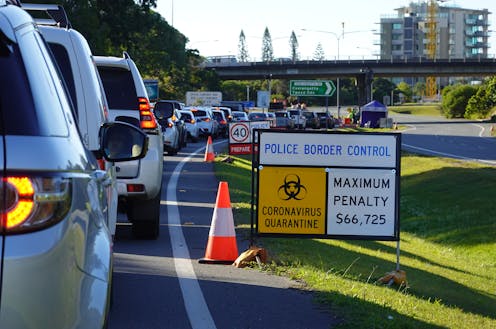
With COVID still classified as an ongoing pandemic, it’s difficult to contemplate the next one. But we need to be prepared. We’ve seen several pandemics in recent decades and it’s fair to expect we’ll see more.
For the final part in a series of articles on the next pandemic, we’ve asked a range of experts what Australia got right and wrong it its response to COVID. Here they share their thoughts on the country’s COVID response – and what we can learn for the next pandemic.
Quarantine
The federal government mandated 14 days of quarantine for all international arrivals between March 2020 and November 2021. During that period, 452,550 people passed through the system.
The states and Northern Territory were given just 48 hours to set up their quarantine systems. The states chose hotel quarantine, while the Northern Territory repurposed an old miner’s camp, Howard Springs, which had individual cabins with outdoor verandas. The ACT had very few international arrivals, while Tasmania only had hotel quarantine for domestic travellers.
During the first 15 months of the program, at least 22 breaches occurred in five states (New South Wales, Victoria, Queensland, Western Australia and South Australia). An inquiry into Victoria’s hotel quarantine found the lack of warning and planning to set up the complex system resulted in breaches that caused Victoria’s second COVID wave of 2020, leading to almost 800 deaths. A breach at Sydney airport led to the introduction of the Delta variant into Australia.
In the next pandemic, mistakes from COVID need to be avoided. They included failure to protect hotel residents and staff from airborne transmission through ventilation and mask usage. Protocols need to be consistent across the country, such as the type of security staff used, N95 masks for staff and testing frequency.
These protocols need to be included in a national pandemic preparedness plan, which is frequently reviewed and tested through simulations. This did not occur with the pre-COVID preparedness plan.
Dedicated quarantine centres like Howard Springs already exist in Victoria and Queensland. Ideally, they should be constructed in every jurisdiction.
Michael Toole
Treatments
Scientists had to move quickly after COVID was discovered to find effective treatments.
Many COVID treatments involved repurposing existing drugs designed for other viruses. For example, the HIV drug ritonavir is a key element of the antiviral Paxlovid, while remdesivir was originally developed to treat hepatitis C.
At the outset of the pandemic, there was a lot of uncertainty about COVID treatment among Australian health professionals. To keep up with the rapidly developing science, the National Clinical Evidence Taskforce was established in March 2020. We were involved in its COVID response with more than 250 clinicians, consumers and researchers.
Unusually for evidence-based guidelines, which are often updated only every five years or so, the taskforce’s guidelines were designed to be “living” – updated as new research became available. In April 2020 we released the first guidelines for care of people with COVID, and over the next three years these were updated more than 100 times.
While health-care professionals always had access to up-to-date guidance on COVID treatments, this same information was not as accessible for the public. This may partly explain why many people turned to unproven treatments. The taskforce’s benefits could have been increased with funding to help the community understand COVID treatments.
COVID drugs faced other obstacles too. For example, changes to the virus itself meant some treatments became less effective as new variants emerged. Meanwhile, provision of antiviral treatments has not been equitable across the country.
COVID drugs have had important, though not game-changing, impacts. Ultimately, effective vaccines played a much greater role in shifting the course of the pandemic. But we might not be so fortunate next time.
In any future pandemic it will be crucial to have a clear pathway for rapid, reliable methods to develop and evaluate new treatments, disseminate that research to clinicians, policymakers and the public, and ensure all Australians can access the treatments they need.
Steven McGloughlin and Tari Turner, Monash University
Vaccine rollout
COVID vaccines were developed in record time, but rolling them out quickly and seamlessly proved to be a challenge. In Australia, there were several missteps along the way.
First, there was poor preparation and execution. Detailed planning was not finalised until after the rollout had begun.
Then the federal government had overly ambitious targets. For example, the goal of vaccinating four million people by the end of March 2021 fell drastically short, with less than one-fifth of that number actually vaccinated by that time.
There were also supply issues, with the European Union blocking some deliveries to Australia.
Unfortunately, the government was heavily reliant on the AstraZeneca vaccine, which was found, in rare cases, to lead to blood clots in younger people.
Despite all this, Australia ultimately achieved high vaccination rates. By the end of December 2021, more than 94% of the population aged 16 and over had received at least one dose.
This was a significant public health achievement and saved thousands of lives.
But over the past couple of years, Australia’s initially strong vaccine uptake has been waning.
The Australian Technical Advisory Group on Immunisation recommends booster doses for vulnerable groups annually or twice annually. However, only 30% of people aged 75 and over (for whom a booster is recommended every six months) have had a booster dose in the past six months.
There are several lessons to be learned from the COVID vaccine rollout for any future pandemic, though it’s not entirely clear whether they are being heeded.
For example, several manufacturers have developed updated COVID vaccines based on the JN.1 subvariant. But reports indicate the government will only be purchasing the Pfizer JN.1 booster. This doesn’t seem like the best approach to shore up vaccine supply.
Adrian Esterman, University of South Australia
Mode of transmission
Nearly five years since SARS-CoV-2 (the virus that causes COVID) first emerged, we now know airborne transmission plays a far greater role than we originally thought.
In contrast, the risk of SARS-CoV-2 being transmitted via surfaces is likely to be low, and perhaps effectively non-existent in many situations.
Early in the pandemic, the role contaminated surfaces and inanimate objects played in COVID transmission was overestimated. The main reason we got this wrong, at least initially, was that in the absence of any direct experience with SARS-CoV-2, we extrapolated what we believed to be true for other respiratory viruses. This was understandable, but it proved to be inadequate for predicting how SARS-CoV-2 would behave.
One of the main consequences of overestimating the role of surface transmission was that it resulted in a lot of unnecessary anxiety and the adoption of what can only be viewed in retrospect as over-the-top cleaning practices. Remember the teams of people who walked the streets wiping down traffic light poles? How about the concern over reusable coffee cups?
Considerable resources that could have been better invested elsewhere were directed towards disinfecting surfaces. This also potentially distracted our focus from other preventive measures that were likely to have been more effective, such as wearing masks.
The focus on surface transmission was amplified by a number of studies published early in the pandemic that documented the survival of SARS-CoV-2 for long periods on surfaces. However, these were conducted in the lab with little similarity to real-world conditions. In particular, the amounts of virus placed on surfaces were greater than what people would likely encounter outside the lab. This inflated viral survival times and therefore the perception of risk.
The emphasis on surface transmission early in the pandemic ultimately proved to be a miscalculation. It highlights the challenges in understanding how a new virus spreads.
Hassan Vally, Deakin University
National unity
Initially, Commonwealth, state and territory leaders were relatively united in their response to the COVID pandemic. The establishment of the National Cabinet in March 2020 indicated a commitment to consensus-based public health policy. Meanwhile, different jurisdictions came together to deliver a range of measures aimed at supporting businesses and workers affected by COVID restrictions.
But as the pandemic continued, tensions gave way to deeper ideological fractures between jurisdictions and individuals. The issues of vaccine mandates, border closures and lockdowns all created fragmentation between governments, and among experts.
The blame game began between and within jurisdictions. For example, the politicisation of quarantine regulations on cruise ships revealed disunity. School closures, on which the Commonwealth and state and territory governments took different positions, also generated controversy.
These and other instances of polarisation undermined the intent of the newly established National Cabinet.
The COVID pandemic showed us that disunity across the country threatens the collective work needed for an effective response in the face of emergencies.
The COVID response inquiry, due to release its results soon, will hopefully help us work toward national uniform legislation that may benefit Australia in the event of any future pandemics.
This doesn’t necessarily mean identical legislation across the country – this won’t always be appropriate. But a cohesive, long-term approach is crucial to ensure the best outcomes for the Australian federation in its entirety.
Guzyal Hill and Kim M Caudwell, Charles Darwin University
This article is part of a series on the next pandemic.
Authors: Adrian Esterman, Professor of Biostatistics and Epidemiology, University of South Australia


















