

Giant handaxes suggest that different groups of early humans coexisted in ancient Europe
- Written by: Martina Demuro, ARC DECRA Research Fellow, University of Adelaide
Even our earliest human ancestors made and used technology - something we can look back on thanks to the lasting nature of stone tools.
An exceptionally high density of giant handaxes dated to 200,000-300,000 years ago has been uncovered at an archaeological site in Galicia, northwest Spain. The findings are documented in a new article published by our international research team of archaeologists and dating specialists.
Read more: The origin of 'us': what we know so far about where we humans come from
The discovery of these handaxes suggests that alternative types of stone tool technologies were simultaneously being used by different populations in this area – supporting the idea that a prehistoric “Game of Thrones” scenario existed as Neanderthals emerged in Europe.
Additional evidence for this idea comes from fossil records showing that multiple human lineages lived in southwest Europe around the same time period.
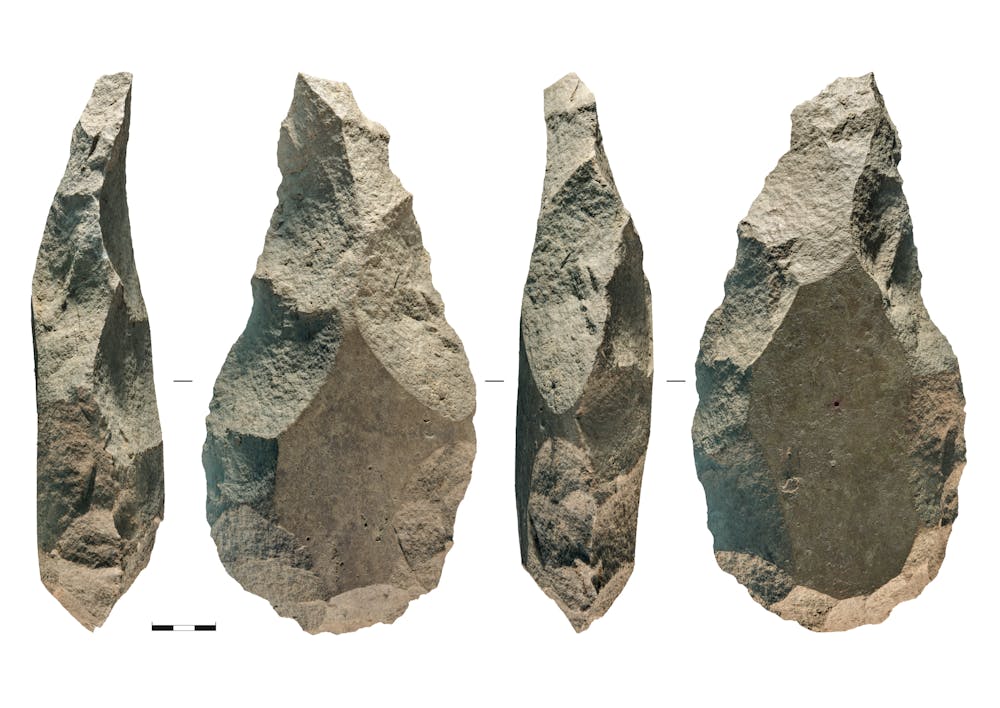 The large tools are consistent with a culture known as Acheulean.
Eduardo Mendez Quintas, Author provided
The large tools are consistent with a culture known as Acheulean.
Eduardo Mendez Quintas, Author provided
Stone tool technology
Porto Maior is near the town of As Neves (Pontevedra, Galcia) on a terrace 34m above the current level of the Miño River, which borders northern Portugal and Spain.
The archaeological site at Porto Maior preserves an ancient stone tool culture known as the Acheulean. Characterised by symmetrically knapped stones or large flakes (known as bifaces), the Acheulean is the first sophisticated handaxe technology known in the early human settlement record of Europe.
While Acheulean sites are widespread across the continent, Porto Maior represents Europe’s first extensive accumulation of large cutting tools (LCTs) in the Acheulean tradition. Until now, such high densities of LCTs had only been found in Africa. This new finding reinforces an African origin for the Acheulean in Europe, and confirms an overlap in time-frames of distinctly different stone tool cultures on the continent.
Photogrammetry model of a handaxe from the Porto Maior site - click and hold to rotate
At around the same time that handaxes were being used at Porto Maior, a different stone tool tradition (the Early Middle Palaeolithic) was present in Iberia, for example at Ambrona and Cuesta de la Bajada. In central and eastern Europe – where tools were made exclusively on small flakes – the Acheulean tradition has never been found.
Porto Maior introduces further complexity to this overlapping technological pattern, and suggests that distinct early human populations of different geographical origins coexisted during the Middle Pleistocene (between 773,000 and 125,000 years ago).
Abundant large cutting tools
In total, 3,698 discarded artefacts were recovered from river-lain sediments at the site, with 290 of these making up the studied assemblage reported in our new paper.
The stone tool assemblage is composed of 101 LCTs in original position, and that are on average 18cm long, with a maximum length of 27cm. These handaxe dimensions are exceptionally large by European Acheulean standards (typically only 8-15cm long). The assemblage also contains large cleavers, a type of tool typically found in African sites.
3D photogrammetry model of the Porto Maior excavation - click and hold to rotate
At 9.5 pieces per m² in an excavated area of more than 11.8m², the density of the Acheulean stone tool accumulation is one of the highest recorded globally, surpassing previous European findings of smaller Acheulean tools (usually less than 3 artefacts per m²).
Laboratory analyses indicate that the tools were used to process hard materials such wood and bone, in activities that could have included the breaking up of carcasses.
Read more: Indian stone tools could dramatically push back date when modern humans first left Africa
The Spanish site of Porto Maior clearly resembles extensive accumulations of very large tools previously only seen in Africa and the Near East. These similarities reinforce the idea of an African origin for the Acheulean tradition of southwest Europe.
They also raise new questions regarding the origin and mobility of prehistoric human populations – the ancestors of Neanderthals – that occupied the European continent during the Middle Pleistocene period before the arrival of our own species, Homo sapiens.
Dating the tools
The age of these unusually large Acheulean tools at Porto Maior was determined using two different dating methods – post-infrared infrared stimulated luminescence (pIR-IRSL) dating of potassium feldspar grains and electron spin resonance (ESR) dating of quartz grains.
These techniques provide an estimate of the last time sand grains within sediments were exposed to sunlight, by looking at their luminescence or paramagnetic properties – that is, they can tell us the timing of sediment burial. This, in turn, can be used to determine when the site was last occupied and when the artefacts discarded by prehistoric populations were subsequently buried by sediment accumulation.
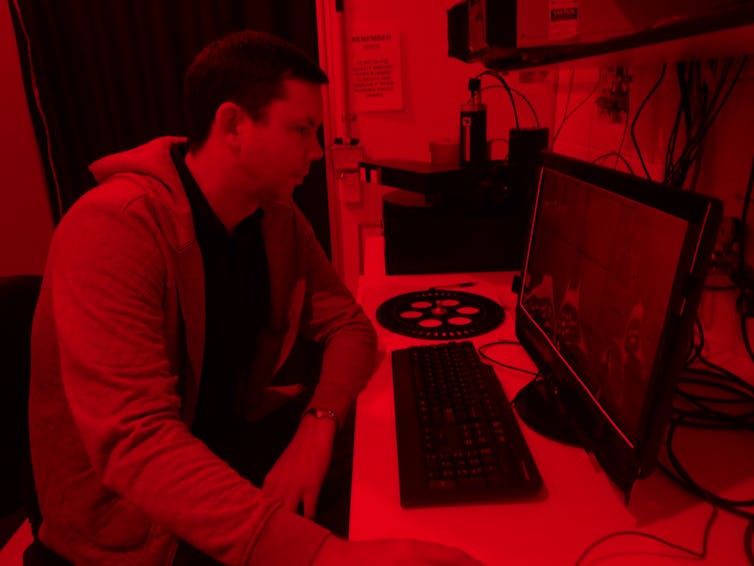 Luminescence dating samples being measured under controlled lighting conditions at the University of Adelaide’s Prescott Environmental Luminescence Laboratory.
Lee Arnold
Luminescence dating samples being measured under controlled lighting conditions at the University of Adelaide’s Prescott Environmental Luminescence Laboratory.
Lee Arnold
In the study of Porto Maior, pIR-IRSL and ESR dating were applied to grains that had been carefully collected from the sediment layers hosting the stone tools, without exposing the sample material to daylight.
The two methods, which were applied independently at two different Australian institutions (University of Adelaide and Griffith University), produced remarkably similar ages.
This confirms the reliability of the dating results, and indicates that the archaeological record spanned the time period from 200,000 to 300,000 years ago.
Migration from Africa
The Acheulean tool-making tradition originated in Africa about 1.7 million years ago, and disappeared on that continent by 500,000 years ago. The specific type of Acheulean tools described at Porto Maior is exclusive to southwest Europe, suggesting that the technology was brought into the region by an “intrusive” population.
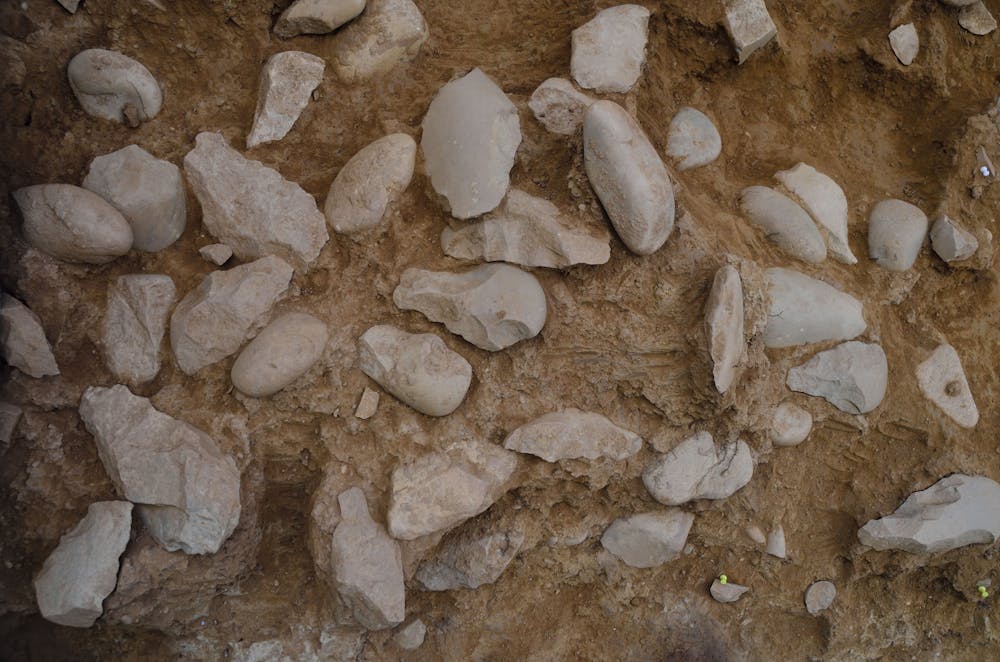 Acheulean tools in their primary position at Porto Maior, Spain.
Eduardo Mendez-Quintas, CC BY
Acheulean tools in their primary position at Porto Maior, Spain.
Eduardo Mendez-Quintas, CC BY
The age of Porto Maior is consistent with previous findings from Iberia that suggest that the Acheulean culture experienced an expansion in the region between 400,000 to 200,000 years ago.
Read more: How our species got smarter: through a rush of blood to the head
This latest discovery supports the increasingly complex narrative developing from ongoing studies of human fossils from Europe; namely that human groups of potentially different origins and evolutionary stages coexisted across the continent during a time when the emergence of Neanderthals was taking place.
While it is clear that more human fossil and stone tool sites need to be reliably dated across the region, a picture appears to be emerging of a turbulent “Game of Thrones” style scenario of hominin evolution in Eurasia during the Middle Pleistocene period.
Authors: Martina Demuro, ARC DECRA Research Fellow, University of Adelaide


















