

new research suggests shared reading groups combat loneliness – and the effects can be astounding
- Written by: Juliane Roemhild, Senior Lecturer in English, La Trobe University
In Eleanor Rigby, the Beatles asked: “All the lonely people – where do they all come from?” The answer to that question is complex, but loneliness is a widespread feeling among Australians. One in three people feel lonely, and one in six experience severe loneliness.
The findings of our research suggest that shared reading groups, where people from all walks of life meet regularly to read and discuss literature, can provide the kind of meaningful social connections necessary to alleviate loneliness.
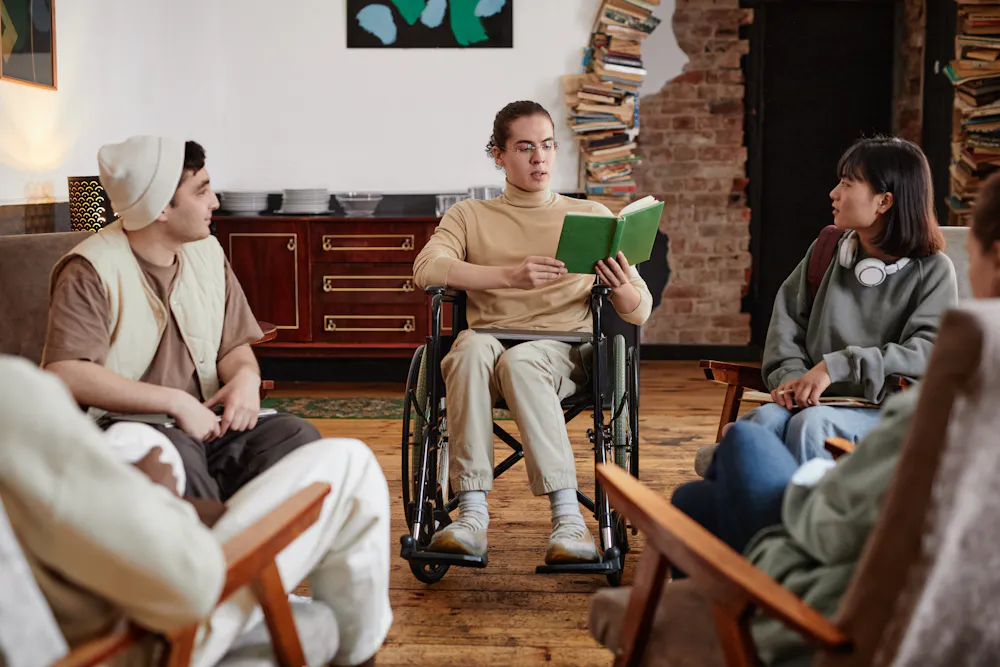
In shared reading, small groups of people read aloud short stories and poetry under the guidance of a trained facilitator, who gently steers the conversation to encourage deeper conversations about life, emotions and personal experience.
Not quite a book club or a self-help group, shared reading unites the best of both. It can take place in a variety of settings: libraries, community houses, care homes, prisons, hospitals and schools. The aim is to reconnect people with themselves and others, thereby nurturing wellbeing and social inclusion.
In 2022-2023, we assembled a team of researchers to run a pilot project with ten shared reading groups in Melbourne and Bendigo. We wanted to find out if the groups could help Victorians leave behind their sense of isolation after the pandemic and improve mental health. Our partners included libraries, a neighbourhood house, a hospital, an aged care home and the Victorian Mental Illness Awareness Council. We surveyed 35 participants and conducted 26 follow-up interviews.
The groups read stories and poems chosen by the facilitators. Texts were selected for their potential to evoke strong feelings and describe broadly relatable human experiences, so as to encourage members of the groups to open up. Authors included Kate Chopin, Langston Hughes, Mary Oliver, Li-Young Lee, Tobias Wolff, Susan Glaspell, Moniza Alvi, Maya Angelou, James Joyce and Judith Wright.
Although our participants differed in age, social background, mental and physical health and cultural identity, the most salient feature was that they came to feel a deep sense of social connection and improved wellbeing. In fact, almost all of the surveyed participants said the group had made them feel better, while the majority found it helped them relate to others in a deeper way.
Take 94-year-old “Elaine”, who joined a shared reading group shortly after moving into aged care. When she joined, she was feeling “miserable” and “crook on everybody”, but she found the group rejuvenating: “it just lifted me and I couldn’t wait till the next week […] It brought me out of myself.”
The positive effects were not only social. “When I came here I wasn’t walking, I was in a wheelchair,” Elaine reported. “I had a boost in my walking […] It was a struggle to get here. But I could run back.”
Shared memories and experiences
In shared reading, literature works as a springboard to talk about life, compare experiences and share memories in a safe and inclusive space. The effects are nothing short of astounding. Research into shared reading has shown its capacity to combat loneliness, alleviate depression, lower anxiety and even help with chronic pain.
Shared reading is widely established in the United Kingdom, where The Reader Organisation runs over 700 groups across the country and has received NHS funding. But initiatives in Australia are still limited in scope and scale.
Conversations in shared reading groups tend to skip the small talk and, through the medium of a story, get to the core of things. Hearing different perspectives from other group members helps participants connect across differences and reflect on common human experiences.
As “Ruby” found, the shared text “enables you to get quite a deep understanding of other people”. It provides a “jumping off point to really quickly get to know people as opposed to starting with, you know, general chit chat or, like, things that seem a little bit more superficial”.
One of the most powerful motivations for reading is a sense of identification, or recognition of facets of one’s own experience in the text. We read to feel reassured that we are not alone in the world. The effect of recognition is amplified in shared reading when the sharing of experiences is met with an accepting response from the group. We are not left alone with the experience, as we are when we read by ourselves.
That sense of visibility and connection within the group played a particular role all the reading groups we held. Shared reading offered a safe space to show oneself without any pressure to confess. “Beth” described how potent those moments of sharing can be:
People shared parts of themselves that you can tell made them feel vulnerable as well. Or when they were being very honest, like there was a reflection in something that either myself or someone else in their group was really touched by. And those moments of connection were really, really powerful.
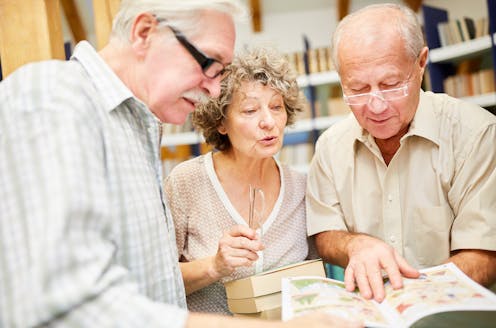
 In Australia, one in three people feel lonely, and one in six experience severe loneliness.
David Michael Bellis/Shutterstock
In Australia, one in three people feel lonely, and one in six experience severe loneliness.
David Michael Bellis/Shutterstock
Combatting loneliness
According to the recently released State of the Nation Report on Social Connection, loneliness is an experience that affects all of us, but some are more vulnerable than others. Young people, carers, people who have poorly met financial needs, those who live in rural areas, live alone, or have chronic disease and poor mental health are particularly vulnerable to loneliness.
While men and women are equally lonely, young people aged 18-24 report the highest levels of loneliness, followed by 45-54 year-olds. Contrary to common perception, older people – those over 65 – feel less lonely.
While those living on their own report higher levels of loneliness than those living with a partner or friends, being surrounded by people is not marker of feeling connected. In fact, half of those living with extended family report loneliness – by far the highest levels.
Part of the problem is that the stigma surrounding loneliness remains high: nearly one in two believe that lonely people have negative personality traits. More than half say they would not want to be friends with a lonely person. A third of the people believe loneliness is a sign of weakness or that there is something wrong with someone who is lonely.
No wonder, then, that 58% of people won’t talk about their feelings of loneliness to others and half say they would conceal their loneliness.
Yet the price we pay for loneliness is high: our mental and physical health can be severely affected by loneliness. Loneliness and depression are closely linked. Lonely people are less productive at work and seek help from mental health services more often, confirming that we tend to see loneliness as a personal shortcoming which needs medical attention.
So what can be done? Two key suggestions made by the State of the Nation report are relevant to all of us: we need to change the conversation surrounding loneliness, and we need to foster meaningful connections within communities.
As it turns out, shared reading groups seem to be doing just that. These groups can foster the kind of meaningful connections that are needed to combat widespread loneliness in Australia.
If groups run long enough, they can spark friendships. “Janet”, who migrated from China and joined a group to improve her English, has been attending for over two years. She has made lasting friendships, and the group is now the highlight of her week:
It’s just making me feel life worth living, just gave me the pleasure of love of life […] yeah really, really important I can come.
Tea and biscuits encourage socialising before or after sessions. Over time, participants get to know each other well. But even without this element, shared reading offers of a third space: an informal opportunity to meet and talk on a regular basis in a safe setting about the things that matter.
Authors: Juliane Roemhild, Senior Lecturer in English, La Trobe University


















