

Lee Miller helped shape our understanding of war. Her life as a photojournalist echoes in those working today
- Written by: Andrea Jean Baker, Senior Lecturer in Journalism, Monash University
This story contains spoilers.
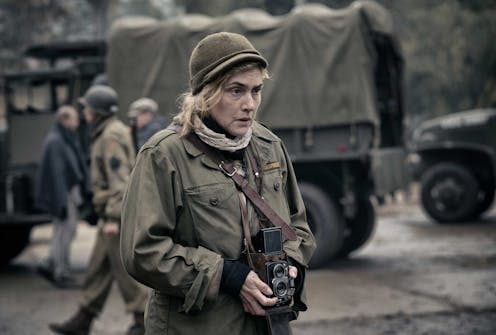
Lee, the feature film debut from director Ellen Kuras, explores the rawness of authentic image making and the impact of gender in war reporting.
Kate Winslet stars as the world weary photojournalist Elizabeth “Lee” Miller – better known for featuring in an iconic photograph, rather than taking one.
The same day Adolf Hitler committed suicide at his Berlin bunker in 1945, photojournalist David E. Scherman took a photograph of Miller sitting in the bath in Hitler’s Munich apartment.
But Miller was also a trailblazing, feminist photojournalist who managed to shift Vogue magazine from beauty and aesthetics to capturing the reality of the second world war. She gave us images of the frontline, fearful women and children, concentration camps, and the aftermath of war.
Here’s what you should know about the real woman behind the film – and what we can learn about war correspondents today through her story.
In front of and behind the camera
Miller was born in New York in 1907, and began her bohemian life as a model for Vogue before the war, and as a muse to her surrealist mentor Man Ray.
The film follows Miller from her work as a fashion photographer pre-war, through to her photographing the second world war and then the liberation of Paris in 1945.
Lee explores tensions with other renowned photographers at the time, such as Cecil Beaton (Samuel Barnett); her relationship with the second husband, English artist, historian and poet, Roland Penrose (Alexander Skarsgård); and her connections to the French resistance.
Female photojournalists of the time were usually assigned to taking portraits or working in fashion.

When Miller was in her 30s, her photographs for Vogue leaned towards the surreal. This was also seen in her Blitz images, where two staff from the magazine wearing creatively designed gas masks about to enter a bomb shelter was published in the London edition.
When the war broke out, Miller was accredited as one of four American female photojournalists. Like fellow American Margaret Bourke-White, Miller was known for the horrific images of Buchenwald and Dachau concentration camps in Germany, reinforcing the fact that photojournalism tells a story that is more powerful than any other form of journalism.
Ethics and photojournalism
A 2019 study examined how professional photojournalists apply ethics to their work.
Photojournalists believe photographs should be published alongside news, that photographers are key in supporting the public’s “right to know”, and they must balance “their obligation to the truth, while minimising harm”.
You can see these ethical frameworks all at play in Miller’s work, especially in her images of Dachau just after the war.
 Lee faced similar issues around ethics that photojournalists face today.
STUDIOCANAL
Lee faced similar issues around ethics that photojournalists face today.
STUDIOCANAL
The editor of British Vogue, Audrey Withers (played in the film by Andrea Riseborough), refused to publish the photos. But American Vogue published them in June 1945, with the headline “Believe it”, as a modern memorial to the war.
But photojournalists also take actions that prioritise themselves. Sherman’s image of Miller sitting in Hitler’s bath, though a visual metaphor for the end of the war, has been criticised as a “look at me” moment.
In 2006, the New York Times described the photograph as “a woman caught between horror and beauty, between being seen and being the seer”.
The place of the woman photographer
Contemporary research suggests female photojournalists are more empathetic and have better access to vulnerable subjects than their male counterparts.
In the film, Miller’s gentle photo of a French woman publicly accused of being an informant to the Germans illustrates empathy, while masking the hidden contradictions of war.
Befriending a frightened girl in a bomb shelter, Miller has flashbacks of her youth as a victim-survivor of sexual violence. “There are different kinds of wounds, not just the ones you see,” she says in the film.
A survey in 2019 of 545 female photojournalists from 71 countries found women faced more obstacles than their male counterparts, are still considered subordinate in the profession and subject to sexism.
During the war, Miller used the gender-neutral Lee as her first name, instead of Elizabeth, fearing press accreditation on the frontline would not be approved if she was a woman.
The National Press Photographers Association say gender bias and assumptions still continue to hinder female photojournalists. These commonly held assumptions include women are weaker, less skilled and will eventually leave the profession to raise a child.
Living through her archive
Lee begins and ends with the 70-year-old Miller reflecting on her career to a young male journalist, while continuously gulping down alcohol, perhaps illustrating undiagnosed post traumatic stress syndrome, all too common among news photographers.
Returning to London after the war, Miller gave up photojournalism.
After her death in 1977, more than 60,000 negatives of her work were discovered in her attic at home. These images of surrealist photography, Vogue editorials, second world war photojournalism and portraits of important 20th century figures formed the basis of her 1985 biography, The lives of Lee Miller, written by her son Antony Penrose.
Lee is a visually, brave story about a female photojournalist whose images alter and enlarge our notions of what is worth looking at – and what we have a right to observe.
Authors: Andrea Jean Baker, Senior Lecturer in Journalism, Monash University



















.jpg)