

You can keep your ghosts and ghouls – the ‘Cordyceps’ fungus creates real-life zombies
- Written by: Gregory Moore, Senior Research Associate, School of Agriculture, Food and Ecosystem Sciences, The University of Melbourne
I have never really been interested in ghosts, mummies or zombies, not even at Halloween. But as October 31 approaches each year I am reminded of a biological tale involving all three. It’s the real-life horror story of a flesh-eating, brain-warping fungus from the genus Cordyceps, which inspired the zombie-apocalypse video game and TV series The Last of Us.
Worldwide, there are hundreds of species of Cordyceps. Most of them prey on insects. They’re famous for hijacking the brains of some ants. Once the fungus takes over, it directs the ant to climb to a high point on a plant and then bite down on the stem or twig in a macabre death grip. The reproductive structures of this parasitic fungus will soon burst out of the ant’s head, spreading its spores to infect another unsuspecting host.
But the species with which I am most familiar (Cordyceps gunnii) doesn’t attack ants – it parasitises insects such as rather large “ghost” caterpillars. This species doesn’t force its victims to climb, but takes control when they are buried in the soil.
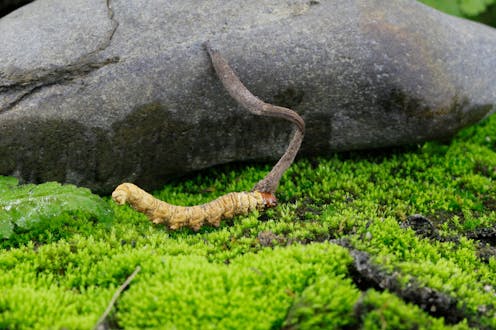
You might spot a grotesque-looking dead caterpillar pushing up through the earth as if rising from the grave, with a large fungal growth emerging from its head. Some are about the size of an adult finger, but cream and dark brown in colour. It is truly a thing that could trigger nightmares.
‘Zombie’ Parasite Cordyceps Fungus Takes Over Insects Through Mind Control | National Geographic.Consuming the ghostly host
Unsuspecting insects become infected with Cordyceps when they eat them by mistake, or when spores attach to their bodies.
The caterpillar of the Australian ghost moth (Abantiades labrynthicus) tends to burrow straight down into the soil to graze on roots of gum trees and some other species related to eucalypts. So it probably picks up the fungus as it burrows into the earth. The fungus then penetrates the exoskeleton or digestive tract of the insect with a thin, needle-like tube.
Once inside the caterpillar, the fungus starts to grow rapidly. It produces very fine threads (hyphae) that spread through the body of the insect, replacing its structure. The fungus expands to fill the available space, assuming ultimate control. Exactly how the fungus takes control of the insect brain is not fully understood, but we know the fungus produces a range of chemicals that influence the brain in a way that meets the environmental and reproductive needs of the fungus.
The caterpillar is doomed as soon as the fungus starts to grow inside it. After being taken over by another life form, the zombie caterpillar dies. All of this happens out of sight, under the soil surface.
But Cordyceps is not done with the caterpillar just yet. It consumes all the resources the insect can offer, then pushes antler-like reproductive structures out through the caterpillar’s head. These spore-producing structures can be more than 10cm long. They’re clearly visible above ground, but can be hard to spot as they look a bit like a twig. Wind carries the spores to infect more unwary caterpillars.
These fungus-filled caterpillars are now fully mummified. Nothing remains of the caterpillar but a brittle exoskeleton.
As the reproductive structures dry and wither, they gently tug on the mummy to which they are still attached. If the soil is dry, the now empty exoskeleton of the caterpillar emerges from its hole. As it does so, the fungal reproductive structures are often lost and all you see remaining is the empty husk.
The Last of Us: Could it happen? Infectious disease doctor explains cordyceps (UC Davis Health).Half animal, half vegetable
Members of the genus Cordyceps boast the unusual common name of vegetable caterpillars. This strange name comes from a belief, which persisted until the 1800s, that the caterpillars had somehow transformed from insects to fungi, or from animal to plant.
This was a much debated and widely written about example of transmutation, a theory that was not uncommon in pre-Darwinian times. It was not until the early 1900s that the true, full and gruesome nature of the relationship between Cordyceps and its insect victims was revealed.
On the lookout for Cordyceps
Cordyceps gunnii is the most commonly seen species of vegetable caterpillar in southeastern Australia, found in several states.
Another less conspicuous species, the fawn vegetable caterpillar, Cordyceps hawkesii, occurs along Autralia’s east coast, often under wattles, but is even harder to see. Naturalists hunting for this vegetable caterpillar often find they have already inadvertently trampled over it before they spot it.
Yet another species, Cordyceps taylori, can also be regularly seen emerging from large ghost moth caterpillars in Victoria. When the husks of these dead, mummified caterpillars appear to emerge from their holes in the ground, they look particularly striking.
The classification of these vegetable caterpillar fungi is still being debated by experts. It is likely not all are closely related. Some are now placed in a new genus, Ophiocordyceps, but regardless of the name, they are all capable of making zombies and mummies of their victims.
You can join in the process of hunting for and mapping these elusive species through citizen science projects such as he Great Aussie Fungi Hunt or iNaturalist Australia.

Traditional medicines and the vegetable caterpillar
As Halloween approaches, you may be wondering whether humans need worry about being zombified and mummified by Cordyceps fungi. Could the naturalists hunting the vegetable caterpillars become the hunted? The answer is a resounding no. In fact, the opposite is true – these macabre creatures have a long history in traditional medicine.
Cordyceps sinensis, a Chinese vegetable caterpillar very similar to C. gunnii, has been used in traditional medicine for centuries. Modern research shows there may be benefits from its use (or extracts from it) in treatments associated with autoimmune responses. While the fungus has been cultivated for about 40 years, naturally growing, wild fungi can be very expensive as they are still relatively rare and difficult to find. A kilogram can retail for A$30,000, driving a fungal gold rush across the Himalayas.
Members of the genus Coryceps, or more correctly the Ophiocordyceps genus, have been around for more than 45 million years. Despite their depiction in The Last of Us, humans have nothing to worry about. The fungi are quite particular about their victims. But if you are a certain species of ant or ghost moth, then Halloween may take on a whole new meaning.
Authors: Gregory Moore, Senior Research Associate, School of Agriculture, Food and Ecosystem Sciences, The University of Melbourne


















