

Despite its green image, NZ has world's highest proportion of species at risk
- Written by: Michael (Mike) Joy, Senior Researcher; Institute for Governance and Policy Studies, Victoria University of Wellington
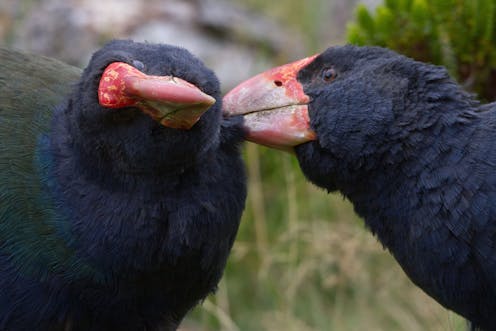
A recent update on the state of New Zealand’s environment paints a particularly bleak picture about the loss of native ecosystems and the plants and animals within them.
Almost two-thirds of rare ecosystems are threatened by collapse, according to Environment Aotearoa 2019, and thousands of species are either threatened or at risk of extinction. Nowhere is the loss of biodiversity more pronounced than in Aotearoa New Zealand: we have the highest proportion of threatened indigenous species in the world.
This includes 90% of all seabirds, 84% of reptiles, 76% of freshwater fish and 74% of terrestrial birds. And this may well be an underestimate. An additional one-third of named species are listed as “data deficient”. It is likely many more would be on the threatened list had they been assessed. Then there are the species that have not been named and we have no idea about.
Read more: Climate change is hitting hard across New Zealand, official report finds
Why biological diversity matters
Biodiversity is a word that means different things to different people. Its use has exploded recently as more people appreciate the magnitude of its decline and its importance to people’s future.
Popularly biodiversity is understood as the number of species in a given country or ecosystem. For scientists, the concept is deeper. It includes genetic and ecosystem diversity and has crucial components such as endemicity (species found nowhere else), native diversity (the proportion of native species) and keystone species (species that are crucial to ecosystem function).
Globally, biodiversity in all its guises is undergoing an unprecedented decline. Estimates are that we are now losing species at more than 1,000 times the background or natural rate. People are also moving species outside their native ranges, and this results in a global biological homogenisation and has helped a small number of species to thrive in human-dominated habitats across the world.
The classification of threat status, globally and in New Zealand, is complex. There are multiple levels, ranging from “nationally critical” to “at risk”. When describing levels of biodiversity decline, it is simpler to look at the proportion of species listed as “not threatened”.
In New Zealand, only around 18% of beetles, 26% of freshwater fish, 38% of marine mammals, 12% lizards, 5% of snails and 50% of plants are listed as not threatened or not at risk. This is a rather dire situation, especially given the 100%-pure slogan used to market Aotearoa New Zealand overseas.
Ineffective legal protection
Another important facet of biodiversity decline is that New Zealand has many endemic species, with around 40% of plants, 90% of fungi, 70% of animals and 80% of freshwater fish found nowhere else. If they are lost here they are lost entirely.
In a recent report to the UN Convention on Biological Diversity, the Department of Conservation could not say whether New Zealand’s biodiversity is declining or not. One quarter of the nearly 4,000 species currently classified as threatened or at risk have only been assessed once and there is no way to know whether their conservation status has changed. Of the remaining roughly 3,000 threatened or at risk species, 10% had worsened to a more threatened ranking. Only 3% had improved.
The numbers above show the failure of legislation intended to protect biodiversity in Aotearoa New Zealand. The Wildlife Act (1953) purportedly gives absolute protection to all wildlife. But it is not enforced in any meaningful way, and therefore has had no impact on biodiversity conservation.
The Native Plants Protection Act (1934) stipulates that native plants have protection on conservation land but makes no mention of protection outside that and, in any case, is not enforced. Native fish are not covered by the Wildlife Act and the Freshwater Fisheries Act affords them no protection either.
Human impact on land
Apart from ineffective species protection, another factor is the loss of habitat and ecosystems through land-use change for agricultural and urban intensification. The first changes happened with Polynesian arrival, and then again after European colonisation, including massive forest clearance and wetland drainage. More recently, the expansion of dairy farms has contributed to significant biodiversity losses.
Freshwater fish are a good example. The increase in the proportion of threatened species has gone from around one-quarter in the early 1990s to three-quarters now. This recent loss reveals the failure of successive governments to protect biota, their habitats and ecosystems. Lowland coastal forests and wetlands in particular continue to be degraded by human activity.
Read more: New Zealand’s urban freshwater is improving, but a major report reveals huge gaps in our knowledge
Indigenous terrestrial vegetation cover is now less than 30%, down from approximately 90% in pre-human times. One-third of the country is covered in exotic grasslands.
About one-third of the country is putatively protected by being within the conservation estate. This sounds impressive, but it obscures the true state of protected areas. The ecosystem types in the estate are far from a representative selection. It mostly contains areas that are too steep to farm and too inhospitable to live in.
The failure to protect habitats is reflected in the reduction in ecosystem diversity: 62% of the ecosystems classified as rare are now listed as threatened, and more than 90% of wetlands have been destroyed. This loss is not confined to the past. Estimates are that 214 wetlands (1,250 ha) were lost between 2001 and 2016, and a further 746 wetlands declined in size.
Marine conservation
Protection levels of marine habitats are even worse. New Zealand’s marine area is 15 times larger than its land area, but marine biodiversity is poorly regulated. Only 0.4% is covered by “no-take” marine reserves.
As a signatory to the UN Sustainable Development Goals (SDGs), New Zealand is obligated to reduce biodiversity loss. We have committed to achieving SDG 14 (life under water) and SDG 15 (life on land). The former stipulates that we “conserve and sustainably use the oceans, seas and marine resources for sustainable development”. The latter that we “protect, restore and promote sustainable use of terrestrial ecosystems, sustainably manage forests, combat desertification, and halt and reverse land degradation and halt biodiversity loss”.
There is no sign of any real achievement in reducing biodiversity loss. While New Zealand produced a national biodiversity strategy in 2000, it has been largely ineffective at improving the state of biodiversity. As the OECD noted, the strategy and plan lack clarity and clear implementation pathways.
We have tried writing plans with no teeth. Now it is time for action from all levels of society. Cities and regions need to ensure parks and protected areas are adequately managed. Government must work to update ineffective legislation and commit to enforcing the law.
Authors: Michael (Mike) Joy, Senior Researcher; Institute for Governance and Policy Studies, Victoria University of Wellington


















