

How do children learn good manners?
- Written by: Sophia Waters, Senior Lecturer in Writing, University of New England
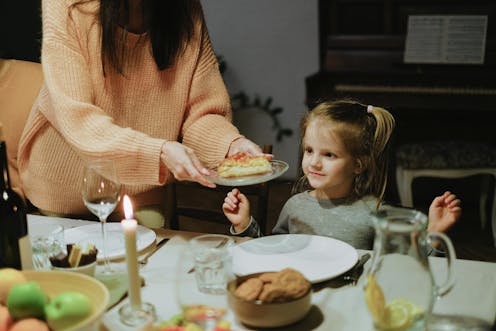
Ensuring kids have manners is a perennial preoccupation for parents and caregivers.
How, then, do you teach good manners to children?
Modelling good manners around the home and in your own interaction with others is obviously crucial.
But there’s a clear uniting theme when it comes to manners in Australia: in Australian English, good manners centre on honouring personal autonomy, egalitarianism and not appearing to tell people what to do.
Which manners matter most in Australia?
Some of the most important manners in Australian English are behavioural edicts that focus on particular speech acts: greeting, requesting, thanking and apologising.
These speech acts have a set of words associated with them:
- hello
- hi
- may I please…?
- could I please…?
- thank you
- ta
- sorry
- excuse me.
Good manners make people feel comfortable in social situations by adding predictability and reassurance.
They can act as signposts in interactions. Anglo cultures place a lot of weight on egalitarianism, personal autonomy and ensuring we don’t tell people what to do.
If you want to get someone to do something for you – pass you a pen, for example – you frame the request as a question to signal that you’re not telling them what to do.
You’ll also add one of the main characters in Anglo politeness: the magic word, “please”.
This framing recognises you don’t expect or demand compliance. You’re acknowledging the other person as an autonomous individual who can do what they want.
If the person does the thing you’ve asked, the next step is to say “thank you” to recognise the other person’s autonomy. You’re acknowledging they didn’t have to help just because you asked.

The heavy hitters
The words “please” and “thank you” are such heavy hitters in Australian English good manners, they’re two of the words that language learners and migrants learn first.
They can help soften the impact of your words. Think, for example, of the difference between “no” and “no, thank you”.
Of course, there are times when “no” is a full sentence. But what if someone offered you a cup of tea and you replied “no” without its concomitant “thank you” to soften your rejection and acknowledge this offer didn’t have to be made? Don’t be surprised if they think you sound a bit rude.
The other big players in Australian English good manners are “sorry” and “excuse me”. Much like in British English, the Australian “sorry” means many things.
These can preface an intrusion on someone’s personal space, like before squeezing past someone in the cinema, or on someone’s speaking turn.
Interrupting or talking over someone else is often heavily frowned on in Australian English because it is often interpreted as disregarding what the other person has to say.
But in some cultures, such as French, this conversational style is actively encouraged. And some languages and cultures have different conventions around what good manners look like around strangers versus with family.
Good manners involve saying certain words in predictable contexts.
But knowing what these are and when to use them demonstrates a deeper cultural awareness of what behaviours are valued.
 Talking over someone else is often heavily frowned on in Australian English.
MDV Edwards/Shutterstock
How do children learn manners?
As part of my research, I’ve analysed parenting forum posts about “good manners”. Some believe good manners should be effortless; one parent said:
Good manners shouldn’t be something that a child has to think about […] teach them correctly at home from day one, manners become an integral part of the way they view things.
Another forum user posited good modelling was the key, saying:
the parent has to lead by example, rather than forcing a child to say one or the other.
One study, which involved analysis of more than 20 hours of videorecorded family dinner interactions collected in Italy, found mealtimes are also sites where parents control their children’s conduct “through the micro-politics of good manners.”
By participating in mealtime interactions, children witness and have the chance to acquire the specific cultural principles governing bodily conduct at the table, such as ‘sitting properly’, ‘eating with cutlery’, and ‘chewing with mouth closed’.
Yet, they are also socialised to a foundational principle of human sociality: one’s own behavior must be self-monitored according to the perspective of the generalised Other.
In Australian English, that means regulating your behaviour to make sure you don’t do something that could be seen as “rude”. As I argued in a 2012 paper:
While child socialisation in Anglo culture involves heavy discouragement of rudeness, French does not have a direct equivalent feature […] French children are taught ça ne se fait pas, ‘that is not done’. Where the French proscribe the behaviours outright, the Anglos […] appeal to the image one has of oneself in interpersonal interactions.
In Anglo English, the penalties for breaches could be other people’s disapproval and hurting their feelings.
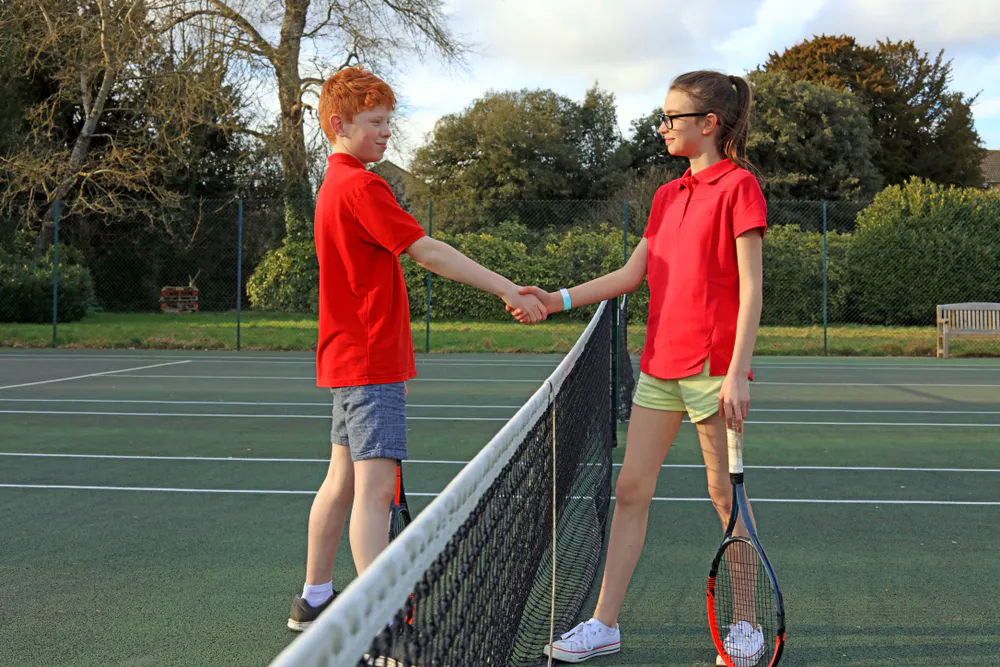 Good manners form part of the bedrock for human sociality.
Shutterstock
Why are good manners important?
Good manners affect our interactions with others and help us build positive relationships.
Fourteenth century English bishop and educator, William of Wykeham, declared that “manners maketh the man”.
John Hopkins University Professor Pier Forni called them a “precious life-improvement tool.”
The “Good Manners” chart, based on a set of rules devised by the Children’s National guild of Courtesy in UK primary schools in 1889, was issued to Queensland primary schools until the 1960s.
 This ‘Good Manners’ chart was first issued to Queensland schools in 1898 by the Department of Public Instruction as part of the systematic teaching of conduct and manners.
Queensland Department of Education, Author provided (no reuse)
It tells kids to remember the golden rule to “always do to others as you would wish them to do to you if you were in their place.”
Good manners form part of the bedrock for human sociality. Childhood is when we give kids foundational training on interacting with others and help them learn how to be a culturally competent member of a society.
Authors: Sophia Waters, Senior Lecturer in Writing, University of New England
Read more https://theconversation.com/how-do-children-learn-good-manners-237133


















