

In the US, political division can take a significant toll on people’s health. Australia should pay attention
- Written by: Lesley Russell, Adjunct Associate Professor, Menzies Centre for Health Policy and Economics, University of Sydney
Stark health disparities exist across the United States. Life expectancy is lower than in other wealthy countries – and declining. The richest American men live 15 years longer than their poorest counterparts. The richest American women live ten years longer.
Political differences are an interesting and provocative way of looking at these disparities.
Differences are frequently analysed by race, a proxy for other factors that influence health, such as housing, environmental pollution, nutrition and affordable access to health care.
But there are other ways to cut the data. This includes by state – whether it is “red” (governed by the Republican party) or “blue” (by the Democrats). We can also look at individual political affiliation.
One new study from the US looks at political polarisation as a risk factor for individual and collective wellbeing. It finds polarisation – where opinions and beliefs become concentrated at opposing extremes – has a major impact on health.
The paper explores the health risks of polarisation using the COVID pandemic as a case study. COVID saw Americans die at far higher rates than people in other wealthy nations.
Australia escaped the high death toll. But there are still significant lessons we can learn – about how increasing polarisation affects our health and wellbeing, and for the effective management of pandemics and other health crises.
Political orientation and health
The relationship between important health measures, political loyalties and voting patterns in US counties and states is significant. At the state level, policy-making has become increasingly linked to political ideology. With this, differences in lifespan and health status across states have grown.
On average, life expectancy for residents in Democratic-voting states is more than two years longer than in Republican states. Political orientation is also a strong predictor of obesity rates and chronic illnesses linked to obesity, such as heart disease and diabetes.
Red states have higher gun death rates than blue states.
The chronic use of prescription opioid drugs has also been linked to socio-economic disadvantage, health behaviours and the lack of mental health and substance abuse services in red states.
Much of this is due to differences in social policies, such as Medicaid. All of the ten states yet to take up the Obamacare expansion of Medicaid – which provides health insurance for poor people – are run by Republicans.
The scale of welfare programs and firearm regulations in these states also play a role.
Stress of a polarised political climate
Large numbers of Americans also report that politics takes a significant toll on their health. This is caused by stress, loss of sleep, suicidal thoughts, an inability to stop thinking about politics and engagement with social media, for example, making posts they later regret.
A study from 2021 showed people who are more ideologically extreme than their state’s average voter have worse physical and mental health.
This political partisanship has been greatly aggravated by Donald Trump’s arrival on the American political scene. The former Republican president has stoked social division and undermined trust in government, scientific expertise and public health organisations. Disinformation and misinformation continue to spread.
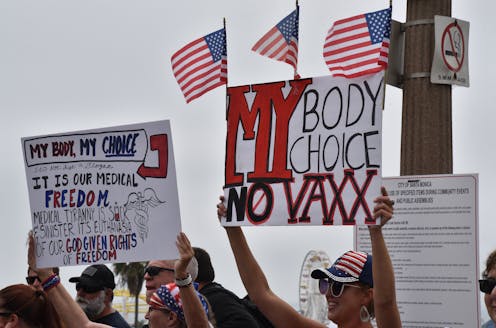
All of this was on show in how the Trump administration handled the COVID pandemic. Trump and other political leaders made the situation worse by linking health behaviours (such as mask-wearing and vaccination) to partisan identity.
There was a clear impact on the rates of COVID infection and death. Red states implemented fewer political decisions to mitigate COVID than blue states. And after vaccines became available, residents of pro-Trump counties – less likely to be vaccinated – were more than twice as likely to die from COVID as those in areas that supported Biden.
It is also interesting to look at the role of education here. Low education levels were found to be a strong and independent predictor of whether you were more likely to die from COVID in the United States. This might be explained by the relationship between education and both collective culture and individual literacy.
There is also a strong link between education and political affiliation.
College graduates are more likely to vote Democratic, while those without a degree, especially white Americans, are more likely to vote Republican. This was not explored in the new US study about health and polarisation.
Erosion of trust is dangerous for health
Trust in government is another key factor not addressed in that research. But in Australia, this is top of mind following the release of the COVID-19 Response Inquiry Report, which found the federal government must work to rebuild trust after lockdowns and other mandates.
Greater trust in government is linked to increased political participation, social cohesion and collaboration in tackling societal challenges. In both Europe and the United States, social cohesion and public trust in politicians and experts have been linked to lower excess mortality from COVID.
In Australia, the Australian Cohesion Index shows the pandemic and cost-of-living crisis have eroded trust in government and affected health and well-being. At the same time, Australians see the nation as increasingly polarised.
Read more: Inquiry warns distrustful public wouldn't accept COVID measures in future pandemic
The presidential election this week will decide much about the future of the United States as a polarised and divided nation. In Australia, the lessons and recommendations from the COVID report provide an opportunity to avert the choices facing the United States.
Authors: Lesley Russell, Adjunct Associate Professor, Menzies Centre for Health Policy and Economics, University of Sydney


















