

Modern Australian
Men's Weekly

.

Vanessa was ‘kidnapped’ by the family policing system aged 10. Now, she’s fighting for other First Nations families

  • Written by Allanah Hunt, Lecturer, Aboriginal and Torres Strait Islander Studies Unit, The University of Queensland
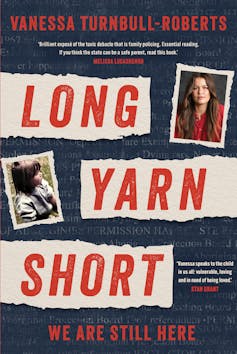
Vanessa was ‘kidnapped’ by the family policing system aged 10. Now, she’s fighting for other First Nations families

“When you take a child, you are taking sovereignty, their role, their connection – you are taking whole communities that live inside that little being,” writes Vanessa Turnbull-Roberts.

Her memoir, Long Yarn Short, imprinted on my mind and heart. In a warm, inviting voice, this proud Bundjalung Widubul-Wiabul woman paints an unflinchingly honest picture of her life as a child stolen by the state, at just ten years old, in the mid-2000s. She describes being “tucked up in bed” by her dad and “about to close [her] eyes” when it happened.

“I want you to imagine your dad going out onto the balcony, terrified,” she writes. “I want you to hear him yelling, ‘Bub … Big girl. I am so sorry, but they are coming to get you’.”

Review: Long Yarn Short by Vanessa Turnbull-Roberts (UQP)

Turnbull-Roberts spent eight years in various out-of-home care placements (foster care) in Sydney. Through this time, she fought to see her family whenever she could, but it was mostly on restricted monthly supervised visits. With great resilience, she refused to allow the state to steal her identity and connection. At 18, when she aged out of the care system, she returned to Bundjalung Country for the first time. On her return, she completed a law degree at University of New South Wales, with the help of a scholarship that allowed her to stay in student housing.

Now, in her role as the Australian Capital Territory’s Commissioner for Aboriginal and Torres Strait Islander Children and Young People, the human rights lawyer and Fulbright scholar fights for other First Nations children to not face the same trauma she did. She wants to prevent them from being “crossover children”, going from the foster care system to juvenile detention.

Kidnappers, not case workers

Turnbull-Roberts was “born to two parents who were battling their own demons”, but describes the feeling of love and care that was always there.

Her mother had schizophrenia, which she was demonised for in the health and foster care systems – where, Turnbull-Roberts writes, she also experienced abuse related to her mental health. Her father was a Bundjalung man carrying generational trauma, who had some unhealthy coping mechanisms – something he was punished for, never helped with.

Turnbull-Roberts and her brother moved between the houses of her parents, who “co-parented in a more open, flexible way than could be understood by Western ways of parenting” at the time she was stolen. Her older brother was with her mother the night she was taken – and he remained with her.

“There was no reason why Mum could not take me,” Turnbull-Roberts writes. Her mother’s mental illness had been “used against her to justify the removal” of the first of her three children, Turnbull-Roberts’ eldest brother. Since Turnbull-Roberts was conceived, her mother had feared her being taken as well. “In my world, she was my mum, my everything,” Turnbull-Roberts writes.

She chooses her words carefully and poignantly, never buying into the euphemisms and lies of a system built to destroy her connection to kin and culture. They aren’t “case workers”, they are “kidnappers”. They aren’t “removing” her, they are “kidnapping”.

As I read, Turnbull-Roberts never let me forget she was ripped away from community, family and warmth, to be neglected and abused by a system that proclaimed it saved her from neglect and abuse.

‘A familiar lie’

In a note to her younger self at the end of the book, Turnbull-Roberts writes that she has “embarked on journeys in law and social work, dedicating herself to supporting other youth and children, fighting for her people”.

This story, perpetuated by the family policing system, of Indigenous children being neglected and unloved by their parents, is a familiar lie. These were the exact narratives spun when justifying historic oppressive policies, like the original Stolen Generations.

FAL This memoir reminds us these aren’t past practices, but are very much current. Same words, same story, same results, different era: a state benefiting from Black bodies and their suffering. Turnbull-Roberts’ warning rings true: “Being stolen changes your life forever. This is not just history. This is right now.” Long Yarn Short is a sobering reminder that the Stolen Generations are still in full swing. While Turnbull-Roberts educates readers about the racist foundations these institutions are built on, the book never becomes dry or academic. Instead, she personalises these facts, showing how pathologising Indigenous parenting and culture results in unfair judgements of neglect and abuse. She points out: “if a kid from a wealthy family has dirty clothes, they had a fun day; however if a child from a poor family has dirty clothes, they must be neglected.” The racist treatment can feel almost dystopian at some points, but it is scarily real to those targeted. Throughout, it is haunting to feel that the state had already decided Turnbull-Roberts’ fate, regardless of her parents’ efforts. She makes it clear that, despite the state’s claims of “protection”, the child welfare system was never there to save her. In reality, the system benefited financially from Turnbull-Roberts’ removal. “The child protection industry continues to make money on the back of Indigenous lives,” she writes, “our bodies are the data for the salary, the property and the income of all those who have a stake in this industry”. She also describes some of her foster carers taking children for the payments they bring. At the same time, the system unfairly judges people like her parents. First Nations culture, mental health issues and poverty struggles are all deemed “failures” that families must be punished for. Turnbull-Roberts highlights our society’s thirst for punitive measures when anyone we deem “less than” struggles. Her book is a chilling reality check on our skewed view of “justice” and “support”. Love, sovereignty, connection, community Turnbull-Roberts’ memoir educates readers on Indigenous culture and appreciating its value structures: love, sovereignty, connection and, most of all, community. Where we support a mum struggling to buy diapers, not steal her baby. These scenes of First Nations love and community are the memoir’s most impactful. They make Turnbull-Roberts’ kidnapping even more painful to read about, understanding just what was stolen from her. In this raw and powerful book, Turnbull-Roberts bares her soul. She lets us feel the pain of that loss, of the memories she didn’t get to share with her parents. This is only compounded by both her parents passing away young, traumatised by the system. Turnbull-Roberts unpicks this racist, punitive system with its antithesis: love. This may sound clichéd, but in the hands of such a powerful writer, it’s not. It isn’t just some vague, feelgood notion: she gets to the nitty-gritty of how love, support and healing could create a system where Indigenous parents and children are helped, instead of punished, when they fall on hard times. Community-led programs and culturally capable solutions would replace the case workers who have pathologised First Nations culture and family structures for far too long. Imagine another way Throughout the book, Turnbull-Roberts directly addresses the reader. She asks us to imagine. Imagine her as a child stolen away from her father’s house. Imagine our young people: desperate, scared, angry, traumatised by paternalistic, punitive systems. Imagine the terror of wondering: will my baby be stolen from me today? Imagine, she whispers, over and over again. But she doesn’t just ask us to imagine the trauma. She also asks us to imagine what could have been if the “protection” services acted with Indigenous community values in mind. To imagine how much it would have helped her father and mother in their own personal struggles. How her family structure and identity would never have been torn apart, leaving all involved with almost indescribable trauma. Where she didn’t have to heal from these layers of trauma caused by the system. She leaves us with one final “imagine”: “Imagine we offered a little more of our love and ethics instead of punishment. Imagine.” As a Barkindji woman with mental health issues, as a person who got to stay with my kin, this isn’t something I should simply imagine: it needs to be something I do. It needs to be something we all do. Authors: Allanah Hunt, Lecturer, Aboriginal and Torres Strait Islander Studies Unit, The University of Queensland

Read more https://theconversation.com/vanessa-was-kidnapped-by-the-family-policing-system-aged-10-now-shes-fighting-for-other-first-nations-families-239217

Why Year 12 Tutoring Plays A Crucial Role In Academic Success

The final year of school is one of the most demanding periods in a student’s academic journey, which is why year 12 tutoring has become an essent...

Legal Remedies Available in a Breach of Contract Case

When a contract is broken, the consequences can affect cash flow, reputation and ongoing business relationships. A breach of contract may occur when...

Long Weekend Camping in the Yarra Ranges: Three Weekends of High Country Adventure

Yarra Ranges National Park, Victoria. Image by Mattinbgn (talk · contribs), CC BY 3.0, via Wikimedia CommonsVictoria’s Yarra Ranges offer keen trav...

Why Waste Management Solutions Are Essential For Modern Businesses

Managing waste responsibly has become a critical priority for organisations of all sizes, which is why waste management solutions play such an impo...

The Importance and Varieties of Ride-On Mower Tyres

Ride-on mowers are built to manage larger lawns with consistency and control. The quality and design of ride on mower tyres play a critical role in ...

Gain Peace Of Mind: The Undeniable Benefits Of A Ready First Aid Kit

Life in our vibrant communities, whether it's the bustling city or the quiet country town, is full of unexpected moments. From a scraped knee on the...

The Most Common Conveyor System Issues in Manufacturing

In modern manufacturing, conveyor systems play a central role in keeping production lines efficient, consistent, and cost-effective. When they operate...

How to Secure a Long-Term Rental in a Competitive Market

The rental market can be unpredictable and may present challenges if you’re not prepared. Initially, you might submit numerous applications and stil...

What Smart Investors Know About Real Estate

Many people think investing in property is just about buying a house and waiting for it to get expensive. While that can happen, the people who actual...

The Benefits of Seeking Help for Anxiety and Stress

Anxiety and stress have become common experiences in today’s fast-paced world, affecting people across all ages and lifestyles. From work pressures ...

How to Make the Most of Fashion Wholesale Options for Your Brand

If you want to grow a fashion brand without constantly reinventing the wheel, wholesale can be one of the smartest ways to scale. The key is knowing h...

How to Add Value to Your Home Before Selling

Selling a home is not just about putting up a sign and waiting for offers. It is about presenting a property that buyers instantly connect with and ar...

How Outdoor Play Enhances Learning and Wellbeing

You don’t need to be an expert to conclude that play is an essential part of growing up. When children aren’t restricted and kept indoors, they de...

How to Build Passive Income Through Real Estate

Building passive income is one of the most effective ways to create long-term financial security. While there are many investment opportunities availa...

DIY Guide to Replacing Small Parts in Your Laundry Machine

Finding a puddle or a broken washer is frustrating, but you don’t always need a professional. Many common issues are caused by tiny parts that are c...

Best Practices for Managing Your Warehouse Partner Relationships

Your warehouse partner is an important part of your business. They sit in the middle of your promises to customers. Yet, when they deliver what’s pr...

Benefits of Solar-Based Water Circulation Systems

Imagine your water system running all day without touching your electricity bill. No noise, no heavy cables, no stress when prices go up. Fantastic, r...

Benefits of Using an Outrigger Crane for Complex Lifts

Complex lifts aren’t the kind of jobs you improvise. You’re dealing with awkward shapes, serious weight, and sites that never seem designed for wh...

















