

A submerged continent of grief surfaces in Gideon Haigh’s memoir of his brother’s death
- Written by: Marina Deller, Casual Academic, Creative Writing and English Literature, Flinders University
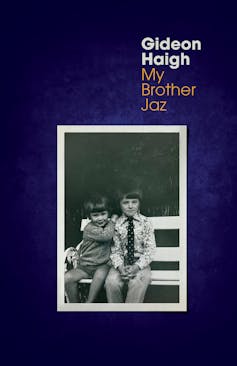
Gideon Haigh’s brother Jasper – “Jaz” – was 17 when he was killed in a car accident. Decades later, Haigh picked up a pen and, in a 72 hour span, wrote about the night Jaz died, all that led up to it, and all that he has lived since.
Haigh is a prolific writer. You may know him from his cricket writing, but also his investigative journalism about crime, trauma and the law. Sometimes he writes about all of these things at once.
To borrow a term from writer Anna Jurecic, Haigh is an “essayistic mourner”: someone who draws on his writing ability to investigate his loss. As Jurecic notes, literary grief memoirs “provide vivid evidence that mourning is more complicated than formulaic accounts of bereavement acknowledge”.
This is undoubtedly the case for Haigh, who expresses a complex (overwhelmingly negative) relationship to memoir, yet turns to the form to explore and explain this event and its reverberations.
Review: My Brother Jaz – Gideon Haigh (Melbourne University Publishing)
The book as document
In My Brother Jaz, Haigh’s working life is a rushing train, fuelled by loss, emitting fumes of memory as it thunders along. We get the sense that writing is at times a sort of self-punishment, and at other times an escape.

 Gideon and Jaz.
Courtesy of Melbourne University Publishing.
Readers are drip-fed information, emulating Haigh’s experience of loss over time. There is the moment his mother reveals that she has never forgotten the name of the child of the other driver in the car accident. There is the moment he reveals that Jaz died in the hospital he was born in. There is the moment he allows himself to realise something others had suggested previously: that Jaz’s death may have been less of an accident than he once considered.
Haigh intersperses photos throughout the memoir, stamping moments in time, but not chronologically. We see flashes of Jaz and Haigh’s faces – young, then older, then young again – exemplifying memory’s fragmented and often non-linear form. The photos are sometimes explained or gestured to, but most are offered with no context beyond what can be gleaned from the image.
We are invited to read Jaz’s physical presence – his youthful smiles, the set of his jaw, a denim vest, a sweatshirt with “Jasper” emblazoned on the front, floppy hair – as remains of the lost boy.
Of course, time moves chronologically in reality. Haigh ages while Jaz can never can be older than 17. The loss of a sibling can be the loss of a parallel self; ageing brings this into sharp relief. “I am now fifty-eight,” Haigh writes:
Jasper would now be fifty-four. The former I can deal with; the latter is beyond my comprehension […] the sense of Jasper is always there, out of sight, but bulking darkly like a submerged continent.
Grief is self-absorbed
Though a well-established nonfiction writer, Haigh professes a vehement dislike of memoir – and autobiography more broadly – at several points. “Friends know of my pronounced, and frankly unreasonable, aversion to autobiographical writings,” he states. “The sentimental gush of life tales. The sickly sweetness of memoir […] Autofiction – kill me now.”
Gideon and Jaz.
Courtesy of Melbourne University Publishing.
Readers are drip-fed information, emulating Haigh’s experience of loss over time. There is the moment his mother reveals that she has never forgotten the name of the child of the other driver in the car accident. There is the moment he reveals that Jaz died in the hospital he was born in. There is the moment he allows himself to realise something others had suggested previously: that Jaz’s death may have been less of an accident than he once considered.
Haigh intersperses photos throughout the memoir, stamping moments in time, but not chronologically. We see flashes of Jaz and Haigh’s faces – young, then older, then young again – exemplifying memory’s fragmented and often non-linear form. The photos are sometimes explained or gestured to, but most are offered with no context beyond what can be gleaned from the image.
We are invited to read Jaz’s physical presence – his youthful smiles, the set of his jaw, a denim vest, a sweatshirt with “Jasper” emblazoned on the front, floppy hair – as remains of the lost boy.
Of course, time moves chronologically in reality. Haigh ages while Jaz can never can be older than 17. The loss of a sibling can be the loss of a parallel self; ageing brings this into sharp relief. “I am now fifty-eight,” Haigh writes:
Jasper would now be fifty-four. The former I can deal with; the latter is beyond my comprehension […] the sense of Jasper is always there, out of sight, but bulking darkly like a submerged continent.
Grief is self-absorbed
Though a well-established nonfiction writer, Haigh professes a vehement dislike of memoir – and autobiography more broadly – at several points. “Friends know of my pronounced, and frankly unreasonable, aversion to autobiographical writings,” he states. “The sentimental gush of life tales. The sickly sweetness of memoir […] Autofiction – kill me now.”
 Gideon Haigh.
Melbourne University Publishing
This may be the reason for an underlying hum of paradoxically unabashed self-consciousness. Haigh acknowledges this at times – “I almost cannot get over how ridiculous this makes me sound” – yet he does get over it: the particular anecdote is shared.
Although Haigh seems set on the low-hanging accusation that memoirists are often narcissists, the most memoir-like moments – the moments where Haigh situates himself, his identity and his loss in relation to one another – are the ones that reverberate.
Accusations of naval-gazing neglect the fact that grief is self-absorbed by necessity, in order to help us understand ourselves and acknowledge the ties that bind us. There are several moments in My Brother Jaz which speak of the embodiment of grief, the way it haunts our cells, how loss literally becomes a part of us. Haigh writes,
what I chose in my campaign of renunciation was itself a slow kind of suicide: I took my brother’s eating disorder and cubed it […] my weight plunged to 42 kilos […] I did suspect that there had been a degree of volition in my brother’s death, and perhaps I did fear the tendency was in me also.
These words are accompanied by a startlingly thin profile image.
The scene that has stuck with me since reading My Brother Jaz is one where Haigh, a non-driver, reluctantly gains his L plates and attempts to get behind the wheel of a car. He becomes “trapped”, “plagued by pedals”. He is “genuinely transported back to that police lot”. This moment, in which Jaz’s traumatic death and Haigh’s attempts to grow collide, is heartfelt and heartbreaking.
Haigh’s identity as a journalist and writer is central to his approach. He may laments the move into memoir at times, but it allows him to grieve for Jaz using the tools he has at hand. “My brother died in the week my first book was published,” he writes,
to him my second book was dedicated. But in forty-nine subsequent books I’ve never been able to do better, never felt up to the task of addressing my life’s gravest loss.
It is somehow proper that Haigh confesses this in a book that rises to the task.
Authors: Marina Deller, Casual Academic, Creative Writing and English Literature, Flinders University
Gideon Haigh.
Melbourne University Publishing
This may be the reason for an underlying hum of paradoxically unabashed self-consciousness. Haigh acknowledges this at times – “I almost cannot get over how ridiculous this makes me sound” – yet he does get over it: the particular anecdote is shared.
Although Haigh seems set on the low-hanging accusation that memoirists are often narcissists, the most memoir-like moments – the moments where Haigh situates himself, his identity and his loss in relation to one another – are the ones that reverberate.
Accusations of naval-gazing neglect the fact that grief is self-absorbed by necessity, in order to help us understand ourselves and acknowledge the ties that bind us. There are several moments in My Brother Jaz which speak of the embodiment of grief, the way it haunts our cells, how loss literally becomes a part of us. Haigh writes,
what I chose in my campaign of renunciation was itself a slow kind of suicide: I took my brother’s eating disorder and cubed it […] my weight plunged to 42 kilos […] I did suspect that there had been a degree of volition in my brother’s death, and perhaps I did fear the tendency was in me also.
These words are accompanied by a startlingly thin profile image.
The scene that has stuck with me since reading My Brother Jaz is one where Haigh, a non-driver, reluctantly gains his L plates and attempts to get behind the wheel of a car. He becomes “trapped”, “plagued by pedals”. He is “genuinely transported back to that police lot”. This moment, in which Jaz’s traumatic death and Haigh’s attempts to grow collide, is heartfelt and heartbreaking.
Haigh’s identity as a journalist and writer is central to his approach. He may laments the move into memoir at times, but it allows him to grieve for Jaz using the tools he has at hand. “My brother died in the week my first book was published,” he writes,
to him my second book was dedicated. But in forty-nine subsequent books I’ve never been able to do better, never felt up to the task of addressing my life’s gravest loss.
It is somehow proper that Haigh confesses this in a book that rises to the task.
Authors: Marina Deller, Casual Academic, Creative Writing and English Literature, Flinders University 

















