

Fixing the gap between Labor's greenhouse gas goals and their policies
- Written by: Mark Diesendorf, Honorary Associate Professor, UNSW
As the federal election approaches, Labor has two principal climate and energy targets: a 45% reduction in greenhouse gas emissions from the 2005 level by 2030, and for half of Australia’s electricity to come from renewable sources by 2030 (up from its current share of 19%).
The renewable electricity target is easily achievable with inexpensive extensions to Labor’s existing policies, but that policy would still leave Labor far short of its emissions target.
Read more: Labor's climate policy: a decent menu, but missing the main course
Because electricity contributes only 34% of Australia’s total emissions, more substantial policies are needed to reduce emissions from both electricity and the rest of the energy sector to achieve Labor’s greenhouse target.
How much greenhouse gas are we talking about?
In 2015 the government chose 2005 as the baseline for its Paris target, presumably because it was one of our highest-emission years since 1990 (2015 emissions were much lower).
In the year ending September 2005, Australia’s emissions were equivalent to 605 million tonnes (MT) of carbon dioxide. From 2007, emissions dropped sharply due to a reduction in land clearing and then again between mid-2012 and mid-2014 due to Labor’s carbon price.
In the year ending September 2018, the latest year for which we have firm numbers, Australia’s emissions total was 536MT of CO₂ equivalent. Since 2015 our annual total has risen slightly, due to increases in non-electricity emissions outweighing reductions in electricity emissions.
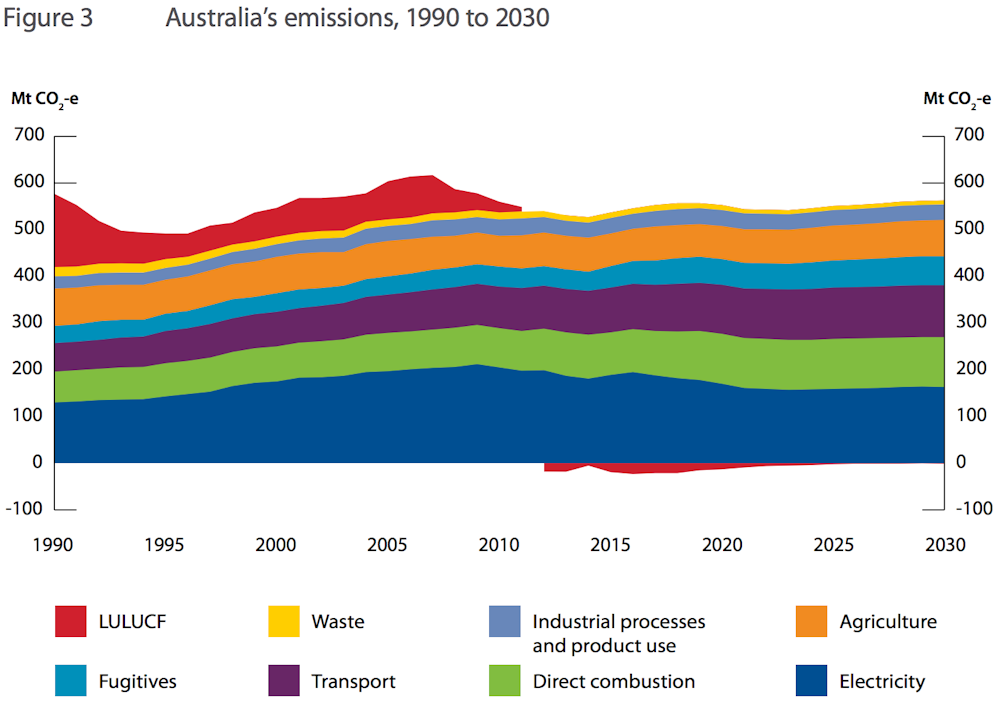 Australia’s historical and projected emissions, calculated in 2018. Note: LULUCF stands for ‘land use, land use change and forestry’.
Australia’s emissions projections 2018, Department of the Environment and Energy
Australia’s historical and projected emissions, calculated in 2018. Note: LULUCF stands for ‘land use, land use change and forestry’.
Australia’s emissions projections 2018, Department of the Environment and Energy
Labor’s emissions target is a 45% reduction from 605MT, which is equivalent to a goal of 333MT. Therefore its policies have to cut 203MT from our 2018 annual emissions by 2030.
How much emissions does 50% renewable electricity cut?
As shown in the pie chart below, electricity currently contributes 34% of Australia’s annual emissions, or 182MT.
Let’s assume Labor’s proposed energy policies stop the growth in non-electricity emissions, and that annual electricity emissions don’t increase.
Then, taking into account that renewable energy is already 19% of total electricity generation, Labor’s 50% target would cut electricity emissions by 56MT.
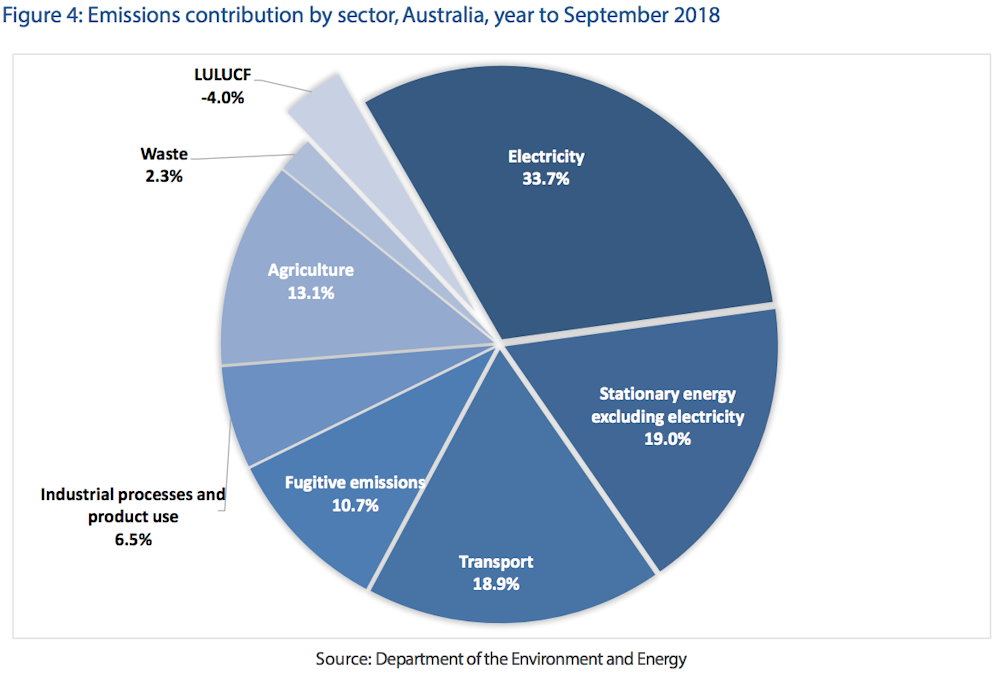 Quarterly Update of Australia’s National Greenhouse Gas Inventory: September 2018.
http://www.environment.gov.au/system/files/resources/4391288e-fc2b-477d-9f0b-99a01363e534/files/nggi-quarterly-update-sept-2018.pdf
Quarterly Update of Australia’s National Greenhouse Gas Inventory: September 2018.
http://www.environment.gov.au/system/files/resources/4391288e-fc2b-477d-9f0b-99a01363e534/files/nggi-quarterly-update-sept-2018.pdf
Successfully cutting 56MT from the annual emissions total 203MT gives us a gap of 147MT.
Closing the gap
Let’s look at some feasible options for Labor to reduce this emissions gap. These are not all independent and so cannot simply be tallied up, but they do nevertheless offer some concrete targets.
The two most substantial options are increasing the renewable electricity target to 100%, and improving overall energy efficiency by 20%.
Further goals could include electrifying one-quarter of vehicles by 2030 and charging them only with renewable energy; electrifying half of non-electrical heat; halving non-energy industrial emissions; and halving fugitive emissions.
So how attainable are these objectives?
100% renewable electricity
Electricity is the easiest and cheapest energy supply option to transition to renewables. A 100% renewable energy target, together with no increase in non-electricity emissions (and without electrification of transport and heating), would cut 2018 annual emissions by 182MT, from 536MT to 354MT, and reduce the gap to 21MT.
Key federal policies needed for 100% renewable energy are:
- reverse auctions with contract-for-difference for solar and wind farms in the states that don’t have these auctions (NSW and WA),
- funding of key transmission links both interstate and intrastate,
- substantial additional funding to the Clean Energy Finance Corporation and the Australian Renewable Energy Agency (ARENA) specifically for storage, and
- reform of the National Electricity Market objective, structure and rules.
Labor’s policy specifies A$10 billion for the Clean Energy Finance Corporation, A$5 billion for upgrading the electricity grid, and A$200 million for household batteries – all big steps forward – but doesn’t mention reverse auctions which can have zero net cost to government.
Energy efficiency
The second biggest potential reduction is in energy efficiency. Improving overall energy efficiency by 20% would save 88MT of CO₂.
To achieve this, we would need to see a suite of policies along the following lines, none of which have been mentioned explicitly by Labor:
The other targets
Electrifying one-quarter of land transport and charging vehicles with renewable electricity is more substantial than Labor’s current transport target, namely that half of new vehicles should be electric by 2030.
Under Labor’s policy, the vast majority of vehicles would still have internal combustion engines and most of the remainder would be charged from a grid that’s 50% fossil-fuelled. A realistic emissions reduction from Labor’s modest transport target would be about 8MT.
However, if battery costs fall substantially over the next decade, the market could make the majority of new vehicles electric by 2030.
With a transition to nearly 100% renewable electricity by 2030, electric cars would be charged either from a “green” grid or rooftop solar. If a quarter of all cars are electric, this could contribute up to 17MT of emissions cuts.
Electrifying half of non-electrical heat, which currently comprises 19% of annual emissions, would contribute about 40MT of emissions reductions, assuming 100% renewable electricity; this would be challenging but possibly achievable with policies to shift gas heating to electrical.
Halving non-energy industrial emissions, which currently comprise 6.5% of our annual emissions, would save around 17MT. This goal needs regulation to implement research and development; one good starting point is to phase out traditional Portland cement and replace it with geopolymer cement.
Labor’s proposed baseline and credit scheme, Safeguard 2.0, would in theory reduce non-electrical heat and non-electrical industrial emissions, but in practice the enormous political power of big businesses with annual emissions greater than 25,000 tonnes would probably at best halt, instead of reducing, growth in industrial emissions.
Fugitive emissions (accidental methane leaks) from gas pipelines and some oil and gas fields would also shrink with success in electrifying heat, but would still continue from the Gorgon gas field and disused open-cut coal-mines. Halving these fugitive emissions would also save another 28MT.
Read more: Fugitive emissions: what is the real footprint of coal seam gas?
Carbon budgets
According to the Intergovernmental Panel on Climate Change, to keep global warming below 2℃ the world has a total CO₂ budget of 1,000 billion tonnes, or gigatonnes (GT), measured from 2011. To keep the world below 1.5℃, that budget shrinks to 400GT.
Australia contributes 1.5% of global emissions, and annually our emissions have been hovering around 0.55GT. That gives us 23 years of emissions at the current level to hit the 2℃ target. If we aim for the more ambitious 1.5℃ – which most experts agree is necessary to avoid climate disaster – that shrinks to just 5 more years at our current emission levels.
Australia is the world’s biggest exporter of both coal and liquefied natural gas. From a global perspective, we need an urgent strategy to phase out these exports (and thus increase their international prices) and replace them with exports of hydrogen or ammonia produced from renewable energy.
Authors: Mark Diesendorf, Honorary Associate Professor, UNSW


















