

Germany’s post-Holocaust moral remaking is being challenged by the rise of the far-right – and wars in Gaza and Ukraine
- Written by: Francesca Teltscher Taylor, Research Associate and Teaching Associate in European Languages (German Studies), Monash University
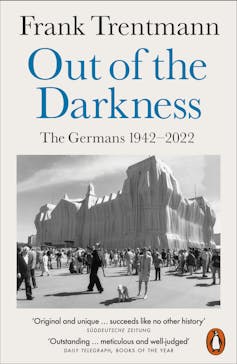
Current conflicts in Ukraine and Gaza (now spreading across the Middle East), have placed Germany in a difficult position, forcing it to reconsider its role in the world. A uniquely German sense of guilt and shame for the Holocaust “inseparably” ties the Israel-Palestine conflict to “Germany’s unquestionable solidarity with Israel”, writes Frank Trentmann, in his new book on the legacy of World War II in Germany.
Since Hamas’ attacks on Israel on October 7 2023, politicians have reiterated that Israel’s security is Germany’s “reason of state”. This makes criticism of Israel’s treatment of Palestinians in the occupied territories “an extremely sensitive matter”. Even Jewish critics of Israel’s government have been cancelled and criticised as antisemitic.
Following the second world war, Germany has focused on atoning for its role as perpetrator and collaborator and, while a NATO member, it has largely avoided playing a leading role in international conflicts. Russia’s invasion of Ukraine has forced Germany to reevaluate its foreign policy and emerge from national introspection in what Chancellor Olaf Scholz has called a “Zeitenwende”, or historical turning point.
Germany has been forced to consider the state of its army. Until last year, when it released its first comprehensive national security strategy, it had “no national security strategy, let alone a security council”. And at the end of 2022, it only had enough bullets for two weeks of fighting.
Trentmann’s impressive book, Out of the Darkness: The Germans 1942–2022 shows: “Germans define themselves through a critical confrontation with their past”.
Review: Out of the Darkness: The Germans 1942–2022 by Frank Trentmann (Allen Lane)
In 2015, then German president Joachim Gauck said: “there is no German identity without Auschwitz”. In this sense, Trentmann writes, Germany is unique in turning “past sins into a source of civic pride”. This didn’t happen instantly.
Aufarbeitung, or critical remembrance, only gathered momentum in the 1970s and 1980s, he points out. He links a range of sociopolitical events to World War II, including then chancellor Angela Merkel’s opening of the border to refugees in 2015. (By the end of the year, 890,000 people had arrived. Another 310,000 followed in 2016.)
He also links the rise of the far-right party, the Alternative für Deutschland (AfD), to the spectre of WWII. Earlier this year, the AfD was leading polls in all five of the former East German states, except in Berlin. Then, last month, it won its first state election in one of those states, Thuringia, with nearly 33% of the vote.

Trentmann argues that the war and its legacies carved its way “through family, work, foreign policy and the environment until effectively all spheres of life were framed in terms of right and wrong”.
But importantly, he warns against defining it as the cause of everything. A bad conscience does not motivate all behaviours – such as recycling glass and paper, or helping the global poor.
“The moral remaking of Germany,” he argues, “is a much richer and more surprising story than this.”
Out of the darkness – into what?
One particular strength of the book is the way it lets the facts, statistics and quotes from primary sources contradict commonly held views.
 For instance, in 1968, the year famous for student rebellions, the West German state’s policies were as left as the ideas of those protesting against it. The protesters were less “harbingers of a new era that broke with the stuffy past”, and more “products of a democratic fermentation that had begun in the mid-1950s”.
At nearly 800 pages, Out of the Darkness is comprehensive. Trentmann’s academic credentials are reflected in the depth of research, which is sorted into a broad range of interconnected themes.
I feared this might result in an overly academic, perhaps inaccessible style. The introduction positions the book in relation to existing scholarship, justifying its structure and methodological approach. But then, the first section quotes directly from the diary of a young German soldier during the second world war.
Experiencing a troubled conscience, the 18-year-old addresses his diary entry to his mother:
Liebes Muttchen, I know it is not right that I write to you about these things, but I need to get it off my chest. For my comrades it is not an issue!
He continues:
The German soldier ought to be far too proud for such deeds […] since he prides himself everywhere for being superior to those of other nations.
Trentmann consistently focuses on individual case studies. This makes his historical monograph a positive page-turner, in the context of its genre.
The evocative title, Out of the Darkness, begs the question: into what? Trentmann maps the nuances and complexities that characterise and shape postwar Germany. Specifically, the book is structured into four main sections.
Lingering antisemitism and active neo-Nazis
Although Trentmann’s book primarily explores the postwar period and the war’s legacy, he dedicates much of Part One to the end of the war itself.
He outlines the war’s history and horrors, and demonstrates their influence on the German Democratic Republic (the Soviet-backed GDR in the East) and West Germany. While West Germany eventually came to see itself as responsible for the horrors of the second world war, the Soviet GDR saw itself as its victim.
For instance, in 1968, the year famous for student rebellions, the West German state’s policies were as left as the ideas of those protesting against it. The protesters were less “harbingers of a new era that broke with the stuffy past”, and more “products of a democratic fermentation that had begun in the mid-1950s”.
At nearly 800 pages, Out of the Darkness is comprehensive. Trentmann’s academic credentials are reflected in the depth of research, which is sorted into a broad range of interconnected themes.
I feared this might result in an overly academic, perhaps inaccessible style. The introduction positions the book in relation to existing scholarship, justifying its structure and methodological approach. But then, the first section quotes directly from the diary of a young German soldier during the second world war.
Experiencing a troubled conscience, the 18-year-old addresses his diary entry to his mother:
Liebes Muttchen, I know it is not right that I write to you about these things, but I need to get it off my chest. For my comrades it is not an issue!
He continues:
The German soldier ought to be far too proud for such deeds […] since he prides himself everywhere for being superior to those of other nations.
Trentmann consistently focuses on individual case studies. This makes his historical monograph a positive page-turner, in the context of its genre.
The evocative title, Out of the Darkness, begs the question: into what? Trentmann maps the nuances and complexities that characterise and shape postwar Germany. Specifically, the book is structured into four main sections.
Lingering antisemitism and active neo-Nazis
Although Trentmann’s book primarily explores the postwar period and the war’s legacy, he dedicates much of Part One to the end of the war itself.
He outlines the war’s history and horrors, and demonstrates their influence on the German Democratic Republic (the Soviet-backed GDR in the East) and West Germany. While West Germany eventually came to see itself as responsible for the horrors of the second world war, the Soviet GDR saw itself as its victim.
 The Initiative Freedom for Dissidents making the public aware of injustice in the GDR at the Berlin border in 1988.
STR/AAP
Their different interpretations of history informed different cultures in East and West Germany. Antisemitism did not disappear overnight. Even by 1986, “West German intelligence knew of 1,460 active neo-Nazis”, of which eight were policemen and 124 civil servants. To this day, antisemitism remains an issue.
But in West Germany, a debating culture was encouraged – and had to be learned. The saying “Talking is silver, silence is gold”, slowly became “Talking is silver, debating is gold”. As the West eventually began to turn a critical eye to its recent past, contemporary debates were coloured by the war and the Holocaust.
In postwar debates about abortion, for instance, the “Nazi murder of disabled people gave the debate a particular charge”. In the immediate postwar period, elections were particularly factual, sober affairs, for fear of slipping into Hitler’s manipulative approach.
And to this day, many Germans volunteer: a cultural trend that began as “repayment for the aid Germans themselves had received after the war”.
The Initiative Freedom for Dissidents making the public aware of injustice in the GDR at the Berlin border in 1988.
STR/AAP
Their different interpretations of history informed different cultures in East and West Germany. Antisemitism did not disappear overnight. Even by 1986, “West German intelligence knew of 1,460 active neo-Nazis”, of which eight were policemen and 124 civil servants. To this day, antisemitism remains an issue.
But in West Germany, a debating culture was encouraged – and had to be learned. The saying “Talking is silver, silence is gold”, slowly became “Talking is silver, debating is gold”. As the West eventually began to turn a critical eye to its recent past, contemporary debates were coloured by the war and the Holocaust.
In postwar debates about abortion, for instance, the “Nazi murder of disabled people gave the debate a particular charge”. In the immediate postwar period, elections were particularly factual, sober affairs, for fear of slipping into Hitler’s manipulative approach.
And to this day, many Germans volunteer: a cultural trend that began as “repayment for the aid Germans themselves had received after the war”.
 The Nazi murder of disabled people, like these prisoners in Buchenwald, gave Germany’s abortion debate ‘a particular charge’.
Holocaust Memorial Museum/Photograph #13132
‘Inner reunification’ is painful and unfinished
The reunited Germany we know today still carries scars of its divided past. The book’s second part outlines how the challenges of reunification continue to this day.
Some Germans take the “Stasi view”, Trentmann writes: the GDR was a “dictatorship that violated basic human rights”. Others take the “nursery” view, emphasising “the social accomplishments of the GDR: free nurseries, health clinics, cheap rents and guaranteed jobs for all”.
Despite their differences, East and West Germany shared the need to create a new national identity after the second world war. The ways they went about it differed, as did the two states’ approaches to “denazification”.
To this day, in many Germans’ minds, it remains relevant whether someone came from East or West Germany. Part Three, titled “United and Divided”, explores the unresolved issues of reunification.
The Nazi murder of disabled people, like these prisoners in Buchenwald, gave Germany’s abortion debate ‘a particular charge’.
Holocaust Memorial Museum/Photograph #13132
‘Inner reunification’ is painful and unfinished
The reunited Germany we know today still carries scars of its divided past. The book’s second part outlines how the challenges of reunification continue to this day.
Some Germans take the “Stasi view”, Trentmann writes: the GDR was a “dictatorship that violated basic human rights”. Others take the “nursery” view, emphasising “the social accomplishments of the GDR: free nurseries, health clinics, cheap rents and guaranteed jobs for all”.
Despite their differences, East and West Germany shared the need to create a new national identity after the second world war. The ways they went about it differed, as did the two states’ approaches to “denazification”.
To this day, in many Germans’ minds, it remains relevant whether someone came from East or West Germany. Part Three, titled “United and Divided”, explores the unresolved issues of reunification.
 To this day, in many Germans’ minds, it remains relevant whether someone came from East or West Germany.
STR/AAP
Some in the East continue to resent the West for the collapse of East German companies and industry. On the other hand, it was the West who bailed out the GDR, which had debt worth 123 billion marks by 1988, making it the “world champion in debt”.
“‘Inner reunification’, as the Germans call it, has been a slow, painful process that remains fragile and unfinished,” writes Trentmann. For some, the memories of the past became brighter. Ostalgie (nostalgia for the East, or Ost), was born.
This tended to ignore some terrible aspects of life in the East. But it was part of East Germans “reclaiming things of the socialist past as a way of asserting their distinct identity in a present dominated by stars and products from the West”.
To this day, in many Germans’ minds, it remains relevant whether someone came from East or West Germany.
STR/AAP
Some in the East continue to resent the West for the collapse of East German companies and industry. On the other hand, it was the West who bailed out the GDR, which had debt worth 123 billion marks by 1988, making it the “world champion in debt”.
“‘Inner reunification’, as the Germans call it, has been a slow, painful process that remains fragile and unfinished,” writes Trentmann. For some, the memories of the past became brighter. Ostalgie (nostalgia for the East, or Ost), was born.
This tended to ignore some terrible aspects of life in the East. But it was part of East Germans “reclaiming things of the socialist past as a way of asserting their distinct identity in a present dominated by stars and products from the West”.
 Protesters in Saxony, a former East German state, sport symbols of the German Democratic Republic.
Peter Endig/AAP
Inequality continues to exist between East and West Germany: at “the current snail’s pace it will take at least another fifty years before parity is reached”. But, Trentmann argues, Ostalgie highlights that the “fundamental problem is not regional difference as such”, nor the gap in wealth, but “the assumption that the East should be like the West”.
The differences are reflected in their different readings of history: “Easterners remember the end of the GDR as their achievement, Westerners as the inevitable failure of socialism.”
Notably, the German far-right party, the AfD, now gains most of its votes in the East. This, too, can be understood as a legacy of how the country has grappled with its Nazi past. As Trentmann points out, while right-wing parties have been on the rise across much of Europe, the German AfD “taps into older frustrations with the shift in values”.
It also taps into the belief, held mostly by “middle-aged men with a decent job or their own small business” (not the actual losers of globalisation), “that the world around them is out of control”.
Protesters in Saxony, a former East German state, sport symbols of the German Democratic Republic.
Peter Endig/AAP
Inequality continues to exist between East and West Germany: at “the current snail’s pace it will take at least another fifty years before parity is reached”. But, Trentmann argues, Ostalgie highlights that the “fundamental problem is not regional difference as such”, nor the gap in wealth, but “the assumption that the East should be like the West”.
The differences are reflected in their different readings of history: “Easterners remember the end of the GDR as their achievement, Westerners as the inevitable failure of socialism.”
Notably, the German far-right party, the AfD, now gains most of its votes in the East. This, too, can be understood as a legacy of how the country has grappled with its Nazi past. As Trentmann points out, while right-wing parties have been on the rise across much of Europe, the German AfD “taps into older frustrations with the shift in values”.
It also taps into the belief, held mostly by “middle-aged men with a decent job or their own small business” (not the actual losers of globalisation), “that the world around them is out of control”.
 A demonstration against the AfD right-wing party in Ulm, Germany this month.
Christoph Schmidt/AAP
Where to from here?
Focusing on the 1950s to the present, Part Four examines the Germany most recognisable to us today. Of course, Germany’s postwar history cannot be reduced to a legacy of the Nazis. But the dark shadow of the second world war continues to influence the country.
As Trentmann examines, Germany today is “more deeply entangled with the world than ever before”. At the same time, he describes Germans’ moral reorientation as “mainly inward looking, first preoccupied with their own suffering, later with their role as perpetrators and collaborators”.
Peculiarly, Germany’s identity as a nation of perpetrators and collaborators has offered some “self-assurance”, “a sense of pride in not being proud”, even “self-satisfaction”. This, Trentmann argues, creates a national introspection – and, it would seem, a number of blind spots: “the rest of the world often disappeared from sight.”
“Learning to take responsibility for past crimes made Germans forget to take responsibility for living in an interconnected world in the present,” he writes.
The central role the Holocaust plays in German national identity has also made it difficult to meaningfully reconsider what Holocaust remembrance means in a multicultural Germany, where many Germans with non-German heritage have a very different connection to the war than the one often articulated in German remembrance culture.
Similarly, the focus on atoning for Nazi crimes has made it difficult to address Germany’s colonial past. For Australian readers, Germany’s successes and failures when it comes to grappling with a dark history leave room for thought.
Trentmann leaves open the question as to what role Germany will play in the future. But Out of the Darkness goes a long way in helping the reader understand how the past informs Germany’s approach to private and public life now.
Authors: Francesca Teltscher Taylor, Research Associate and Teaching Associate in European Languages (German Studies), Monash University
A demonstration against the AfD right-wing party in Ulm, Germany this month.
Christoph Schmidt/AAP
Where to from here?
Focusing on the 1950s to the present, Part Four examines the Germany most recognisable to us today. Of course, Germany’s postwar history cannot be reduced to a legacy of the Nazis. But the dark shadow of the second world war continues to influence the country.
As Trentmann examines, Germany today is “more deeply entangled with the world than ever before”. At the same time, he describes Germans’ moral reorientation as “mainly inward looking, first preoccupied with their own suffering, later with their role as perpetrators and collaborators”.
Peculiarly, Germany’s identity as a nation of perpetrators and collaborators has offered some “self-assurance”, “a sense of pride in not being proud”, even “self-satisfaction”. This, Trentmann argues, creates a national introspection – and, it would seem, a number of blind spots: “the rest of the world often disappeared from sight.”
“Learning to take responsibility for past crimes made Germans forget to take responsibility for living in an interconnected world in the present,” he writes.
The central role the Holocaust plays in German national identity has also made it difficult to meaningfully reconsider what Holocaust remembrance means in a multicultural Germany, where many Germans with non-German heritage have a very different connection to the war than the one often articulated in German remembrance culture.
Similarly, the focus on atoning for Nazi crimes has made it difficult to address Germany’s colonial past. For Australian readers, Germany’s successes and failures when it comes to grappling with a dark history leave room for thought.
Trentmann leaves open the question as to what role Germany will play in the future. But Out of the Darkness goes a long way in helping the reader understand how the past informs Germany’s approach to private and public life now.
Authors: Francesca Teltscher Taylor, Research Associate and Teaching Associate in European Languages (German Studies), Monash University 

















