

The Incas used mysterious stringy objects called ‘khipus’ to record data. We just got a step closer to understanding them
- Written by: Karen Thompson, Research Data Specialist, The University of Melbourne
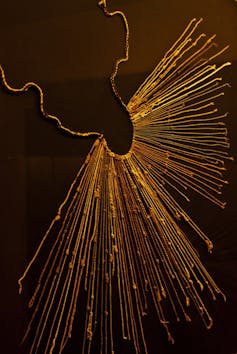
For more than a millennium, many Andean peoples used an object called a “khipu” (also spelled “quipu” and pronounced “key-poo”) to record and communicate information.
Khipus were made with cords or strings with knots tied into them. And experts understand that many, but not all, of these knots were used to represent numbers.
In a new study published today, I make a numeric connection between two important khipus from history – the first being being the largest khipu ever known and the other one of the most complex.
What were khipus used for?
While khipus were used in earlier times, they were especially important to the Inca Empire, which lasted from around 1438 CE to 1532 CE (when the empire was conquered by the Spanish). Since the Inca did not leave any written records, khipus are understood to have been their main system of communication and record-keeping.
Khipus were commonly made from either cotton or fibres sourced from camelids (the group of animals that includes camels, llamas and alpacas). These materials could be dyed or left naturally coloured. Some khipus even include plant fibres, while several incorporate human hair.
It seems specially-trained khipu makers (“khipukamayuqs”) made very deliberate decisions when constructing these record-keeping tools. These decisions related to the colours used, the direction of spin and ply of the cord fibres, the spacing and type of the cord attachments, and the structure and position of the knots.
Early Spanish chroniclers wrote about the khipu’s various numeric applications, which included recording storehouse inventories, population censuses and tax and tribute obligations.
A new numeric connection
For more than a century, researchers have been studying khipu features in hopes that patterns may emerge from a collective view. In recent decades their data have been digitised, which is now freely available via the Open Khipu Repository and the Khipu Field Guide.
For my research, I analysed the data from two khipus found in northern Chile and first recorded by ethno-mathematician Marcia Ascher and anthropologist Robert Ascher in the 1970s. One of these is the largest khipu ever found – spanning more than five metres in length and comprising more than 1800 cords (see the picture below). The other khipu (pictured in the header image) has almost 600 cords in complicated arrangements.

I noticed both khipus used red/white “divider” cords to separate groups of either tens or sevens. The larger khipu was divided into ten groups, with each group having seven cords. The smaller khipu was divided into seven groups, with each group having ten cords (and many subsidiary cords).
After examining and manipulating the data, I realised the smaller and more complex khipu is a summary and reallocation of the information in the larger khipu. In other words, the two khipus record the same data, but represent it differently.
This is the most complicated numeric connection between khipus made to date. It was only possible because of the availability of data and digital tools that make searching for patterns easier – and which wouldn’t have been available to Marcia Ascher back in the 1970s.
New khipu clues
While the numbers in these two khipus are counting and allocating something, we don’t yet know what that was. Why would it be necessary to have two khipus recording the same information in two different ways? We can only speculate.
Perhaps the larger khipu recorded the collection of different amounts of food crops from the community, while the other recorded how these foods were distributed between those in need, or between storehouses. Both ways of looking at the numbers would have been important to the people who used these khipus.
 Khipus used coloured cords adorned with knots at specific points.
Jack Zalium/flickr, CC BY-SA
Khipus used coloured cords adorned with knots at specific points.
Jack Zalium/flickr, CC BY-SA
Experts believe only a tiny fraction of the khipus made throughout history have survived. This is partly because the institutions that used them eventually either became obsolete or used other means of recording after the conquest, combined with a climate that was less than ideal for textile preservation.
Today, about 1,600 khipus remain, residing mainly in collections in the Americas and Europe. Fewer than half of these have had their features digitally saved in research databases.
Through continued digitisation efforts, we hope to discover more khipu clues – and make new numeric connections that add to our understanding of ancient Andean peoples.
Authors: Karen Thompson, Research Data Specialist, The University of Melbourne


















